



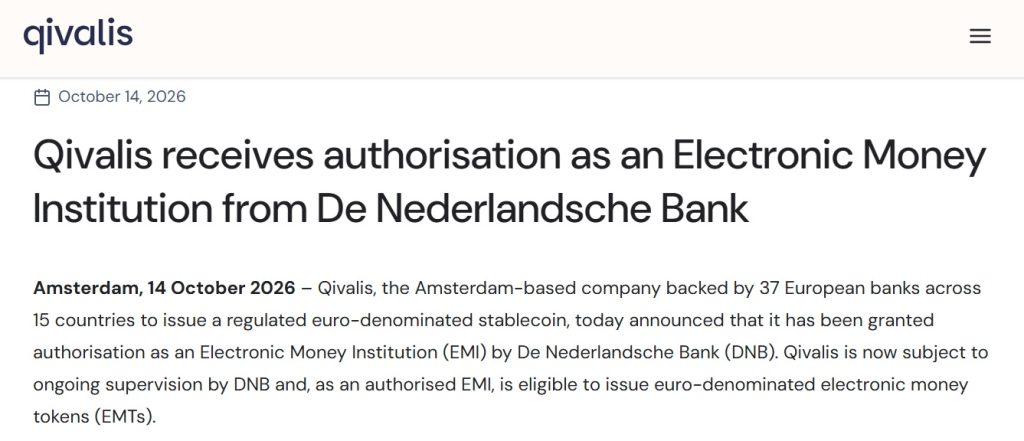
Qivalis, a venture backed by 37 European banks, has been approved for a Dutch central bank to issue a euro-based stablecoin. De Nederlandsche Bank (DNB) authorised the Amsterdam-based company as an Electronic Money Institution (EMI) on 14 October 2026. The approval is an important step towards launching the token, but the company has not announced an exact launch date.
The company had previously planned to launch the stablecoin in the second half of 2026 and now says issuance should take place in the coming months, subject to meeting regulations and publishing the required disclosure document.
Europe’s currency deserves Europe’s rules, on-chain.
Qivalis has been authorised as an electronic money institution by De Nederlandsche Bank. It is an important step towards our euro-denominated stablecoin, to be issued under MiCA, Europe’s regulatory framework for crypto-assets, subject to the completion of the regulatory requirements.
As more of finance moves on-chain, the question of whose rules apply becomes a question of European autonomy. Qivalis is developing an answer, backed by 37 European banks across 15 countries.
— qivalis (@qivaliseu) October 14, 2026
An EMI licence allows an organisation to issue electronic money under the supervision of regulators. Under the Markets in Crypto-Assets Regulation (MiCA), a company generally needs an EMI or banking licence to issue an e-money token. These are a type of stablecoin designed to maintain a stable value based on a reference to a official currency such as the euro.
Qivalis said the authorisation placed it under DNB’s ongoing supervision and made it eligible to issue euro-denominated e-money tokens. However, the company must satisfy the relevant requirements and publish a white paper before issuing the token. White papers explain key details about a crypto-asset and provide information users will need to understand the product.
Source: qivalis.eu
The project aims to provide Europe with a digital payment option linked to its own currency and governed by European law. Chief Executive Jan-Oliver Sell said the approval was an important step towards creating a euro-based digital asset for use in transactions on blockchain networks.
The initiative started in September 2023 with four banks: Danske Bank, ING, KBC and Raiffeisen Bank International. Nine banks officially announced the consortium in September 2025, and more joined in the following months, including BNP Paribas, DZ Bank and BBVA. Another 25 banks joined in May 2026 to make a total of 37, across 15 countries.
Qivalis is chaired by an independent management board and founded by Sir Howard Davies, former chairman of NatWest Group and the UK Financial Services Authority.
The company plans to follow a full-reserve model, where the tokens issued are backed up with reserves of an equal value. Qivalis intends to distribute the stablecoin to eligible banks, crypto exchanges, payment service providers and financial market infrastructure companies, who can offer the coin to their customers.
The regulations that govern the issue of stablecoins in Europe also require issuers to manage their reserves. Under MiCA, issuers of significant e-money tokens would be required to hold a higher percentage of reserves as bank deposits. European authorities have proposed revising some of these requirements to focus more on liquidity.
Details about the proposed stablecoin remain unknown, as Qivalis has not announced the name, ticker, blockchain network, reserve composition or launch partners. Though some online reports have suggested that it would run on the Ethereum platform, the company has not confirmed this.
The Dutch approval brings the project one step closer to launch, but the stablecoin is not yet available. Its actual launch will depend on the company fulfilling the remaining requirements and announcing further details.
Stay informed with the latest trends in Web3, blockchain innovation, and cybersecurity updates at 3verseTV
You need to login in order to Like

















Leave a comment