


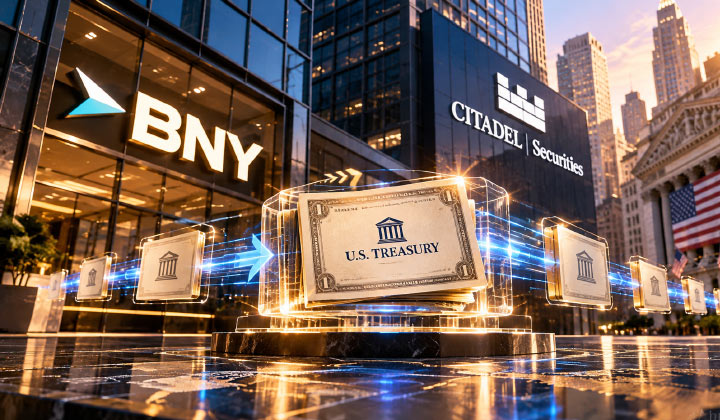
BNY, one of the world’s largest custody banks, and trading firm Citadel Securities have successfully tested the use of tokenized US Treasury securities. The test showcased how blockchain technology could be leveraged to increase the efficiency of moving assets between settlement and financing functions.
The two banks published the news on Tuesday, saying they were aiming to reduce the time between settling government bonds as collateral and reusing them for other financing needs to free up the firms’ liquidity and assets to help them operate more efficiently.
BREAKING: #BNY completes first-of-its-kind transaction with tokenized assets on major triparty repo platform in collaboration with @Citadel Securities.
A 2-year U.S. Treasury note was #tokenized on BNY’s private digital ledger, settled within minutes, and used as collateral in an overnight triparty repo—demonstrating how traditional and digital infrastructure can work together to improve settlement speed and collateral mobility. (1/2)
Release: https://t.co/I09GbUu168
— BNY (@BNYglobal) October 13, 2026
US Treasury securities are government bonds that are commonly used as collateral to secure short-term loans or fund trading activities. But due to the time it can take to transfer them between accounts and settlement systems there can be periods when they are tied up and unable to be used for anything else.
Tokenization involves digitally representing assets on a blockchain and this test used the technology to create a digital representation of the government bonds that would enable them to move more freely between a settlement and financing processes.
The BNY-Citadel Securities transaction was designed to show how the use of tokenized government bonds could serve as collateral for both, and if they proved efficient enough at a larger level, the two institutions would be able to reuse their collateral more quickly and free up funds for other transactions.
Dan Doherty, head of digital asset operations at Citadel Securities, said efficient movement of high-quality collateral was a critical enabler in well-functioning markets, and the reduction in friction during the trading lifecycle would be crucial in improving institutional financial markets.
The development comes as many financial companies are looking at the potential of blockchain-based services. BlackRock, Franklin Templeton and JPMorgan have also been looking at tokenized funds and securities. Advocates of the use of blockchain technology believe it could shorten settlement times, enable automation and make financial assets more portable.
BNY has also announced it plans to roll out more digital cash and tokenized deposit services that can support settlement and financing activities based on blockchain technology.
It also plans to extend the operating hours of its traditional settlement systems for securities that are eligible to use Federal Reserve services and triparty transactions. This would enable it to offer coverage to European and Asian trading hours from next year.
Triparty transactions see a third party, usually a bank, managing the collateral on behalf of a borrower and a lender. They are an important part of short-term financing.
BNY said the use of tokenized US Treasury securities could help bind together settlement and financing to form a more efficient financial system that was open for longer hours.
But the successful test does not mean that all financial markets will move onto a blockchain-based system straight away and wider adoption will depend on how well the technology is proven in practice as well as operational requirements and market acceptance.
Stay informed with the latest trends in Web3, blockchain innovation, and cybersecurity updates at 3verseTV
You need to login in order to Like














Leave a comment