



BlackRock’s latest research explores how AI agents, stablecoins, tokenized assets and computing markets could converge to create a new digital economic infrastructure.
Artificial intelligence is changing how software works. Blockchain is changing how value can move. BlackRock believes the more interesting development may be what happens when the two start working together.
BlackRock Digital Assets Research explores how more autonomous AI agents could engage with financial and economic networks with far less human intervention in its most recent research paper, “The Machine-Native Economy: How digital assets connect intelligence, commerce, and compute.”
The main concept is straightforward: digital assets may offer programmable ownership and machine-native money, while AI offers machine-native intelligence. When AI agents move beyond text production and begin operating in the real world, they would need to buy data, access software, pay for processing power, and interact with financial assets.
Because of this, blockchain technology may be helpful in three areas: tokenized assets, compute markets, and AI-powered payments.
From AI Chatbots To AI Agents
What is the difference between AI chatbots and AI agents? The majority of people still communicate with AI through chatbots. You ask a question, receive an answer, and then decide. Agentic AI operates in a different way.
BlackRock defines agentic AI as systems capable of planning and executing multistep tasks toward a goal while interacting with external tools and infrastructure with limited human intervention. In practical terms, an AI agent could eventually do more than recommend a hotel. It could search for one, compare options, pay for data from different services and complete the booking itself. That seemingly small change creates a large infrastructure problem.
Machines need ways to identify themselves, request services, make payments and verify that a transaction has happened. Traditional financial systems can support automation, but BlackRock argues they may be less suited to the enormous number of tiny, always-on transactions that machine-to-machine commerce could generate.
This is where programmable payment systems and digital assets enter the picture.
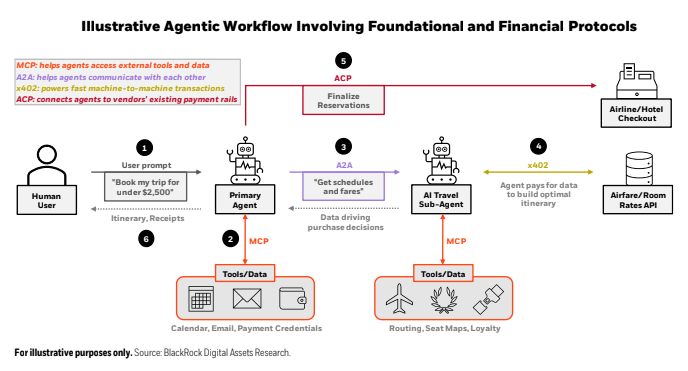
The graphic shows a useful example: a user asks an AI agent to book a trip under $2,500. The primary agent accesses the user’s approved information, delegates research to a travel sub-agent, pays for airfare and hotel data, and then completes the reservation. The important point is that human intervention still sets the objective and permissions. The agents handle the individual steps.
Why Stablecoins Could Matter
BlackRock points to several emerging protocols, including x402, the Machine Payments Protocol (MPP), Agentic Commerce Protocol (ACP), Google’s Agents Payment Protocol and Visa’s Trusted Agents Protocol. These projects approach the problem from different directions but broadly aim to make automated transactions easier to execute and verify.
So, why do AI agents need stablecoins to transact? Because they combine blockchain settlement with a value intended to stay reasonably stable, typically in relation to a fiat currency like the US dollar, stablecoins may be especially pertinent.
BlackRock notes that stablecoins had more than $300 billion in circulating market capitalization as of September 2026, while adjusted stablecoin transaction volume exceeded $11 trillion in 2025. The report also notes that this figure is not directly comparable with traditional payment-network volumes because the methodologies differ.
The growth rate is also notable. According to BlackRock, adjusted stablecoin transaction volume grew at roughly an 80% Compound Annual Growth Rate (CAGR) between 2020 and 2025, compared with about 8.5% for Automated Clearing House (ACH) over the same period.
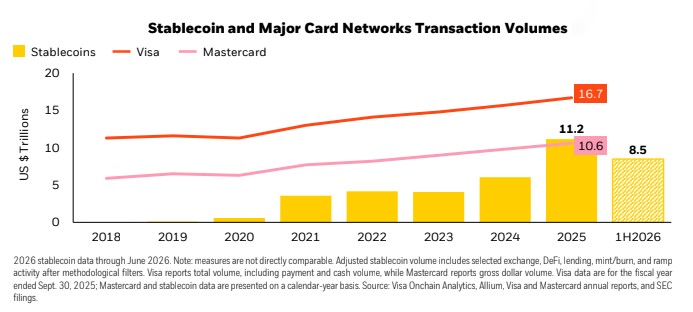
The chart compares stablecoin transaction volumes with Visa and Mastercard. BlackRock explicitly warns that the numbers are not directly comparable, but the visual helps demonstrate how quickly blockchain-based transaction activity has expanded.
The question of whether an AI agent is capable of sending USDC is not the most important one for companies. The question is whether thousands or millions of agents will ever be able to make small payments for software services, data feeds, APIs, or computation without a human authorizing each transaction.
Tokenized Assets Could Give AI A Financial Interface
BlackRock also looks at tokenization, where financial or real-world assets are represented as standardized digital tokens on a blockchain.
The report draws an interesting parallel between AI and blockchain. Large language models break human language into tokens so machines can process information efficiently.
Likewise, blockchain tokenization creates machine-readable digital representations of ownership, value, or economic claims. Although the two procedures differ technically, they both aim to transform complicated real-world data into computer-readable representations. That could become useful for AI agents.
So, how could AI agents use tokenized assets? Imagine an AI system operating within predefined permissions. Rather than navigating multiple disconnected financial databases and manual processes, it could potentially interact with standardized tokenized assets through programmable infrastructure.
A tokenized fund interest, for example, could exist as a digital ownership record with rules governing who is eligible to hold or transfer it. But tokenization does not remove regulation.
BlackRock notes that KYC, AML and other eligibility checks generally remain outside the blockchain, with verified information passed into the transaction process. Legal ownership and regulated-service frameworks also continue to matter.
The technology can streamline how assets move. It does not automatically make every asset accessible to every AI agent.
Compute Could Become An Asset Class Of Its Own
The third part of BlackRock’s thesis could be most interesting. Training large models requires powerful GPUs, while inference, actually running those models for users, requires continued access to computing capacity. That means AI’s economic footprint is not limited to buying chips and building data centres. There is also a growing recurring market for using that infrastructure.
BlackRock estimates that combined revenue from the major cloud segments of Amazon Web Services (AWS), Microsoft Intelligent Cloud and Google Cloud could reach approximately $1.1 trillion by 2030, representing a 29% CAGR from 2025 levels. As compute becomes a larger economic resource, BlackRock argues that markets could develop around it.
One possibility is standardized contracts representing access to specific computing capacity. These claims could potentially be transferred, financed, pledged as collateral or settled through programmable infrastructure. GPU-backed financing is already an early example of financial structures emerging around AI infrastructure. This is where things start looking surprisingly similar to traditional commodity markets.
Oil, electricity and other resources developed markets for pricing, financing and hedging future supply. BlackRock suggests compute could eventually develop similar financial infrastructure, although major questions remain around differences in hardware performance, geographic energy costs and delivery standards.
What Would An AI-powered Compute Market Look Like?
How would an AI compute marketplace work? BlackRock provides another practical example. An AI agent could receive a task requiring significant computing power. It could then check different providers for price, hardware, performance, latency, location and availability, select the most suitable option and pay for the resources automatically.
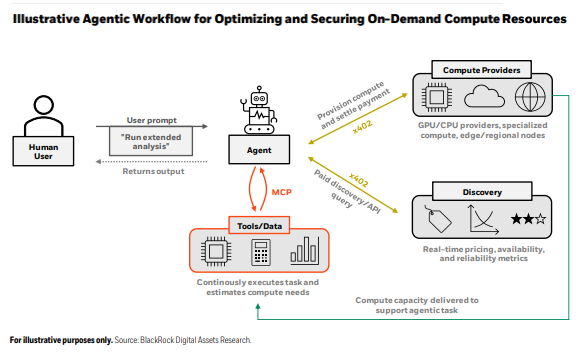
The diagram shows the concept clearly: a human mind gives the agent a task, the agent estimates its compute requirements, discovers available providers and settles payment while receiving the required computing capacity.
BlackRock also points to the expected growth of inference workloads. Citing McKinsey estimates, the report says inference could become the largest AI workload by 2030 and account for an increasing share of data-centre power demand.
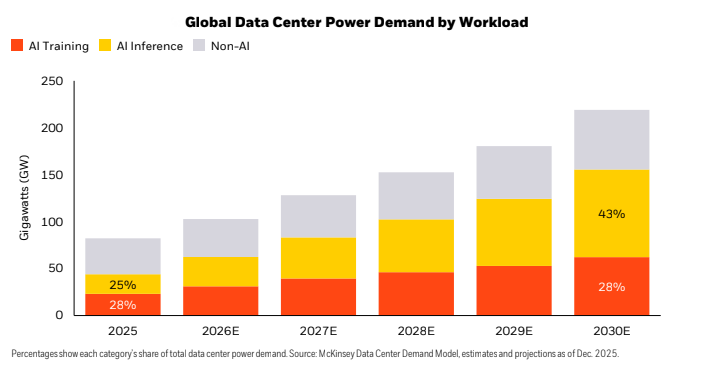
This chart makes the shift particularly easy to understand: AI training and inference account for an increasingly important portion of total data-centre power consumption through 2030.
The Bigger Picture: Machines Doing Business With Machines
Taken together, BlackRock’s argument is less about AI replacing crypto and more about AI creating new economic activity that may require programmable financial infrastructure.
An AI agent interprets information and decides what needs to happen. Digital assets can potentially provide the standardized financial objects and payment rails needed to execute those decisions.
A simple example could eventually look like this:
The user gives an objective → AI finds the required service → AI pays for data → AI buys compute → AI executes the task → blockchain records the settlement.
That is the idea behind the term machine-native economy.
But BlackRock is not presenting this as an established market. The report acknowledges that agentic payment activity remains nascent and that compute-market liquidity is still limited. Standardization, compliance, interoperability and contract design all need further development.
For now, the thesis is best understood as a framework for where AI and digital assets could intersect. The important shift may be that future blockchain demand does not necessarily come only from humans buying and selling tokens. It could increasingly come from machines that need to pay, transact, own and access resources on their own.
Source: BlackRock Digital Assets Research, The Machine-Native Economy: How digital assets connect intelligence, commerce, and compute. The report states that its material includes forward-looking views and projections that may not come to pass. https://www.blackrock.com/us/individual/literature/whitepaper/the-machine-native-economy.pdf
Stay informed with the latest trends in Web3, blockchain innovation, and cybersecurity updates at 3verseTV
You need to login in order to Like











Leave a comment