



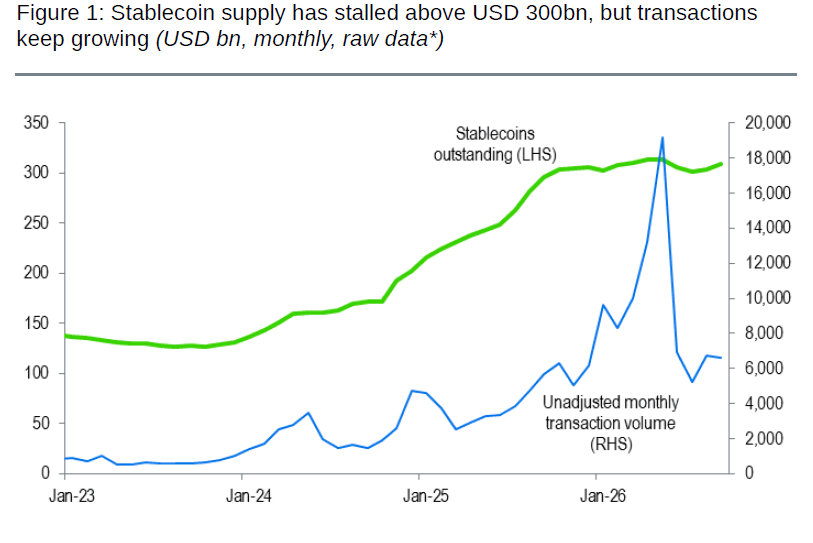
Standard Chartered has revised its forecast for the stablecoin market, now expecting its total value to reach $2 trillion by 2030, two years later than its earlier estimate. The bank’s latest assessment comes as the market’s total value has remained almost unchanged at around $309 billion, even though transaction activity continues to grow.
The bank said, people and businesses are using existing stablecoins more frequently instead of relying only on an increase in the number of tokens available. Geoffrey Kendrick, the bank’s head of digital assets research, said stablecoin use is expanding as more payment and trading opportunities emerge.
THE BLOCK: Standard Chartered has pushed back its $2 trillion stablecoin market cap forecast to 2030 from 2028, citing stalled supply growth this year. The bank maintained the forecast itself, compared with the current market cap of about $309 billion.
StanChart said stablecoin usage continues to grow across emerging-market savings, developed-market transactions, crypto markets and AI-to-AI payments. It sees developed-market transactions, currently led by $USDC, as the “most contested” segment.
— The Block (@TheBlockCo) October 14, 2026
Stablecoins are cryptocurrencies designed to maintain a relatively stable value by linking their price to an asset such as the US dollar. They are used for crypto trading, payments, savings and transferring money. Popular examples include Tether’s USDT and Circle’s USDC.
Standard Chartered has identified four major areas where stablecoins are competing for users. Tether’s USDT is widely used for savings in emerging markets, while Circle’s USDC has a strong position in payments in developed markets. USDC and Ethena’s USDe are also important in crypto trading. USDC is further being used for transactions between artificial intelligence (AI) agents, although this market remains much smaller.
The bank expects competition to be particularly strong in payments in developed markets. New players, including USDG, M^0 and networks supported by several banks, are trying to offer alternatives to existing payment systems.
One important factor could be how stablecoin issuers and payment networks share the income earned from the reserves backing their tokens. According to Kendrick, this could influence which companies attract more users and gain a larger share of the market.
Regulatory changes in the United States could also affect the future growth of stablecoins. The GENIUS Act, passed in 2025, introduced a legal framework for regulating payment stablecoins. US authorities have since proposed rules covering issuance, reserves and consumer protection.
In August, the US Treasury Department proposed rules that would restrict stablecoin issuance in the country to authorised issuers. The licensing requirements are expected to take effect in January 2027. Separately, the Federal Deposit Insurance Corporation (FDIC) proposed that stablecoin holders should not receive pass-through deposit insurance protection.
Accounting rules are another area to watch. The Financial Accounting Standards Board (FASB) proposed an update in August that could affect how companies report certain stablecoins in their financial statements. Blockchain payments company Tempo said the proposed changes could make it easier for businesses to use stablecoins for payments and settlement without facing additional accounting difficulties.
Standard Chartered’s revised forecast suggests that the stablecoin market could continue to expand even if its total value does not rise quickly in the short term. As businesses explore new payment methods and regulations become clearer, the way stablecoins are used may prove just as important as the amount of money invested in them.
Stay informed with the latest trends in Web3, blockchain innovation, and cybersecurity updates at 3verseTV
You need to login in order to Like

















Leave a comment