


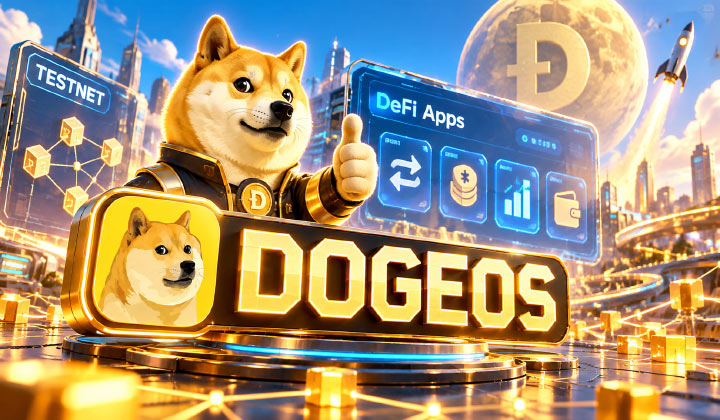
DogeOS has launched a public testnet designed to bring Ethereum-compatible smart contracts and decentralized finance applications to Dogecoin. The testnet went live on September 30 and provides developers with an EVM-compatible environment where they can build applications using DOGE to pay transaction fees.
The platform aims to support DeFi services such as trading, lending and stablecoins, along with prediction markets, games and other consumer applications. Created by the team behind MyDoge, DogeOS adds an application layer to Dogecoin without changing its main blockchain.
1/ DogeOS Testnet is Open to Builders!
Millions of Dogecoin holders are waiting for more things to do with DOGE.
What are you going to build for them?
Start here ↓ pic.twitter.com/L2yPs2ASU5
— DogeOS (@DogeOS) September 30, 2026
Dogecoin was originally built mainly for sending DOGE between wallets and does not natively support complex applications such as decentralized exchanges or lending protocols. DogeOS is attempting to fill that gap through a separate application layer designed as a zero-knowledge rollup that settles its state to the Dogecoin network.
The project uses an Ethereum-compatible environment, meaning developers who already work with EVM-based networks can use familiar tools and infrastructure. The idea is to make it easier for developers to build applications around DOGE without requiring changes to the underlying Dogecoin blockchain.
Several projects are already being developed for the DogeOS ecosystem. Barkswap is working on a liquidity engine, while Superposition Finance is developing a lending protocol for Dogecoin. Derps is building a perpetual exchange and Split Markets is working on options. USDoge is developing a collateral-backed stablecoin.
Other projects are targeting different types of applications. Snag is working on a prediction-market aggregator, while Anoncoin and Starbase are developing launchpads. Doge Escape, PlaysOut and DogeFundMe are among the projects exploring gaming and other consumer-focused applications.
Following the testnet announcement, DOGE was trading at around $0.09575, up about 1.8% over 24 hours, with a market capitalisation of approximately $14.95 billion, according to CoinGecko data.
DogeOS currently uses a permissioned sequencer to determine the order of transactions. Its security model also involves validators and a trusted execution environment. State transitions require valid proofs as well as signatures from a majority of validators and a trusted execution environment signer.
The project eventually wants to connect its security more closely to Dogecoin itself. A proposed Dogecoin Core upgrade called OP_CHECKZKP could allow Dogecoin nodes to verify zero-knowledge proofs showing that calculations carried out on the DogeOS application layer were completed correctly.
The proposal was published in July 2025, but there is currently no activation date. A separate implementation remains a draft and contains a placeholder proof checker. Until such a system is adopted, users will continue to depend on DogeOS operators, validators and trusted hardware rather than having applications directly verified by Dogecoin miners.
The Dogecoin Foundation has also expressed support for the project. Timothy Stebbing, a director of the foundation, described DogeOS as a way to add new utility to Dogecoin while keeping its base layer largely unchanged. DogeOS founder and CEO Jordan Jefferson said the testnet gives developers a place to turn ideas involving Dogecoin into working applications.
The project announced a $6.9 million funding round led by Polychain Capital in May 2025. DogeOS is not the first attempt to build an application ecosystem around Dogecoin. Dogechain launched in 2022 with NFTs, games and DeFi services aimed at Dogecoin users. However, it was a separate blockchain based on Polygon Edge and was not an official project of the Dogecoin Foundation or Dogecoin founders Jackson Palmer and Billy Markus.
DogeOS is now focused on testing its infrastructure and encouraging developers to build applications before a potential mainnet launch. The project has not announced a mainnet date yet. Its longer-term security model will also depend partly on whether Dogecoin eventually adopts native verification of zero-knowledge proofs.
Stay informed with the latest trends in Web3, blockchain innovation, and cybersecurity updates at 3verseTV
You need to login in order to Like

















Leave a comment