


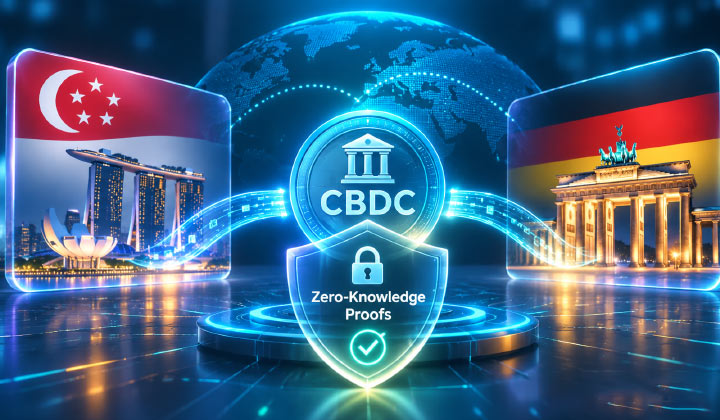
- Singapore’s central bank and Germany’s Bundesbank have completed a cross-border settlement test using wholesale central bank digital currencies.
- The experiment used zero-knowledge proofs to verify transactions without sharing sensitive information between separate banking systems.
- The project explored faster euro and Singapore dollar settlements, including transactions across different banking hours.
Singapore & Germany Complete CBDC Experiment
Singapore and Germany have completed an important experiment looking at how central bank digital currencies can be utilised for international payments. The experiment, known as Project Simbolon, looked at how blockchain and zero knowledge proofs could be used to settle transactions between euros and Singapore dollars.
MAS and the Deutsche Bundesbank have successfully tested connectivity between their respective digital asset settlement solutions’ test environments to facilitate wholesale settlement across different currencies and operating hours. https://t.co/ghNAz4absg
— MAS (@MAS_sg) November 16, 2026
The Monetary Authority of Singapore (MAS) and Germany’s Deutsche Bundesbank announced the findings of the experiment on the 16 th November 2026.
The experiment was between DBS and Deutsche Bank (commercial banking partners) and Partior (technology infrastructure). The goal of the experiment was to streamline international payments. The experiment was centred around wholesale payments between financial institutions and not for consumers.
Zero Knowledge Proofs
An important part of the Project Simbolon experiment was the use of zero knowledge proofs. This means one party can prove information is correct without showing any private information.
When banks trade currencies, both parties will need to ensure certain conditions are met. Zero knowledge proofs can be used to allow both parties to complete this without sharing any confidential information.
The experiment utilised payment versus payment settlement (known as PvP). This means that one currency will only be paid once the payment has been made in the other currency. This stops one bank paying without receiving the other currency.
Crucially, this did not require a joint blockchain between the German and Singapore banking systems. Both could verify if the conditions had been met.
Banks Can Streamline International Payments
Apart from trading currencies, the experiment was looking at how banks can manage their cash needs in different time zones. If a bank based in Singapore needs to pay in euros but the financial markets in Europe are closed, having a streamlined settlement process can allow institutions to have the right amount of funds available when they need them.
The Project Simbolon also looked into potential applications for securities and intraday liquidity. The two central banks signed an agreement in November 2025 to collaborate on international digital asset settlements. This experiment is an important step forward in this collaboration.
Singapore is also taking part in other experiments using blockchain technology for financial services such as Project Guardian and Project Meridian FX APAC. However, this experiment is still a technical experiment. No information has been released about whether this will be commercially available or how many transactions were completed.
The central banks stated that a more detailed report will be released detailing the technology, business applications and challenges. This shows central banks are looking to utilise blockchain technology to improve international financial transactions.
If these systems can be widely used they can allow banks to settle payments quicker, reduce settlement risk and manage money more efficiently between countries.
Stay informed with the latest trends in Web3, blockchain innovation, and cybersecurity updates at 3verseTV
You need to login in order to Like
















Leave a comment