



The concept of agentic commerce where agents can purchase digital services and make autonomous AI payments is fast gaining popularity. Interestingly, the United States is rising as a dominant force in this burgeoning market.
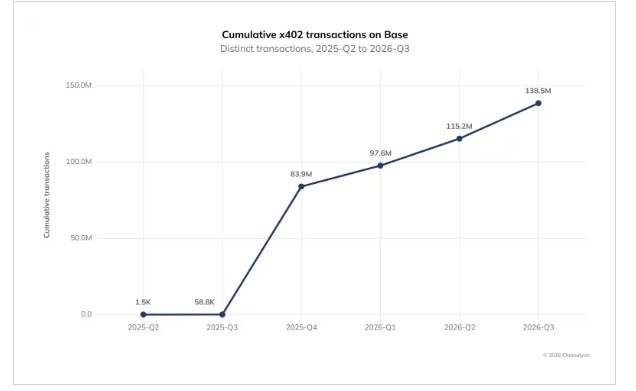
According to Chainalysis, more than 138M transactions occurred through the x402 payment protocol on Coinbase’s Base by the end of its 2026 reporting period i.e 12 months ending July 1, 2026. Base has been widely accepted and has also become one of the most popular blockchain for agentic commerce.
Naturally, curious investors would want to know the reasons why the US dominates this space and which businesses stand to benefit as AI agents become more autonomous in the digital economy. Let’s dive deeper into this.
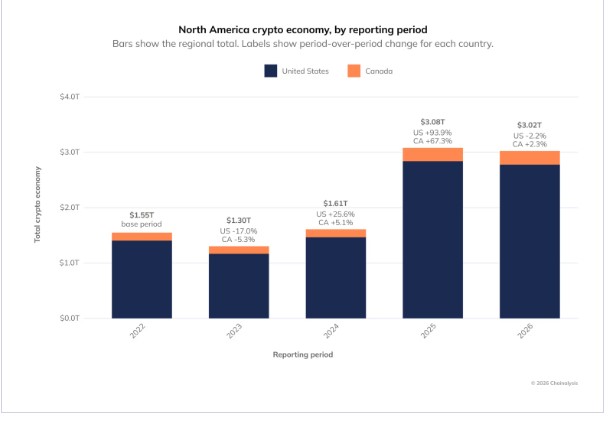
Reasons Why The United States Tops Agentic Commerce Adoption
Agentic Commerce in the US is growing as the country is home to a confluence of AI developers, blockchain companies, payment infrastructure as well as technology investors. This combination forms an ecosystem where AI agents can be created and integrated with digital services and given the ability to make payments to access them.
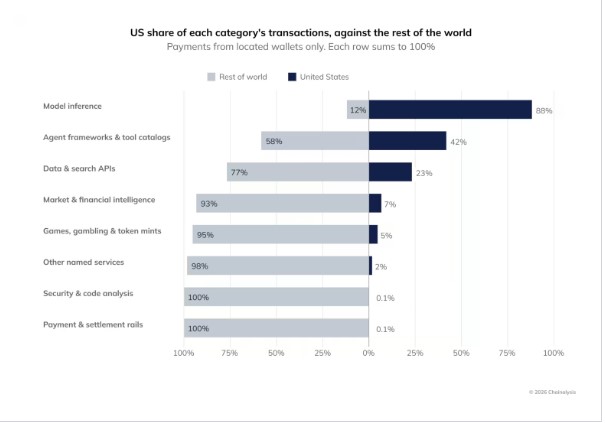
A report by Chainalysis has found that US attributed wallets accounted for 30% of geolocated agent to service transactions. More importantly, they accounted for 88.1% of AI model inference transactions, 41.8% of payments to agent frameworks and tool catalogues and 23.2% of payments to data and search application programme interface (APIs).
These statistics demonstrate the robust US presence in services which enable AI agents to operate. American companies are building both, the AI systems and the payment infrastructure which allows them access to digital services.
Interestingly, this opportunity extends beyond the US and can create international demand for the technology built by Americans. Companies offering AI capabilities, AI agent payment systems, data and developer tools could earn money if autonomous commerce begins to grow.
What Is Agentic Commerce & How Does It Work?
Agentic commerce is a system where AI agents can independently purchase services while performing a goal set by a person or business.
A traditional chatbot may be able to recommend a research tool. An AI agent could go a step further, being able to access that tool and pay for the service, collect the results and perform a task.
An example of this would be if a financial research agent purchased market data, used an AI model to analyse it and paid for an additional service to verify its findings. Each of these steps would create potential demand for digital services.
For investors, the opportunity does not only lie with companies building AI agents. It is also with businesses which provide the services these agents need.
How Do AI Agents Make Autonomous AI Payments Using x402?
To purchase services independently, AI agents need a practical way to make payments. This is where the x402 protocol comes in. If you are wondering what the x402 protocol is in crypto payments, x402 is a payment protocol built by Coinbase which enables AI agents and other software to make on-chain payments.
Well, do you know what’s the difference between x402 and traditional payment systems? Traditional payment systems can be expensive or inconvenient for small transactions. AI agents may need to pay for requests of data, functions of software or small amounts of computing power.
Here, Blockchain payments can be more practical if transaction costs are small enough. Blockchain payments may offer fees for tiny transactions.
Chainalysis recorded more than 138M x402 transactions on Base during its 2026 reporting period. The report also found that more than 87% of the x402 payments analysed were between one-hundredth of a cent and ten cents.
This indicates that autonomous commerce can involve thousands of small payments rather than a few large purchases. Thus, for investors, x402 is an emerging area to follow.
What Are AI Agents Buying?
AI agent commerce is becoming popular but what do these agents buy? AI agents need information as well as special skills to perform multiple tasks. For example, an AI agent working on a business report could pay for access to a data set, analyze information or buy a specialized service to evaluate the results.
Each service provider could earn revenue from that activity. This creates opportunities for businesses which can provide machine-readable information and services which can be purchased automatically. Rather than a monthly subscription, some providers may offer a pay-per-use pricing scheme where the agent pays only for a specific service.
For investors, the important factor is repeat demand. Businesses which have services that AI agents use regularly, have a stronger commercial opportunity than those which rely on one-time experimentation.
What Does Growth Of AI Agent Transactions Reveal?
The number of transactions is only one way to measure adoption. Repeat usage can give additional insight if users are finding practical value in the technology.
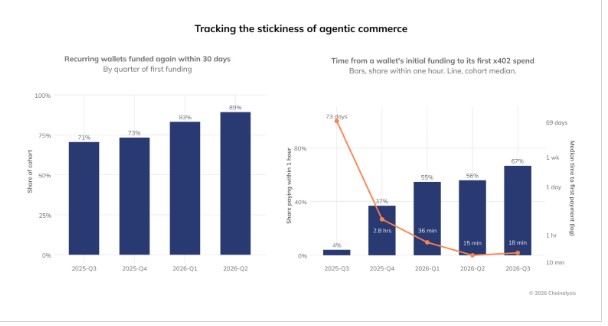
According to Chainalysis, the share of analysed wallets that received funding within thirty days increased from 70.6% to 89.3% in the second quarter of 2026. The report also found that the median time between wallet funding and the first x402 payment dropped from 73 days in late 2025 to 18 minutes by the third quarter of 2026.
These findings indicate that users are increasingly funding wallets for payment tasks. Users are also returning to replenish wallets. For investors, repeat funding and faster first transactions can be encouraging signals of practical usage. It suggests that some users are moving beyond testing the technology.
What Comes Next For AI-powered Commerce?
The next step for AI agent commerce will depend on whether these smart self-running systems can help businesses and people in real ways. A few areas where investors might find chances to grow their money are AI infrastructure, payment technology, digital services, agent platforms as well as security and compliance.
Undoubtedly, various critical safety measures, data protection tools as well as regulatory verification systems are much needed to ensure secure and legal autonomous operations. Investors who are keen to enter the space and benefit from it should focus on these areas.
Final Takeaway
The United States is making a unique presence in the market for AI agent commerce because it has the right mix of AI development, blockchain technology, payment infrastructure and investment capital.
As AI agents become more capable of purchasing data, accessing software and making payments for digital services, new opportunities could emerge across the technology ecosystem.
For investors, the key question is not only which companies are building the most capable AI model but is also which companies will supply the infrastructure and services that autonomous AI systems need to operate. The businesses which turn this emerging activity into products and revenue will be key to watch as agentic commerce takes off.
Disclaimer: This content is for educational purposes only and is not meant to be financial advice. Please consult a financial advisor before making any investment decisions.
Stay informed with the latest trends in Web3, blockchain innovation, and cybersecurity updates at 3verseTV
You need to login in order to Like
















Leave a comment