



Stablecoin transactions broke $891 billion in the third quarter of 2026, more than four times the level recorded in early 2023, according to a report commissioned by Coinbase.
The report, prepared by The Block Research, found that stablecoins handled more than $400 million adjusted transfers per hour quarter in their popularity, which is prompting demand from U.S. banks and corporations: seven of the ten largest U.S. banks are already testing stablecoins or tokenized deposits for payments and settlements, and 30% of mid-size companies involved in cross-border trade are using or testing stablecoins compared to 10% in 2024.
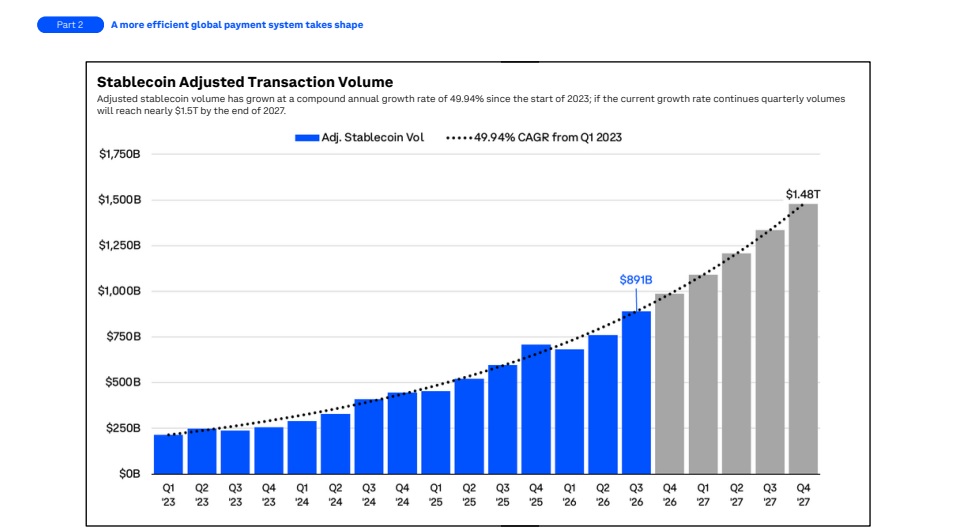
Stablecoins are cryptocurrencies, usually dollar-backed, that seek to avoid the price volatility of bitcoin and other crypto assets, and that can be used for making payments without the risks of a currency whose value fluctuates significantly.
An amazing finding was that 73% of the stablecoin transfers analyzed occurred when the U.S. banking system was closed, reflecting the appeal of these products to facilitate transactions outside of regular banking hours. In addition, business-to-business payments via stablecoins grew 36% from the previous year.
The study also found that 293 million blockchain addresses hold stablecoins, more than the 246 million cards issued by American Express and Discover. However, the researchers emphasize that many of these addresses belong to individuals, since it is relatively simple for people to have multiple blockchain addresses.
The authors also highlight the potential economic benefits of a more significant use of stablecoins: moving 80% of international transactions to stablecoins would generate an additional $155 billion to global GDP every year. It could also free up around $3 trillion in liquidity for the banking system to fund cross-border payments. However, as the authors note, these are projections for a potential scenario that does not consider current trends, and that a higher use of stablecoins would imply lower lending capacity for banks.
According to a survey conducted by the National Cryptocurrency Association, there is growing interest in the banking sector in providing crypto products and services: 42% of U.S. adults (about 112 million people) would be more likely to open an account with a bank offering crypto products or use it for other banking activities.
Of those surveyed, 18% are interested in buying or using stablecoins through their primary bank, although 64% said their bank or financial advisor has never talked to them about cryptocurrency and 43% do not know if their bank offers these products.
Despite the increase in transaction value, the overall size of the stablecoin market continued to experience downward pressure: according to DefiLlama data, on October 20, 2025, the total market value of all stablecoins was $301.42 billion on Tuesday, down around 0.6% from $303.14 billion.
Forecasts for the next five years vary significantly: while Standard Chartered recently reduced its forecast of a $2 trillion stablecoin market from 2028 to 2030 because supply was growing more slowly than expected. Citi, meanwhile, expects the market to reach $1.9 trillion stablecoin market in 2030 in its main scenario, it indicates a more optimistic $4 trillion figure.
All in all, the findings point to the increasing relevance of stablecoins in the financial system and their potential as a source of innovation in the banking industry, although their future will depend to a large extent on their adoption and regulation and their impact on the traditional financial system.
Stay informed with the latest trends in Web3, blockchain innovation, and cybersecurity updates at 3verseTV
You need to login in order to Like

















Leave a comment