


The American Reserve Modernization Act of 2026 (ARMA), H.R. 8957, became the first Strategic Bitcoin Reserve bill to pass a full House committee on September 16, 2026, when the US House Financial Services Committee voted 28–21 in favour of it.
The committee approved a chairman-backed substitute that changes the proposed 20-year lock, Bitcoin reserve reporting rules and the treatment of forked and airdropped assets.
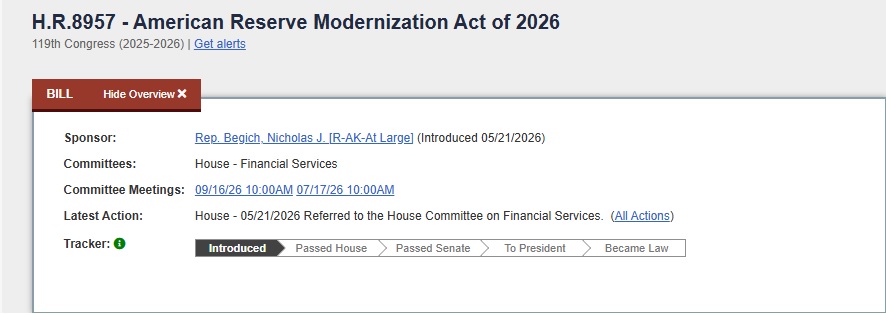
Source: congress.gov
The revised bill would start the 20-year period from the date the law is enacted, rather than starting a separate clock whenever new Bitcoin enters the reserve. It now moves to the full House for consideration.
The legislation, introduced by Representative Nick Begich of Alaska on May 21, is intended to put the existing federal Bitcoin reserve on a statutory footing. President Donald Trump created the Strategic Bitcoin Reserve through an executive order in March 2025. The order directed federal agencies to retain Bitcoin obtained through criminal or civil forfeitures instead of selling it.
One of the biggest changes in the committee-approved version concerns how long the Bitcoin would remain locked. Under the original proposal, every new deposit would have started its own 20-year period. That could have meant Bitcoin seized in 2031 would remain in government custody until 2051. The substitute instead creates one common starting point tied to the law’s enactment.
The bill also reduces the frequency of public reporting. The original version called for quarterly cryptographic attestations. The revised text requires an annual public report covering the government’s Bitcoin holdings, transactions and control of private keys. An independent auditor with experience in cryptographic attestations would verify the report, while the Comptroller General would retain oversight.
The treatment of assets received through blockchain forks and airdrops has also changed. The Treasury would be allowed to dispose of such assets after one year, compared with five years under the original bill. After that period, the government would retain the chain with the higher market capitalisation and could sell the minority token.
The substitute further provides a possible exit mechanism after the 20-year lock. The Treasury could recommend selling up to 10% of the reserve Bitcoin during any two-year period. However, the provision does not require an automatic sale.
Prior to accepting the modified bill by the same 28-21 vote, the committee rejected an amendment proposed by Ranking Member Maxine Waters of California by a vote of 21-28. Although additional congressional action would be necessary before it becomes law, the legislation will now advance past the committee level.
The actual size of the US government’s Bitcoin holdings remains uncertain. Estimates range from about 198,000 BTC to 328,372 BTC, depending on which forfeiture wallets are included. Blockchain trackers have different estimates, while the Treasury has not published a reconciled balance sheet.
The revised ARMA text seeks to address that gap by requiring federal agencies to inventory their digital-asset holdings within 60 days of enactment. The Treasury would then have 180 days to establish custody infrastructure, followed by transfers within 30 days of certification.
Much of the existing Bitcoin reserve reportedly came from government seizures, including assets linked to Silk Road, the Bitfinex hack recovery and the Prince Group case. The reserve therefore differs from a programme in which the government simply buys Bitcoin with taxpayer funds on the open market.
Stay informed with the latest trends in Web3, blockchain innovation, and cybersecurity updates at 3verseTV
You need to login in order to Like















Leave a comment