


By a bipartisan 38-5 vote, the US House Ways and Means Committee advanced the Digital Asset Tax Certainty Act, H.R. 10357, pushing the crypto tax legislation for consideration by the entire House.
PASSED: The Ways and Means Committee just passed the Digital Asset Tax Certainty Act — a historic step toward establishing a clear tax framework for digital assets.
Through strong bipartisan collaboration, Republicans and Democrats came together to modernize outdated tax rules… pic.twitter.com/g5aUK7TVNL
— Ways and Means Committee (@WaysandMeansGOP) September 16, 2026
The bill would apply current anti-abuse regulations, such as wash-sale laws, to digital assets while establishing new federal tax regulations pertaining to stablecoins, mining, staking, lending, and transaction fees. It also proposes relief for certain small crypto transaction fees.
The committee action came a day after the Senate failed to advance the broader CLARITY Act, leaving the two pieces of crypto legislation on separate tracks.
The Digital Asset Tax Certainty Act is designed to address areas where existing US tax rules do not clearly fit digital assets. The Ways and Means Committee described it as a framework intended to provide clearer rules, reduce compliance burdens and bring some crypto tax treatment closer to that of traditional financial assets.
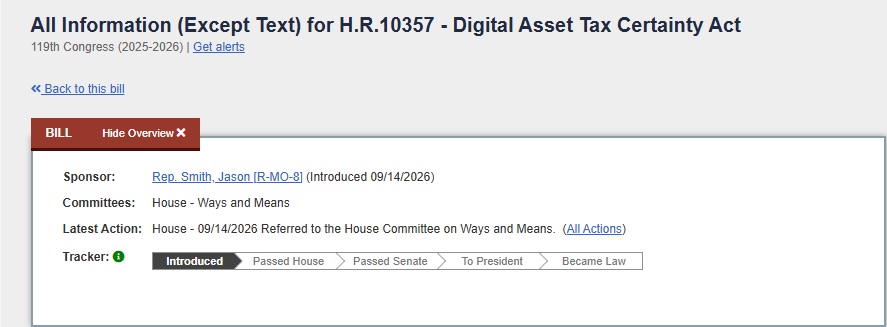
Source: congress.gov
One important part of the legislation deals with stablecoins. The bill would create special tax treatment for qualifying US dollar-pegged stablecoins, including certain transactions where these assets are used for everyday payments. The aim is to reduce the tax paperwork that can arise when a digital asset is used for a routine purchase.
The legislation also addresses crypto mining and staking. These activities generate digital assets as rewards for helping operate or validate blockchain networks, but their tax treatment has been an area of uncertainty. The proposed rules seek to establish clearer treatment for income generated through both activities.
Another significant provision concerns digital asset lending. The bill would extend certain existing tax safe harbours to digital assets, potentially allowing qualifying lending transactions to receive treatment similar to comparable transactions involving traditional financial assets.
The legislation would also apply established anti-abuse provisions to digital assets. These include the wash-sale and constructive-sale rules. The Ways and Means Committee says this would bring digital assets more closely in line with the tax treatment of comparable traditional financial products.
For smaller transactions, the bill proposes a de minimis exemption for certain digital assets used to pay network or transaction fees. Under the proposal, taxpayers would not have to recognise a gain or loss on qualifying transactions involving fees of $10 or less. The measure is aimed at reducing paperwork for everyday blockchain transactions, where calculating a taxable gain on a very small payment can be cumbersome.
The bill also includes provisions that would allow digital asset dealers and traders to use mark-to-market accounting and would make certain digital asset donations eligible for tax treatment similar to publicly traded securities. A voluntary disclosure programme for digital asset taxpayers is also proposed.
Just one day before the House committee vote, the Senate failed to proceed with the CLARITY Act, a more comprehensive bill concerning the market structure of digital assets. With 49 votes in favor and 50 against, the Senate cloture motion did not receive the 60 votes needed to advance the proposal.
More broadly, the CLARITY Act seeks to define the functions of the Commodity Futures Trading Commission and the Securities and Exchange Commission as well as to create a federal regulatory framework for digital assets.
SEC Chair Paul Atkins stated that the agency would carry on operating under its current legislative jurisdiction after the Senate vote. CFTC Chair Michael Selig similarly said the agency would continue developing rules using its current legal powers.
For the crypto industry, the developments show that tax legislation and market-structure legislation are moving on different congressional paths. The Ways and Means vote does not make the proposed tax rules law. The bill still has to go through the House and Senate legislative process and ultimately receive presidential approval.
For now, the 38-5 committee vote gives the US digital-asset industry a significant piece of tax legislation to watch as Congress considers how existing tax rules should apply to an increasingly diverse crypto market.
Stay informed with the latest trends in Web3, blockchain innovation, and cybersecurity updates at 3verseTV
You need to login in order to Like















Leave a comment