


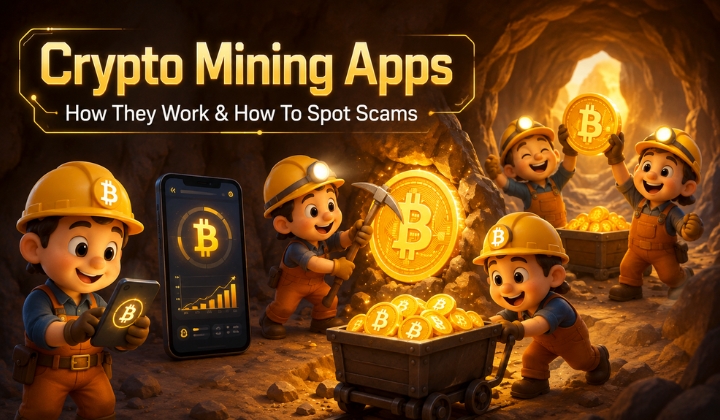
Introduction
Search for crypto mining apps today and you will find hundreds of apps promising an easy way to earn Bitcoin.
Some say you can mine from your phone. Others offer cloud mining contracts. Some simply show a mining balance increasing inside the app without asking you to buy any hardware.
But there is an important thing one needs to know first.
Mining is not like tapping a button on a phone.
Bitcoin mining is the process of using computing power to process and secure transactions on the Bitcoin network. Miners compete to solve a mathematical problem, and the successful miner receives newly created Bitcoin along with transaction fees.
The industry of Bitcoin mining has become specialized today, utilizing purpose-built machines called Application-Specific Integrated Circuit (ASIC) miners. These machines use a lot of electricity and are usually deployed in huge mining farms (not on smartphones).
Therefore, when you find a crypto mining application, you should ask a different question:
What is this app really doing?
Mining apps can mean very different things, from connecting you to real mining hardware to simply rewarding you with tokens for using an app.
How Do Crypto Mining Apps Function?
The best way to know what crypto mining apps are is to break them into three major types.
1. Apps For Cloud Mining
The closest option to real Bitcoin mining without buying the machines yourself is cloud mining.
Rather than buying an ASIC miner yourself, you pay a company that owns the mining hardware to buy or rent a portion of its computing power.
The company operates the machines.
The machines do the mining.
You receive a share of the rewards according to your contract, after fees and operating costs.
Platforms such as BitFuFu, Bitdeer, ECOS, Hashing24 and Binance Cloud Mining use versions of this model, although their contracts, pricing and availability can differ.
The important thing to remember is that cloud mining is still a business, not free Bitcoin. Bitcoin’s price, mining difficulty and electricity costs can all change, while hardware becomes less efficient over time.
Mining companies also face increasing competition and significant electricity costs. This means even a legitimate cloud mining contract can prove unprofitable if the benefits accrued are less than the costs of running the hardware.
For instance, Hashrate Index estimated that Bitcoin mining revenue was about $32 per petahash per day in August 2026, which was about or below breakeven for many miners depending on their hardware and electricity costs.
That explains why a mining contract can be legitimate and still lose money.
2. Reward-based & Simulation Apps
The second category looks like mining but works differently. Apps such as Pi Network use their own reward mechanisms rather than having users perform traditional Bitcoin mining.
That does not automatically make the model illegitimate, but the rewards come from the app’s own system, not from your phone contributing meaningful computing power to Bitcoin.
3. Mining Pool & Monitoring Apps
The third category is for people that already have mining hardware.
A mining pool lets multiple miners pool their computing power and share the rewards. Rather than trying to mine for Bitcoin all on your own, your machine now adds computing power to a group of miners, and you receive a cut of the rewards based on how much work your hardware is doing.
Some apps in this category work mainly as dashboards.
They let miners check hashrate, earnings, machine temperature and other information remotely.
So, the app itself may not be mining anything.
The actual mining is happening on your ASIC or other hardware somewhere else.
This is one reason the phrase Bitcoin mining apps can be confusing. Two apps can both use the word “mining” while doing completely different things.
Can You Really Mine Bitcoin On Your Phone?
For practical purposes, no.
A smartphone simply does not have the computing power or efficiency required to compete with modern Bitcoin mining hardware.
There is also a straightforward reason that genuine mobile crypto mining is rare: both major mobile app stores restrict direct on-device cryptocurrency mining.
Apple’s App Store rules say apps may not mine cryptocurrency unless the processing happens off-device, such as through cloud-based mining. Google Play similarly says apps cannot mine cryptocurrency directly on a device, although apps can remotely manage mining.
So, an app marketed as one of the best crypto mining apps for Android and iOS may connect you to remote hardware, act as a mining dashboard or distribute rewards instead of performing mining on your phone. That does not automatically make it a scam, you just need to understand what is happening behind the screen.
Can USDT Be Mined?
No.
USDT, or Tether’s dollar-backed stablecoin, is not mined like Bitcoin.
Bitcoin uses mining to secure its network and issue new Bitcoin according to its protocol. USDT works differently. Tether issues and redeems the tokens, and its issued tokens are backed by actual reserves.
An app claiming that your phone can “mine USDT” may simply be paying rewards in USDT or using another income-generating model. USDT itself is issued by Tether rather than mined.
This is one of the easiest ways to catch shady advertising around crypto mining apps.
Are Crypto Mining Apps Legit Or Scams?
The answer is both. Some applications connect users to genuine mining infrastructure, some are reward-based systems, and some are outright scams. The problem is that a scam can look surprisingly professional, complete with a polished app and a dashboard showing “earnings” increasing every day.
The real test is what happens when you ask one simple question:
Where Does The Money Come From?
A legitimate platform should be able to explain how its business works, where the computing power comes from and how rewards are generated.
The Federal Trade Commission warns that guaranteed cryptocurrency profits and unusually large returns with little risk are major warning signs. It has also documented scams where fake websites show users supposed profits and then demand additional cryptocurrency before allowing withdrawals.
That is especially relevant to mining scams because mining economics are constantly changing.
A genuine operator cannot simply guarantee the same return every day regardless of Bitcoin’s price, mining difficulty and electricity costs.
Are Cloud Mining Apps Safe In 2026?
They can be legitimate, but “cloud mining” does not mean “safe.”
A company can operate genuine mining hardware and still offer an unattractive contract once electricity, maintenance and other fees are included.
The key distinction is between legitimacy and profitability. A real mining operation can exist while a particular contract still loses money.
What Are The Red Flags Of A Crypto Mining Scam?
There are a few warning signs that should immediately make you slow down.
1. Guaranteed Returns
“Earn 5% every day” or “guaranteed Bitcoin income” should raise questions.
Mining is a competitive business, not a fixed-interest savings account. The Federal Trade Commission specifically warns against cryptocurrency schemes promising guaranteed profits or unusually high returns.
2. No Verifiable Mining Infrastructure
If a company claims to operate thousands of mining machines but cannot provide credible information about its business, hardware or facilities, be cautious.
You do not need to be a mining engineer.
But you should be able to understand what you are paying for.
3. Withdrawal Problems
This is one of the biggest red flags.
Imagine your dashboard shows that you have earned $500.
You then try to withdraw it.
Suddenly the platform tells you to deposit another $100 as an “activation fee” before your money can be released.
That is a major warning sign.
4. Referral Pressure
Referral programs aren’t automatically fraudulent.
But if the platform appears far more interested in getting you to recruit friends than explaining how the mining works, give it a closer look.
Be especially careful when referral rewards are combined with guaranteed returns or withdrawal restrictions.
5. No Clear Company Information
Before putting money into a mining service, find out who operates it.
Look for a real company, identifiable management, operating history, terms and conditions and proper customer support.
The Federal Trade Commission also recommends searching for the company name alongside words such as “scam,” “review” or “complaint.”
What To Check Before Using A Mining App
Before depositing money or signing a mining contract, check five things:
The mining model: Is it cloud mining, a reward-based system or a tool for managing your own hardware?
The infrastructure: Where does the compute power come from?
Economics: What are the fees, mining difficulty, electricity costs and price risks of Bitcoin?
The withdrawal process: What’s the minimums, fees and requirements? Can you withdraw without paying unexpected charges?
The company: Who operates the platform? Does it have a verifiable operating history and public information?
If you cannot get clear answers to these questions, don’t deposit money.
Are Crypto Mining Apps Profitable?
This is where expectations need to stay realistic.
Real Bitcoin mining can be profitable, but it is an industrial business rather than free money.
Miners pay for hardware, electricity, cooling and maintenance. Cloud mining simply shifts some of those costs and responsibilities to the company operating the machines.
Free applications are different.
If an app costs nothing and claims to generate Bitcoin without using meaningful computing power, the reward is probably coming from somewhere else. It could come from advertising, user activity, token distribution or another business model.
The right question is not:
“How much does this app say I can make?”
It is:
“What economic activity is generating my reward?”
That one question can eliminate a huge amount of confusion around crypto mining.
Key Takeaway
The biggest misunderstanding around crypto mining apps is that the app itself is doing the mining.
Usually, it is not.
The important distinction is not whether an app uses the word “mining.” It is whether you can understand where the computing power comes from, how the reward is generated and what you are paying for.
That is why Bitcoin mining apps, mobile crypto mining and cloud mining should never be treated as the same thing.
And caution is utmost needed when an app guaranties profits, huge daily returns or easy money, and almost no risk.
The surest way is simple.
Before trusting the number on your screen, understand what is being mined, where is the mining taking place, and how is the reward generated and most importantly, how much are you being asked to pay.
That is the difference between crypto mining apps and just believing in them.
Stay informed with the latest trends in Web3, blockchain innovation, and cybersecurity updates at 3verseTV
You need to login in order to Like













Leave a comment