


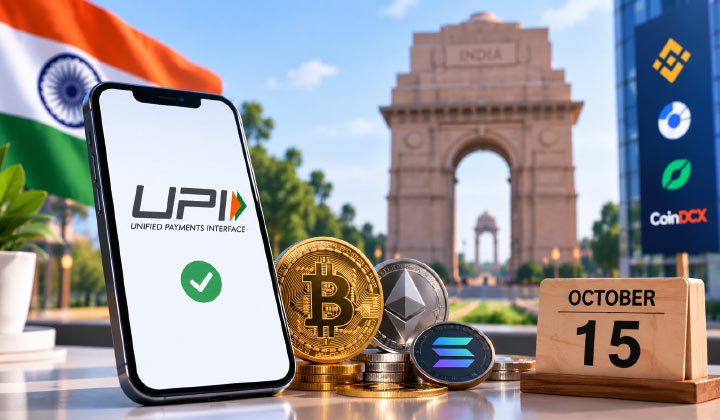
Indian cryptocurrency exchanges that accept rupee deposits via in-app UPI are anticipated to absorb a 0.4% Merchant Discount Rate (MDR) on Person-to-Merchant (P2M) transactions above Rs 2,000 from October 15, 2026. Users will not be required to pay the fee directly.
Certain P2M UPI payments are covered by the new framework, and cryptocurrency exchanges are classified as normal merchants rather than under a unique regulation. No separate crypto circular has been released by the Finance Ministry or the National Payments Corporation of India (NPCI). The amount credited should not change for users making deposits via CoinDCX, CoinSwitch, Mudrex, and ZebPay.
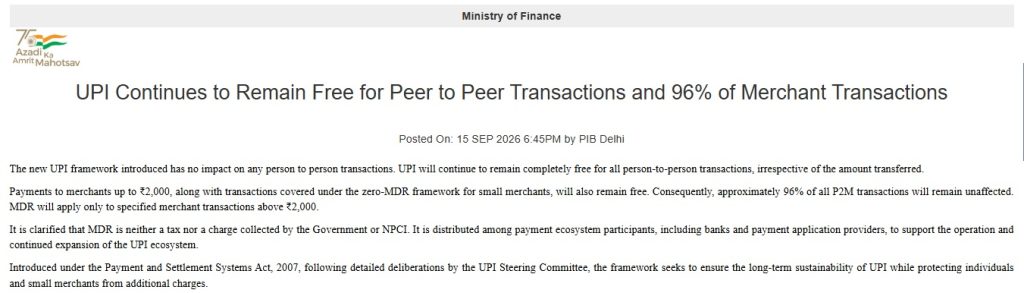
Source: pib.gov.in
The change marks a shift for India’s crypto on-ramp market, where exchanges have generally offered zero-fee UPI deposits. Since MDR on UPI was waived in 2020, free deposits have been an important part of the customer experience for digital-asset platforms.
P2M UPI transactions over Rs 2,000 will be subject to an MDR of 0.4% under the new regime. For transactions of Rs 75,000 or more, the fee is limited to Rs 300. Deposits less Rs 2,000 would not be included in the framework.
For instance, the receiving platform would incur an MDR cost of Rs 40 for a deposit of Rs 10,000. A transaction of Rs 75,000 or more would exceed the Rs 300 cap, while a deposit of Rs 50,000 would result in a Rs 200 fee.
🔰UPI Continues to Remain Free for Peer to Peer Transactions and 96% of Merchant Transactions
▪️The new UPI framework introduced has no impact on any person to person transactions
▪️UPI will continue to remain completely free for all person-to-person transactions, irrespective… pic.twitter.com/In4SsP4qZw
— PIB India (@PIB_India) September 15, 2026
The important point for crypto users is that the MDR is a merchant-side cost. The Finance Ministry has said merchants and UPI applications should not pass the charge on to customers through transaction fees or hidden charges. So, if an exchange continues its zero-fee deposit policy, a user depositing Rs 10,000 should still receive Rs 10,000 in the exchange wallet.
Person-to-Person UPI payments remain outside the MDR framework. This means direct P2P payments, including payments between individuals involved in peer-to-peer crypto trades, do not attract the 0.4% merchant charge on the UPI payment itself. However, the price quoted by a seller can still include a separate margin.
The new rule also excludes small merchants receiving up to Rs 1 lakh a month under the P2PM category. Crypto exchanges, because of their larger transaction volumes, would generally not qualify for this exemption.
The change could nevertheless affect exchange economics. A platform handling Rs 100 crore of monthly UPI deposits above the Rs 2,000 threshold could face MDR costs of up to Rs 40 lakh before the transaction cap and the actual distribution of deposit sizes are taken into account.
That creates a new cost question for Indian exchanges. Platforms could absorb the expense, adjust their spreads, or make changes elsewhere in their pricing structure. Any such move would be separate from the UPI MDR itself, since the current framework does not permit the merchant-side charge to simply be added to the customer’s UPI payment.
The timing is also notable because Indian crypto platforms are already operating under a substantial regulatory and tax framework. Users face a 30% tax on gains from Virtual Digital Assets under Section 115BBH of the Income Tax Act, along with a 1% Tax Deducted at Source on qualifying transactions under Section 194S.
For users, the practical advice remains straightforward: after October 15, check the deposit confirmation screen before completing a transaction. Rupee deposits should preferably be made through the UPI option provided inside the exchange app and from the bank account linked to the user’s KYC.
The new MDR therefore adds another operating cost for India’s regulated crypto exchanges, but the charge itself is not meant to become a new fee paid by users. The bigger question now is how exchanges respond to the additional cost while trying to maintain competitive pricing in India’s increasingly crowded crypto market.
Stay informed with the latest trends in Web3, blockchain innovation, and cybersecurity updates at 3verseTV
You need to login in order to Like
















Leave a comment