


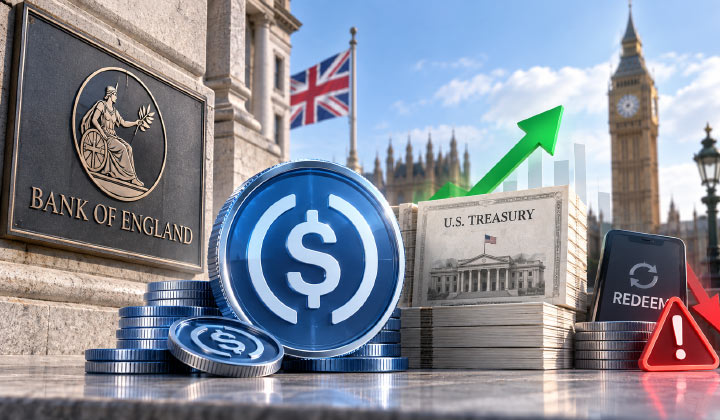
Dollar-backed stablecoins have grown to around $300 billion in circulation, and the Bank of England says their continued expansion could increase demand for US Treasuries while creating risks during periods of heavy redemptions. Carolyn Wilkins, an external member of the Bank of England’s Financial Policy Committee, said dollar stablecoins could strengthen the international role of the US dollar by making dollar-linked assets easier to access globally. She also warned that rapid withdrawals could force issuers to sell reserve assets quickly, potentially adding pressure to Treasury markets.
According to figures mentioned in Wilkins’ speech, 98% of stablecoin value is denominated in US dollars. As of mid 2026, stablecoin value was about $300 billion, having started at less than $5 billion at the beginning of 2020.

Source: bankofengland.co.uk
Stablecoins remain an integral part of crypto transactions, lending, and maintaining liquidity in the markets. However, their use is gradually expanding into payments and international money transfers. Because stablecoin transactions can operate around the clock, they may offer an alternative to traditional cross-border payment systems that rely on multiple banking institutions.
Wilkins pointed to the cost of international remittances as one area where stablecoins could potentially make a difference. Sending $200 across borders cost an average of 6.4% worldwide in 2024, while the average cost in Sub-Saharan Africa was around 8.5%.
The growth of dollar stablecoins also has a direct connection with the US government debt market. Issuers generally invest money received from customers in liquid reserve assets such as cash, short-term government debt and Treasury-backed repurchase agreements.
Research cited by Wilkins showed that Tether and Circle together held almost $150 billion in Treasury bills at the end of 2025. Their net purchases during that year were about $33 billion.
The impact is still relatively small compared with the overall Treasury market. However, stablecoin issuers are becoming meaningful participants in short-term US government debt markets. If stablecoin supply continues to grow, their purchases could add to demand for Treasury bills and put modest downward pressure on short-term yields.
The opposite could happen during a rush to redeem stablecoins. Issuers may need to raise cash quickly by selling reserve assets. If several large issuers faced heavy redemptions at the same time, Treasury sales could add to market pressure, particularly if liquidity was already weak.
Wilkins said the stablecoin sector is not yet large enough to pose a major threat to the Treasury market or create a material financial-stability risk in the UK. Still, she highlighted the importance of considering how a much larger stablecoin market could affect both payments and financial markets.
Stay informed with the latest trends in Web3, blockchain innovation, and cybersecurity updates at 3verseTV
You need to login in order to Like

















Leave a comment