


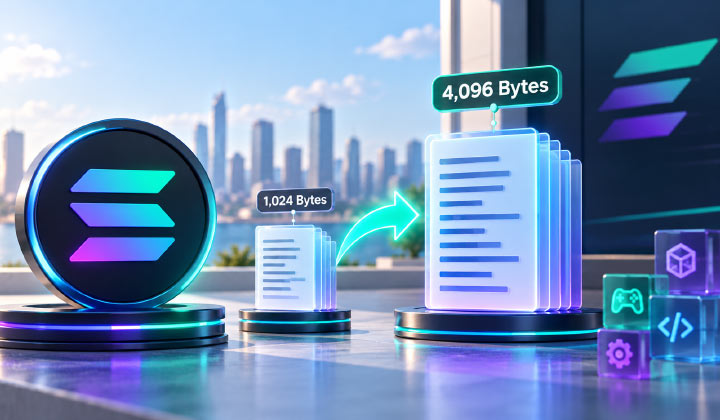
Solana is getting ready to raise the transaction size limit from 1,232 bytes to 4,096 bytes, which would let developers to incorporate instructions into a single operation more than three times.
The modification is currently operational on Solana’s test and development networks and is scheduled for Wednesday. Users might not notice the change right away. Wallets and apps won’t need to convert to the new format unless they need the extra capacity because existing transaction formats will still function. For developers, however, the upgrade could be significant.
Some operations that previously needed to be divided into several transactions could increasingly be handled in one. These include large cryptographic proofs, payments requiring several approvals and some confidential transactions. The change could also help Solana address one of the network’s structural limitations when compared with Ethereum.
Solana to triple transaction size as apps get room for more complex trades
The Solana smart contract blockchain is targeting Wednesday to increase the maximum transaction size from 1,232 bytes to 4,096 bytes, giving developers more than three times as much room to fit… pic.twitter.com/A3TNInOEdG
— Tony (@Crypto_Tony07) September 7, 2026
Solana has long been known for its high speed and relatively low transaction costs. But its transactions have been restricted by a hard size limit of 1,232 bytes.
Ethereum does not have the same rigid protocol-level transaction size limit. Developers can generally fit much larger amounts of data and instructions into a transaction, although doing so can cost more in fees.
By increasing its limit to 4,096 bytes Solana is trying to eliminate some of this bottleneck while maintaining the network’s transaction system’s efficiency. The new transaction format is referred to as Transaction v1. It is designed to allow larger transactions without forcing the entire ecosystem to abandon the existing format.
That compatibility is important because Solana has a large network of wallets, trading applications, explorers and other services.
However, some of the software supporting the network will need to be updated.
Services that retrieve blocks and transactions must understand the new v1 format. If they do not, they could fail when they encounter a larger transaction using the new system.
There is also a change in how some priority-fee information is stored. Priority fees are optional additional payments that users can make when they want their transactions processed more quickly.
Under v1, this information is stored differently. Software that has not been updated could therefore display a priority fee of zero even when the user actually paid one.
That may sound like a technical detail, but it matters because wallets and trading applications often depend on background services to show users what happened on the blockchain.
Another consideration is network bandwidth. Larger transactions contain more data, which means they consume more network resources.
Developers expect users sending larger transactions may sometimes need to offer higher priority fees when the network is busy. The upgrade, however, does not introduce a new fee based directly on the number of bytes in a transaction.
The original 1,232-byte limit dates back to Solana’s early networking design. At the time, transactions were designed to fit within roughly a 1,280-byte internet data packet.
Solana changed how transaction traffic is transmitted in 2022, making the old limit less necessary. The new 4,096-byte ceiling is intended to reflect the network’s current architecture more closely.
There is also a practical reason for stopping at 4,096 bytes. Four kilobytes corresponds to a standard memory-page size used by validator hardware.
Going substantially beyond that could require a transaction to span multiple memory pages, potentially making processing more expensive for the computers that run the Solana network.
The change is covered by two Solana Improvement Documents, SIMD-0296 and SIMD-0385, co-authored by Jacob Creech and Andrew Fitzgerald.
The upgrade is separate from recent Solana governance decisions involving the rate at which new SOL enters or leaves circulation through network fees.
The bigger goal is to give applications more room to perform complicated tasks in a single transaction.
For example, a transaction involving several approvals can become easier to manage if those instructions can be bundled together. The same applies to applications using larger cryptographic proofs or more complicated financial operations.
The change does not make every Solana transaction larger. Instead, it raises the maximum size available when applications actually need the extra capacity.
Should the adoption go smoothly, the developers will provide more flexibility without changing much on the part of the users in their wallets.
For Solana, this upgrade is yet another step towards enabling the network to accommodate increasingly sophisticated applications while preserving its emphasis on speed and efficient processing of transactions.
Stay informed with the latest trends in Web3, blockchain innovation, and cybersecurity updates at 3verseTV
You need to login in order to Like















Leave a comment