



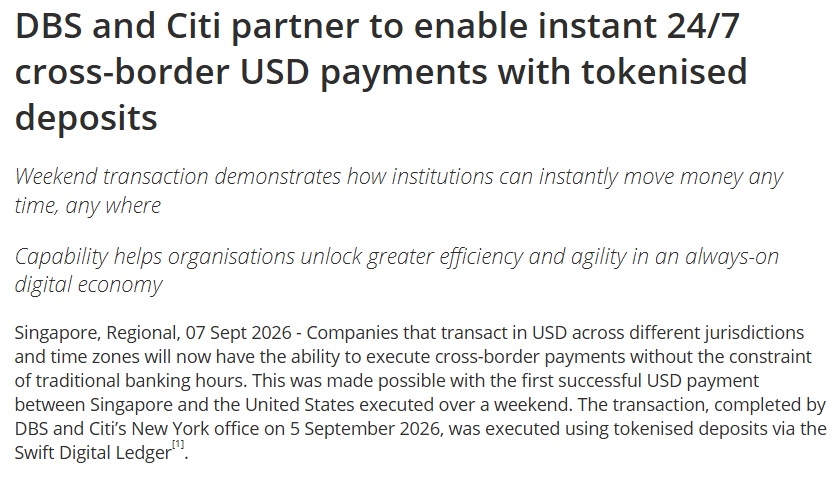
DBS and Citi have completed a cross-border US dollar payment over a weekend using tokenized deposits on Swift’s Digital Ledger, highlighting how blockchain technology could make international payments faster and available around the clock.
The transaction took place on September 5, between DBS in Singapore and Citi’s New York office. According to the banks, the payment settled within minutes rather than taking the one or two business days that can be common with traditional cross-border payments.
The test is the second confirmed live transaction on Swift’s blockchain-based ledger. In August, HSBC and Standard Chartered completed the first live cross-border transfer using the system.
The developments come as Swift, one of the world’s largest financial messaging networks, tries to adapt to a payments industry that is becoming increasingly digital.
Source: dbs.com
Swift’s network handles enormous volumes of international financial activity, but traditional cross-border payments do not always operate continuously. Weekends and holidays can create delays because banks and payment systems in different countries may not process transactions at the same time.
For a company moving money between Singapore and the United States, that can create a practical problem. A payment initiated on a Friday may not settle until the following Monday. For businesses operating digital platforms around the clock, even a short delay can affect supplier payments and leave working capital tied up.
Tokenized deposits offer one possible solution. They represent deposits held with banks in digital form and can potentially move across blockchain networks at any time.
DBS said its latest transaction demonstrates how an always-on payment system could address some of the limitations of traditional cross-border settlement.
The bank has also found that financial institutions are increasingly exploring blockchain technology. A global DBS survey found that half of finance leaders are looking at blockchain for areas such as liquidity and foreign-exchange management.
The potential market is substantial. Asia’s outbound cross-border payments are forecast to reach $24 trillion by 2033, almost twice the estimated $13.5 trillion recorded in 2025, according to figures cited by DBS from Money20/20 and FXC Intelligence.
That growth could increase demand for faster and more flexible international settlement systems. DBS is the only Asian-headquartered bank in Swift’s 12-bank digital ledger core design group. Swift launched the pilot in July with 17 banks from six continents.
The Digital Ledger is part of Swift’s effort to build blockchain capabilities into its existing financial infrastructure rather than leave the field entirely to newer digital payment networks.
This is becoming increasingly important as stablecoins and tokenized deposits offer settlement that can operate outside traditional banking hours.
The pressure is not only about speed. Financial institutions also need systems that can work with existing banking infrastructure while meeting regulatory and compliance requirements. Swift’s approach therefore seeks to combine blockchain-based settlement with the established network used by banks around the world.
LATEST: 🏦 Citi and DBS completed the first weekend cross-border dollar payment between Singapore and the US in minutes using tokenized deposits via Swift’s blockchain ledger. pic.twitter.com/dqNkoNXsrd
— CoinMarketCap (@CoinMarketCap) September 7, 2026
For DBS and Citi, the weekend transaction provides a practical demonstration rather than simply a technology experiment. The payment shows that a US dollar transaction between two major financial centres can be completed even when traditional banking systems are outside normal business hours.
The banks’ test also comes at a time when financial institutions are increasingly exploring tokenized money as an alternative to conventional payment processes.
Stablecoins have already demonstrated that digital dollar-like assets can move at any time. Tokenized bank deposits offer a similar always-on capability while remaining linked to the banking system.
Whether these systems become widely used will depend on regulation, interoperability and the willingness of banks and businesses to adopt them.
For now, the DBS-Citi transaction is another sign that blockchain-based payment infrastructure is moving beyond experiments and into real-world financial activity.
As cross-border payments continue to grow, the ability to settle money within minutes even on a weekend could become an increasingly important advantage.
Stay informed with the latest trends in Web3, blockchain innovation, and cybersecurity updates at 3verseTV
You need to login in order to Like

















Leave a comment