


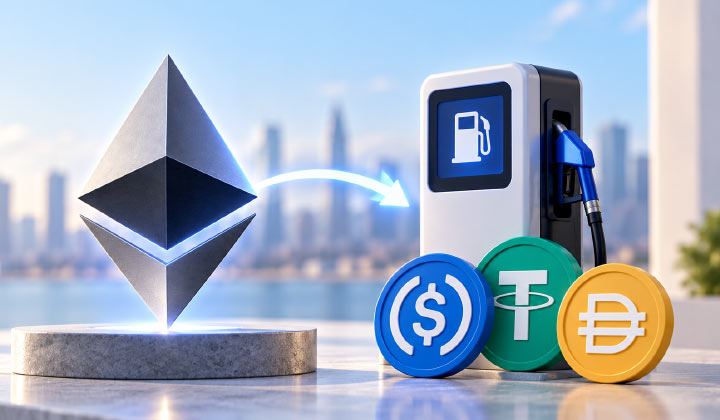
Ethereum developers are preparing for a major change in how users interact with the network. One of the key proposals for the upcoming Hegotá upgrade could make the need to keep a small amount of ETH for transaction fees much less important.
The proposal, known as EIP-8141 or Frame Transactions, has been included as a headline feature of the Hegotá upgrade, which is planned for 2027.
Stablecoins Could Be Used To Cover Gas Costs
Today, someone holding USDC or another stablecoin in an Ethereum wallet may still be unable to send those tokens if the wallet does not contain enough ETH to pay the gas fee. Frame Transactions are designed to address this problem by making fee payments programmable.
Under the proposed system, transaction authorisation, fee payment and execution can be handled as separate parts of a transaction. A payment application, for example, could charge a user in stablecoins while another wallet or service provides the ETH needed to pay the Ethereum network.
The Protocol Cluster has published two new posts:
Hegotá EIP Opinion Post and Tier List evaluates and grades all 62 EIPs proposed for Hegotá, providing the cluster’s first unified tier list for a network upgrade
Current and Emerging Priorities covers commitments and research… pic.twitter.com/GadgBb1xCK
— Ethereum Foundation (@ethereumfndn) September 7, 2026
This does not mean Ethereum will start accepting USDC directly as its protocol fee. The network will continue to charge its fees in ETH. Instead, a sponsor could pay the ETH fee and receive stablecoins from the user in return.
That could make Ethereum easier to use, particularly for people who do not want to maintain a separate ETH balance simply to move other digital assets.
Frame Transactions could also allow several actions to be grouped into one transaction. For example, a token approval and a swap could happen together. If the swap fails, the approval could also be automatically reversed.
The proposal brings another important change. Accounts could potentially change their authorisation rules without first moving their funds to another address. This could help users adopt new signature technologies and rotate cryptographic keys more easily.
Frame Transactions Get Top Priority For Hegotá
Vitalik Buterin is among the authors of EIP-8141, which was developed with nine other contributors. The proposal remains in draft form, so some details could still change before it reaches Ethereum mainnet.
The Ethereum Foundation has ranked Frame Transactions as an S-tier proposal, meaning it is considered one of the changes that defines the Hegotá fork. The other S-tier proposal is FOCIL, or Fork-choice enforced Inclusion Lists.
We’ve published the EF Protocol cluster’s priorities and our first shared Hegotá EIP tier list, with input from ~60 researchers and engineers across all 9 Protocol teams.
We’re aggressively targeting a quantum-resistant Ethereum L1 no later than December 2029. That has…
— Fredrik (@0xfredrik) September 7, 2026
The Foundation said both proposals will need extensive testing before they can be safely deployed. Around 60 researchers and engineers were involved in assessing 62 possible EIPs for the upgrade.
Hegotá will follow Glamsterdam, which is currently targeted for December 2026. Client teams could begin work on Hegotá towards the end of 2026.
But Hegotá is not only about improving Ethereum’s user experience. Frame Transactions are also connected to the network’s longer-term security plans.
Ethereum Targets Quantum Resistance By 2029
The Ethereum Foundation is targeting December 2029 for Ethereum Layer 1 to become resistant to quantum attacks across execution, consensus and data. The target is deliberately aggressive because it assumes that sufficiently powerful quantum computers could arrive as early as 2030.
The Foundation plans to reassess that assumption in January 2027 with input from outside experts.
The post-quantum work will cover different parts of Ethereum because the execution, consensus and data layers face different technical challenges.
Frame Transactions could help on the execution side by giving Ethereum greater cryptographic flexibility. In the future, accounts could potentially move away from the current secp256k1 signature system without requiring users to move their funds to new addresses.
Researchers are also examining the cryptographic systems Ethereum could use in a post-quantum environment. Earlier work considered specialised hash functions such as Poseidon, particularly because of their efficiency in zero-knowledge proofs. New developments in binary-field SNARKs, however, have made established functions such as SHA-2 and BLAKE more practical for some proof systems.
Broader Ethereum Roadmap
Ethereum’s broader long-term roadmap also includes faster finality, greater privacy, improvements to state management and further development of the zkEVM.
The Foundation has said Hegotá itself will remain relatively focused. Only two proposals—FOCIL and Frame Transactions—received the highest S-tier ranking.
For ordinary Ethereum users, the most visible change could eventually be the ability to interact with the network without worrying about having ETH available for every transaction. For developers, the upgrade could provide more flexible transaction structures and account security.
However, none of these changes are available on Ethereum mainnet yet. EIP-8141 is still being developed, and its final form will depend on further research, testing and implementation work.
Stay informed with the latest trends in Web3, blockchain innovation, and cybersecurity updates at 3verseTV
You need to login in order to Like

















Leave a comment