


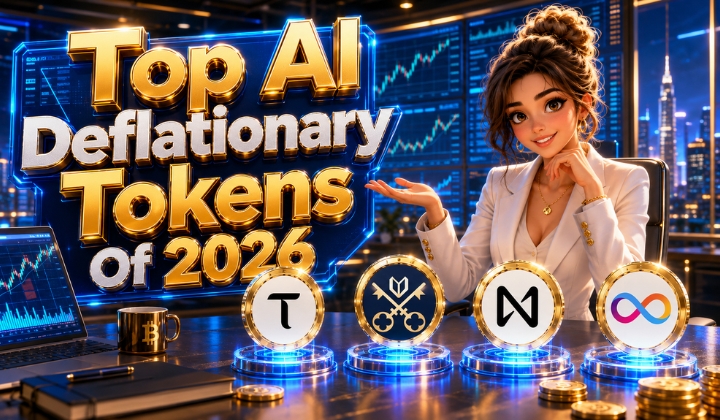
Artificial intelligence (AI) and blockchain are becoming increasingly connected as decentralized networks work on AI agents, computing power, data and machine intelligence. At the same time, AI crypto projects are experimenting with tokenomics designed to control supply and reduce inflation.
Bittensor, Venice AI, NEAR Protocol and Internet Computer are among the projects combining AI-related infrastructure with mechanisms such as supply caps, reduced emissions and token burns.
In this blog, we will dive into AI crypto projects with deflationary tokenomics, understand deflationary tokenomics and explore some of the deflationary AI crypto tokens, and AI crypto coins with token burn.
What Are AI Crypto Projects?
AI crypto projects combine AI with blockchain technology to create decentralized networks for AI applications and infrastructure. These networks have their own native tokens which can be used for payments, rewards, staking, governance as well as for accessing services.
Deflationary Tokenomics? What’s That?
Deflationary tokenomics refers to a token design where mechanisms are introduced to reduce the growth of token supply or permanently remove tokens from circulation.
But, how do token burns work in AI crypto projects? In AI crypto projects as well as cryptocurrencies, token burn is a popular mechanism. Here, tokens are permanently removed from circulation.
Another approach is reducing token emissions. This lowers the number of new tokens entering the market and can reduce inflation. What is the difference between deflationary and disinflationary AI tokens?
In Disinflationary AI tokens, new token creation decreases over time whereas in deflationary AI tokens, total circulating supply is actively reduced through permanent token burns. Both concepts manage token economics to build value but use different methods to control supply growth.
Which AI Crypto Projects Have Deflationary Tokenomics In 2026?
Do you want to know what are the best AI crypto coins with token burn mechanisms? If yes, here are a few projects.
1. Bittensor (TAO)
Bittensor is one of the most prominent decentralized AI networks in the crypto market. It allows independent subnets to create digital commodities such as machine intelligence, compute, inference, storage and prediction, with contributors earning TAO for their work. What makes Bittensor interesting from a tokenomics perspective is its fixed maximum supply of 21M TAO, similar to Bitcoin.
The network also uses halving mechanisms to reduce the rate at which new TAO enters circulation. Bittensor completed its first halving in December 2025, reducing emissions from approximately 7,200 TAO per day to around 3,600 TAO per day. This does not mean TAO is deflationary in the traditional burn-based sense.
Instead, its scarcity model is based on a hard supply cap and decreasing emissions. As more demand develops for decentralized machine intelligence, the combination of AI utility, limited supply and declining emissions could make TAO an important token to watch among AI crypto projects.
2. Venice Token (VVV)
Venice AI is focused on providing private AI services for users, including text, image, video, music, speech and other AI tools. Its VVV token is designed to connect the AI platform’s economic activity with token holders. VVV has introduced several mechanisms aimed at tightening its token supply.
Venice has reduced annual emissions over time and has also used token burns. In March 2025, Venice burned approximately one-third of the total VVV supply consisting of unclaimed airdrop tokens. The project has also introduced a programmatic buy-and-burn mechanism in which a portion of Venice’s revenue can be used to purchase VVV from the market and burn it.
This creates a direct connection between the platform’s business activity and its token supply. Venice has also continued reducing emissions, with annual emissions scheduled to fall further during 2026. The combination of lower emissions and revenue-linked burns gives VVV one of the more direct supply-reduction mechanisms among AI-related tokens.
3. NEAR Protocol (NEAR)
NEAR Protocol is another blockchain increasingly positioning itself around the AI economy, particularly AI agents and user-owned AI infrastructure. Its ecosystem aims to support applications and agents that can operate across blockchain networks. NEAR’s tokenomics has also gone through significant changes.
In 2025, the community supported a proposal to reduce the network’s maximum annual inflation by half, bringing it down from 5% to approximately 2.5%. The network also has a fee-burning mechanism. Transaction fees are paid in NEAR, with a portion of those fees being burned. As network activity increases, the amount of NEAR removed through fees can also increase.
The important point is that NEAR should not simply be described as permanently deflationary. Its tokenomics is better understood as a combination of reduced inflation and fee burns that can create stronger deflationary pressure as network usage grows. With AI agents and cross-chain applications becoming increasingly important, greater network activity could potentially strengthen this economic model over time.
4. Internet Computer (ICP)
Internet Computer is building blockchain-based infrastructure capable of hosting applications, services and AI workloads directly on-chain. Its tokenomics has received significant attention through Mission 70, an initiative targeting a reduction of ICP inflation by at least 70% by the end of 2026. The plan combines changes to rewards with mechanisms designed to increase the amount of ICP burned through network usage.
Internet Computer Protocol (ICP) uses “cycles” as fuel to run apps and store data. When you change ICP into cycles, that ICP is destroyed forever, or “burned.” This reduces the total supply of ICP and keeps network costs stable.
Mission 70 aims to increase network usage and strengthen the relationship between economic activity and token burning. The broader objective is to reduce inflation substantially while increasing the burn rate generated by actual usage of the Internet Computer.
This makes ICP particularly interesting because its potential supply reduction is linked to the growth of its blockchain infrastructure rather than depending only on an arbitrary token-burning event.
Should You Bet On AI Projects With Deflationary Tokenomics?
Deflationary tokenomics can make an AI crypto project more interesting, but it should not be the only factor considered before investing. A lower token supply can potentially create scarcity, but scarcity alone does not create value. There must be genuine demand for the underlying network, product or service.
For AI crypto projects, investors should look at real-world adoption, AI infrastructure, developer activity, network usage, token utility, revenue generation, emissions and the project’s competitive position.
It is also important to understand the difference between a hard supply cap, lower inflation and actual deflation. Bittensor relies heavily on its 21M supply cap and halving schedule, while Venice focuses more directly on emission reductions and burns. NEAR combines lower inflation with fee burning, while ICP is attempting to link lower inflation with increased network-driven burns.
Therefore, a deflationary or scarcity-focused tokenomics model can support a project’s long-term economic design, but it cannot guarantee price appreciation or investment returns.
Key Takeaway
AI crypto projects are evolving as blockchain networks increasingly provide decentralized computing, AI agents, machine intelligence and privacy-focused applications. However, deflationary tokenomics is only one part of the investment equation and you should consider adoption, network utility and activity along with long-term sustainability before making any investment decision.
Disclaimer: This content is for educational purposes only and is not meant to be financial advice. Please consult a financial advisor before making any investment decisions.
Stay informed with the latest trends in Web3, blockchain innovation, and cybersecurity updates at 3verseTV
You need to login in order to Like















Leave a comment