



Solana has taken another step toward its 200-millisecond slot target after reducing its network slot time from 300ms to 250ms. The latest activation, which went live on Sept. 18, lifts the targeted production rate to four slots per second, up from roughly 3.3 earlier.
Solana, a layer-1 blockchain network built to process decentralized applications and on-chain transactions, is progressing out the development through SIMD-0525.
Although slots are now being generated nearly 17% faster, the upgrade does not deliver a similar increase in overall processing capacity because calculation and data allowances are reduced alongside shorter slot times.
BREAKING: @Solana slot time has dropped to 250ms for the first time after the latest reduction under SIMD-0525 went live at epoch 1037.
The network has now reduced its target slot time from 400ms to 250ms, with 200ms as the final target. https://t.co/ANqvgY7kf9
— SolanaFloor (@SolanaFloor) September 18, 2026
Solana Slot Time Reaches 250ms
A slot represents the period during which a selected validator has an opportunity to produce a block. By shortening this interval, Solana can provide wallets, exchanges and trading applications with more frequent information about transactions and the latest state of the blockchain.
Validators continue to act as leaders for four consecutive slots. Under the earlier 300ms configuration, that gave each leader a minimal window of 1.2 seconds. With slots now targeted at 250ms, that window has been reduced to one second.
The shift is part of a steady transition under SIMD-0525 rather than a single move from Solana’s original 400ms setting directly to 200ms. The rollout was divided into four stages: 350ms, 300ms, 250ms and 200ms eventually. Each stage requires its own feature activation so developers and validator operators can observe how the network performs before moving to the next speed level.
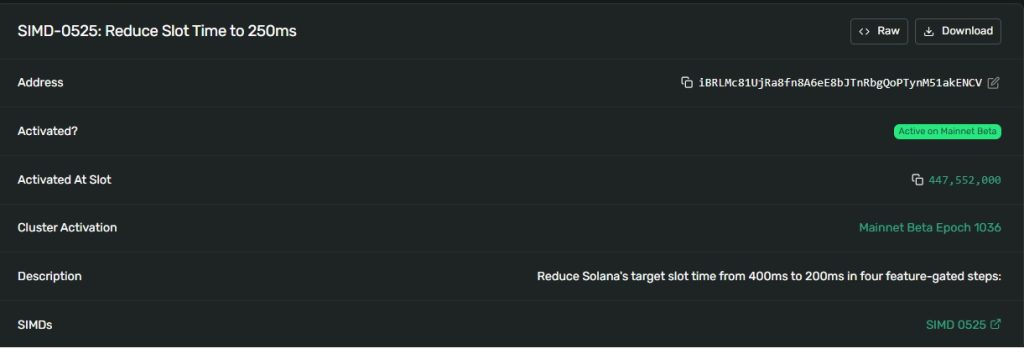
Source: solana.com
For users and applications, shorter slots mean network information can restore more often. That can be mainly relevant for oracle-driven markets and automated market makers, where outdated on-chain information can affect trading activity. Swaps may also benefit because there is less time between succumbing a transaction and seeing it progress through the network. However, the faster slot rate should not be cluttered with a nearly 17% increase in Solana’s raw transaction-processing capacity.
SIMD-0525 adjusts resource ceilings downward as each slot becomes shorter. The network therefore produces more slots over the same amount of real-world time, but each slot can carry less calculation and data. Under the proposal’s 60 million compute-unit baseline, the limit at 250ms stands at 37.5 million compute units per slot. At the proposed 200ms stage, it would fall further to 30 million.
Faster Blocks Change Solana Infrastructure Requirements
The upgrade also changes the workload for substructure operators. Even though Solana’s overall real-time processing ceiling remains approximately similar, providers now need to handle and store a larger number of specific blocks.
Applications that estimate intervened time by assuming a fixed relationship between slot numbers and slot duration may also need to adjust their systems. Blockhashes now expire sooner in real-world time because slots advance more rapidly. That can leave less time for transaction workflows involving late approvals or offline signing.
Epoch duration is altering as well. Solana maintains 432,000 slots in each epoch, so reducing the length of every slot certainly makes an epoch shorter. At the previous 300ms target, an epoch was expected to last around 36 hours. The new 250ms alignment reduces that estimate to approximately 30 hours. At 200ms, an epoch would fall to about 24 hours.
The staged slot-time reductions form part of the broader Agave 4.2 rollout. Agave is Solana’s chief validator software, developed by Anza, the development team responsible for maintaining and advancing the client used by network operators. The rollout has included several separately activated changes rather than requiring every upgrade to go live together.
✅ 400ms -> 350ms
✅ 350ms -> 300ms
✅ 300ms -> 250ms
📶 250ms -> 200msFaster
— Solana Developers (@solana_devs) September 18, 2026
SIMD-0525 also includes a safeguard linked to block-skip rates. If skipped blocks rise beyond levels developers consider acceptable, development toward the next slot-time setting can be paused. This gives validators time to operate under the current configuration before another drop is introduced.
Solana Upgrades Extend Beyond Faster Slots
Slot speed is only one element of the network changes associated with Agave. Solana has independently introduced Transaction V1, an elective transaction format that increases the maximum sequential transaction size from 1,232 bytes to 4,096 bytes.
The expanded format is designed to provide more room for data-heavy operations, including zero-knowledge proofs and compound multisignature instructions that may otherwise need to be divided across transactions.
Existing applications are not being forced to switch. Legacy and version-zero transactions remain supported, while developers can adopt V1 when they need the larger format. Services that read blocks, however, need to support the new transaction version so they can correctly process V1 activity.
Significantly, Transaction V1 and SIMD-0525 are separate upgrades. Increasing the maximum size of an individual transaction does not determine how quickly Solana produces slots, just as shorter slots do not automatically increase the maximum size of transactions. Solana is activating these changes independently through feature gates.
Solana Still Targets 200ms Slots
The final SIMD-0525 stage would reduce Solana’s target slot time from 250ms to 200ms. That would raise the targeted rate from four to five slots every second.
Because validators remain leaders for four consecutive slots, their insignificant leader window would fall again from one second under the current setting to unevenly 800 milliseconds. The expected epoch duration would also decline from about 30 hours to around 24 hours.
There is currently no announced mainnet date for the final 200ms reduction. Whether the network proceeds will depend on its performance at 250ms, including whether validators can continue operating while keeping block-skip rates within acceptable limits.
The slot-time initiative is also distinct from Alpenglow, Solana’s planned overhaul of its consensus system. Alpenglow is designed to replace TowerBFT with a voting mechanism called Votor while removing on-chain voting transactions from the core agreement process. The redesign is targeting finality of roughly 150 milliseconds.
Alpenglow code has already been included for testing, but its mainnet deployment is tied to the Agave 4.3 release rather than the feature gates controlling SIMD-0525. Community validators began testing the consensus design earlier in 2026, allowing operators to assess it before a mainnet rollout. Anza has described Alpenglow as the most significant consensus change in Solana’s history.
For now, Solana remains at the 250ms stage. Reaching 200ms would complete a phased excursion that began at 400ms and moved through 350ms, 300ms and 250ms, with network resource limits being familiar at each step.
Stay informed with the latest trends in Web3, blockchain innovation, and cybersecurity updates at 3verseTV
You need to login in order to Like

















Leave a comment