


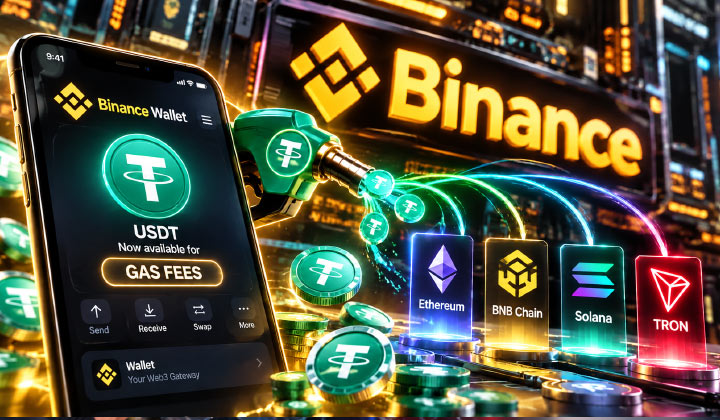
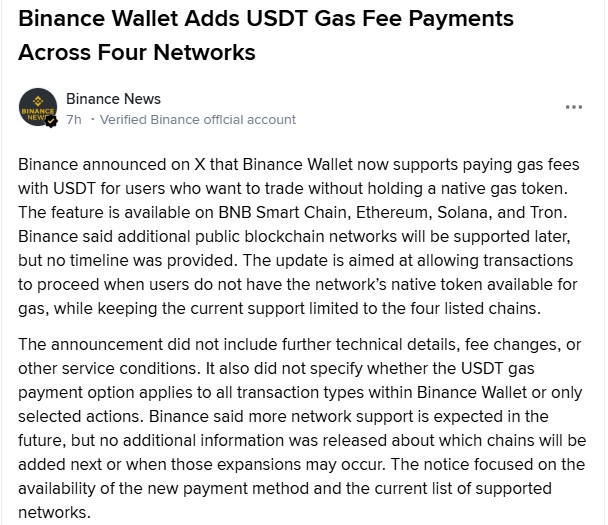
Binance Wallet has introduced a feature allowing users to pay blockchain gas fees in USDT on four networks, BNB Smart Chain, Ethereum, Solana and TRON. The change means users no longer need to hold the native token of each network simply to pay transaction fees when using supported transactions.
Previously, users generally needed BNB for BNB Smart Chain, ETH for Ethereum, SOL for Solana and TRX for TRON. Binance says more networks could be added later. The new option is designed to simplify transactions for people who already hold USDT but may not have enough of a network’s native token to cover gas.
No gas? No problem. ⛽
Don’t have enough of the network’s native token to cover gas? Binance Wallet now lets you pay gas fees with USDT directly from your wallet.
No need to stop and get BNB, ETH or TRX first. Just select USDT as your gas payment method and continue your… pic.twitter.com/bZMNrXbxba
— Binance Wallet (@BinanceWallet) September 25, 2026
Binance Wallet calculates the required network fee based on current blockchain conditions. The underlying blockchain fee, however, has not disappeared. Network validators or other participants still receive the charge needed to process the transaction.
Binance’s support documentation also makes clear that the network fee does not go to Binance. The company distinguishes blockchain gas charges from separate service fees that may apply to products such as swaps.
The actual cost can change depending on network activity. On Ethereum and other EVM-based networks, congestion can push fees higher as users compete for transaction processing. Lower network activity can reduce the amount required.
TRON has a different fee structure based on bandwidth and energy. Users can obtain these resources through mechanisms such as staking TRX or renting energy. When available resources are not enough, TRX may be burned to cover the remaining cost.
Source: Binance.com
For Binance Wallet users, the important change is therefore the payment method, rather than the removal of network fees. Users who do not have enough USDT in their wallet can also use eligible balances held in their Binance Exchange accounts. Binance lists BNB, USDT, USDC, ETH and SOL among assets that may be used through eligible Spot, Funding or Earn balances.
The wallet also provides other ways to obtain the required gas token, including transferring it from Binance Exchange, receiving it from another wallet or buying supported assets with a bank card.
Binance has separately introduced a promotion for USDT and other TRC-20 transfers on TRON. From September 23, eligible users can receive zero gas fees for qualifying transfers through Binance Wallet. The promotion is scheduled to run until December 22, 2026, subject to available campaign spots.
After the promotional period, Binance says qualifying transfers will receive a discounted fee of 1 USDT per transaction. The company continues to warn users to select the correct blockchain when moving assets between Binance and external wallets. Sending an asset over an incompatible network can result in funds becoming difficult or impossible to recover.
The latest feature is part of Binance’s broader effort to make its self-custody wallet easier to use. By allowing USDT to cover gas on multiple networks, the wallet removes one common hurdle for users who understand what they want to transfer but do not hold the native token needed to complete the transaction.
Stay informed with the latest trends in Web3, blockchain innovation, and cybersecurity updates at 3verseTV
You need to login in order to Like












Leave a comment