


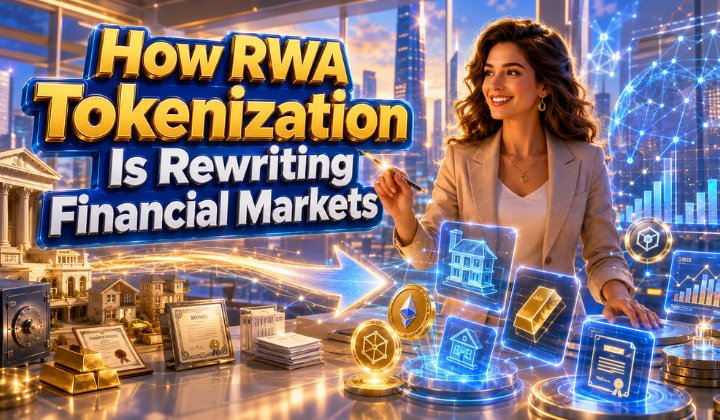
A Quiet Revolution In Ownership
Each generation tends to think it is experiencing a financial revolution. But history shows that real market changes rarely happen with big announcements or sudden shifts. Instead, they develop quietly and gradually, until the old ways just seem out of date.
Consider how information moved before the internet. Letters could take days or weeks to arrive. Newspapers decided what news reached the masses, but with advent and rapid adoption of the internet, things changed forever. The flow of information became faster and easier. In one generation alone, digital communication became very common, and what’s more, most people barely noticed the shift.
The world of finance, too, went through a similar transformation. Trading floors were replaced by electronic exchanges. Hard copy of share certificates turned into digital records. Banking activities shifted from busy branches to mobile apps. These changes made finance easier for people, but the systems behind the scenes remained the same. Trading in securities is still done through brokers, custodians, clearing houses and settlement agencies. Transactions are quicker for customers, but the process is not always simpler for the system.
This gap is hard to miss. Today, artificial intelligence (AI) can analyze markets in seconds and payments can cross global borders almost instantly. Yet, transferring ownership of a financial asset often still relies on systems created decades ago. Extra steps like reconciliation, paperwork and multiple middlemen still add cost, time and complexity.
Recently, the world’s largest financial institutions have started to embrace an idea that was once linked mainly to cryptocurrencies. Real World Asset (RWA) tokenization began as an experiment in blockchain communities, but it is now making its way into boardrooms, stock exchanges and regulatory talks.
Tokenization is more than just making a digital version of an asset. It is about changing how ownership is created, transferred and managed in a world that is more connected than ever.
The phrase ‘Click, Tokenize, Own’ might sound catchy, but it points to a big change. For years, technology has changed the way we communicate, shop and receive or exchange information. Now, it is starting to change how we own things. If this shift takes place, the most important story in blockchain will not be about Bitcoin. Instead, it will be about how financial markets are quietly being reinvented to become programmable, connected and driven by software.
From Speculation To Infrastructure
For most of the past decade, people saw blockchain mainly through the lens of cryptocurrencies. The main topics were rising prices, market crashes and the idea of decentralized money.
These trends made blockchain popular, but they also led many to think its main value was in creating new digital assets. Ironically, blockchain’s biggest impact might be something very different.
Rather than just creating new assets, blockchain is starting to change how existing assets are issued, owned and traded. Things like government bonds, money market funds, commercial real estate, private credit, and even commodities are slowly moving onto distributed ledgers.
The conversation around tokenization is fundamentally different from the excitement surrounding cryptocurrencies. The loudest voices today are no longer technology enthusiasts predicting the end of traditional finance. They are some of the world’s largest banks, asset managers and market infrastructure providers asking a far more practical question: Can financial markets function more efficiently? The answer is a resounding yes.
Unlike earlier blockchain experiments, RWA tokenization addresses a problem familiar to everyone in finance. While trading apps make buying and selling assets look easy, each transaction depends on a complicated process of clearing, settlement, reconciliation and record-keeping.
Every intermediary adds value, but also brings delays, costs and risks. Tokenization is about using a shared digital system where ownership records can move securely, transparently and almost instantly.
Blockchain is slowly moving away from the spotlight and becoming more of a background technology. Investors will just see faster settlements, more investment options and better transparency, without needing to know what technology is behind it.
When Ownership Turns Into Software
The term tokenization might sound as if finance is just changing from hard copy to its digital versions. However, this oversimplification misses the bigger picture. If digitization was only about making electronic copies of assets, interest in RWAs would have faded by now. Instead, excitement has grown because the industry now sees that tokenization is not changing the assets themselves; it is changing what those assets can do to your finance.
Think about how software has changed industries. Mobile phones were meant to be used only for calls. Now, they are cameras, wallets, navigation tools and entertainment centres because software made them flexible. Financial assets are starting to change in the same way. A bond is no longer just something that pays interest. On a blockchain, it can be programmed to automatically pay coupons, check investor eligibility, settle trades almost instantly and connect with other digital financial tools.
This is why the idea of “financial markets becoming software” is more than just a figure of speech. It shows a real change in how markets are built. Instead of many institutions updating records on their own, blockchain lets everyone use a shared, secure record of ownership. Pre-set rules can run automatically through smart contracts. Tasks like settlement, compliance checks, paying dividends, or managing collateral, which used to need separate systems, can now be built into the asset itself.
This vision is no longer just limited to topics of research papers or innovation labs. Some time back, the Depository Trust & Clearing Corporation (DTCC) processed live trades with tokenized securities. DTCC safeguarded more than $114 trillion in assets and handled about $4.7 quadrillion in securities trades last year. Nearly 40 major financial institutions, including BlackRock, JPMorgan, Goldman Sachs, Vanguard and the New York Stock Exchange participated. DTCC is now getting ready to launch its tokenization service.
This development matters not just because another blockchain project worked, but because it shows a shift in thinking. For years, blockchain companies tried to convince Wall Street to use decentralized finance. Now, Wall Street is choosing blockchain to update its own systems. The question has changed from “Should we use blockchain?” to “Where does blockchain add real value?”
The answer is more about reducing friction. Franklin Templeton says the tokenized RWA market has grown over five times since 2023. Tokenization projects now cover government securities, money market funds, ETFs, private credit and real estate. At the same time, a recent survey found that 84% of financial firms now see tokenization as a key priority, showing a move from testing to actually using it.
The biggest irony might be that blockchain’s real success will come when investors no longer notice it. Just like people send emails without thinking about internet protocols or use their phones without knowing how payment networks work, future investors may buy government bonds, join money market funds or invest in real estate without ever asking if the asset is tokenized.
The technology will fade into the background. What investors will notice is that transactions settle faster, ownership is easier to check and markets are more accessible than before.
The Next Financial Revolution May Be Invisible
Every major technology eventually becomes so much a part of daily life that we barely notice it. Most of us don’t think about the internet when we send an email or pay online; we just expect it to work quickly and securely. Blockchain could follow the same path. Instead of becoming a buzzword, it might fade into the background because people won’t need to talk about it.
This shift is a big change from blockchain’s early days. Back then, the focus was on cryptocurrencies, trading and the idea of decentralized money. In the coming years, the real impact may be quieter but more important: updating the world’s financial systems. Rather than replacing everything, tokenization is helping current systems work more efficiently, transparently and accessibly.
The changes go beyond just speeding up transactions or cutting costs. As ownership becomes programmable, financial products start to change, too. Bonds could pay out automatically, real estate could be split among investors worldwide, and private assets could open up to more people. Markets that used to be limited by location or institution may slowly become more connected, flexible and open to everyone.
This change won’t happen all at once. Rules, legal issues, technology compatibility and investor trust will all affect how quickly things move. If history is any guide, big changes in finance usually happen slowly. Electronic trading took years to replace old methods, and internet banking took decades to become normal. Tokenization will probably take a similar route.
Yet the direction appears increasingly clear. Around the world, governments are refining regulatory frameworks, central banks are experimenting with digital currencies, financial institutions are investing in tokenization platforms and market infrastructure providers are preparing for a future where digital assets coexist with traditional securities. These are not isolated developments; together, they point towards a gradual redesign of the financial system’s underlying architecture.
In the future, investors might buy government bonds, join private equity funds, or own part of a commercial property without ever wondering if the asset is tokenized. They’ll just expect fast transactions, clear ownership records and investments that move as easily as information does now.
When that happens, blockchain won’t have taken over financial markets; it will simply be part of their foundation. The phrase ‘Click, Tokenize, Own’ won’t just be a fintech slogan anymore; it will define how people would normally think about making their investments, and most probably, become the language of investing!
Disclaimer: This content is for educational purposes only and is not meant to be financial advice. Please consult a financial advisor before making any investment decisions.
Stay informed with the latest trends in Web3, blockchain innovation, and cybersecurity updates at 3verseTV
You need to login in order to Like











Leave a comment