


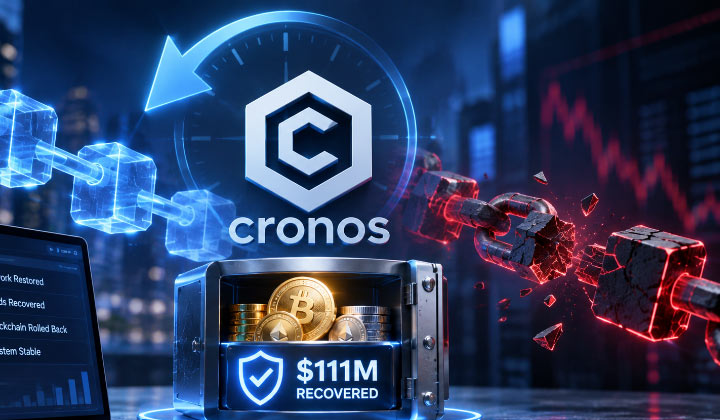
Cronos has confirmed that it rolled back its blockchain after an attack on lending platform Tectonic involved $120.4 million in borrowing activity. Validators reversed 10,961 blocks and recovered $111.2 million, or about 92% of the affected funds.
Cronos said the decision was taken after the attack, which manipulated the price of Tectonic’s TONIC token and allowed an attacker to borrow assets using inflated collateral. About $9.19 million, or 7.6% of the affected funds, left the network before the halt and remains unrecovered. The rollback has sparked fresh debate over blockchain finality and decentralization.
Cronos said the attack took place on August 30. The attacker deployed contracts that pushed the price of TONIC roughly 100-fold within minutes using thin decentralized-exchange liquidity. One transaction then used the artificially inflated token as collateral to borrow $120.4 million across nine lending markets.
LATEST: 🚨 Cronos published a post-mortem on the Aug. 30 Tectonic exploit, saying ~$111.2M of $120.4M in funds at risk was recovered when the chain was rolled back, with ~$9.19M stolen before the chain was halted. pic.twitter.com/UmbO7oynW4
— CoinMarketCap (@CoinMarketCap) September 8, 2026
Cronos halted the network around two hours after the suspicious activity. Validators eventually restored the chain to the block immediately before the attack. Block production resumed around 11 hours after the exploit.
The rollback reversed one hour and 54 minutes of blockchain history, covering 10,961 blocks. This meant that every transaction during that period was reversed, including transactions that had nothing to do with the attack.
That created a difficult situation for ordinary users and developers. Trades, transfers and smart-contract actions carried out during the affected period were also removed from the chain’s history. Cronos acknowledged that open positions on applications were repriced when trading resumed.
The decision also raises concerns for bridges and other applications that rely on Cronos transactions. Such applications may act on a transaction before a rollback takes place, creating additional complications if that transaction later disappears from the blockchain.
Cronos defended the move as a difficult decision made with its validators. The company said the alternative would have been to restart the network without restoring the earlier state, which would have left the borrowed assets in the attacker’s control.
The incident has renewed an old debate in the crypto industry about whether blockchains should ever rewrite their history. Harmony previously announced a similar rollback plan after an attack involving more than 3 trillion ONE tokens. Flow, however, abandoned a proposed rollback following a $3.9 million exploit after concerns that changing the chain’s history would undermine decentralization.
The Tectonic attack also comes as TONIC remains deeply below its recent high. With a market capitalization of over $3.1 million, TONIC was trading at about $0.0000000125 at the time of writing, up 1.22% over the previous day.
Because Cronos can only have 100 validators, the network was able to coordinate the halt and resume quite fast. The rollback showed that blockchain finality on Cronos may be bypassed through validator cooperation in an emergency, even though it allowed the recovery of the majority of the impacted cash.
Stay informed with the latest trends in Web3, blockchain innovation, and cybersecurity updates at 3verseTV
You need to login in order to Like

















Leave a comment