


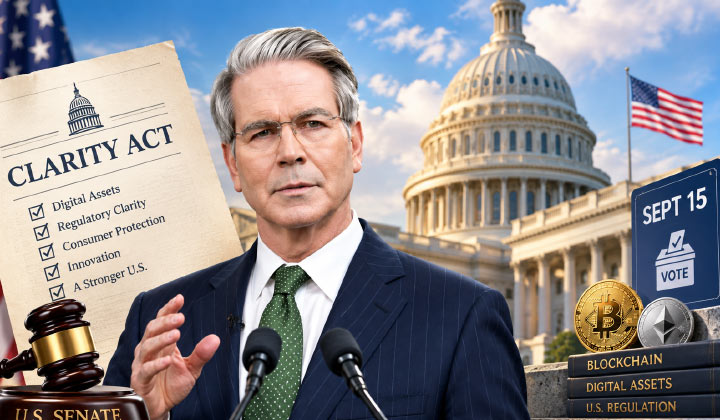
US Treasury Secretary Scott Bessent is urging the Senate to move forward with the CLARITY Act ahead of the crucial September 15 vote, warning that failure could cost the US important crypto-related security tools. At the same time, Coinbase CEO Brian Armstrong says the US crypto industry is likely to get regulatory clarity even if the CLARITY Act fails to clear the Senate. Armstrong said the SEC and CFTC are already prepared to issue rules, making September 15 an important date but not necessarily a make-or-break moment for crypto regulation.
Bessent made his appeal on X on September 9, asking senators to support the motion to proceed and continue negotiations. He argued that abandoning the legislation would send a damaging message about America’s willingness to lead in digital assets and could mean giving up enhanced national security tools to tackle their misuse.
In July, I called on the Senate to advance the Clarity Act — a bill to establish a comprehensive regulatory framework for digital assets and upgrade our ability to prevent bad actors from exploiting these critical technologies.
When the Senate returns from August recess, I…
— Treasury Secretary Scott Bessent (@SecScottBessent) September 9, 2026
The September 15 vote is a cloture vote on the motion to proceed to H.R. 3633, the Digital Asset Market Clarity Act. It is not a final vote on the legislation. If the vote is successful, the Senate can proceed to floor debate; if it is unsuccessful, the bill’s current course will be terminated. If all senators vote along party lines, at least seven Democrats would need to approve cloture because Republicans control 53 Senate seats.
Speaking on CNBC’s Squawk Box Asia, Armstrong provided a more sobering analysis of the circumstances. He said that if the bill passes, the industry would get durable legislation, but if it fails, the SEC and CFTC are still expected to publish regulatory rules. He said regulatory clarity could therefore arrive around September 15 or within a day or two afterwards.
The CLARITY Act would establish a clearer division of responsibilities between the SEC and CFTC. Under the proposed framework, the SEC would oversee digital assets treated as securities, while the CFTC would regulate decentralised digital commodities such as Bitcoin.
Armstrong said Coinbase’s earlier “must-have issues” had been resolved and that the remaining major dispute involved ethics rules for elected officials holding digital assets. Republicans have proposed restrictions on officials issuing or sponsoring crypto tokens, while Democrats are seeking stronger measures, including possible divestiture requirements.
There are still debates around stablecoin incentives and DeFi. Attempts to obtain the 60 votes required for cloture may be hampered by these outstanding difficulties.
Important phases of the law have already been passed. The Senate Banking Committee advanced its version of the bill by 15-9 in May 2026, while the House passed it 294-134 in July 2025. Since the House is anticipated to have a constrained agenda later in September, supporters now face a tight legislative timeline.
Bessent’s latest intervention also marks a change in emphasis. Earlier calls for the CLARITY Act focused mainly on creating a market-structure framework. His latest argument puts national security at the centre of the debate. Former Pentagon chief Mark Esper has also made a similar case, suggesting that national security concerns are gaining importance in the push for crypto legislation.
The Senate should listen to @SecScottBessent!
It’s time to pass this strong, bipartisan bill which will protect consumers, help our law enforcement officials, and keep this growing industry based in America. Let’s send the Clarity Act to President Trump’s desk. https://t.co/oZaB73dx7K
— Senator Cynthia Lummis (@SenLummis) September 9, 2026
Senator Cynthia Lummis has backed Bessent’s appeal, saying the legislation could protect consumers, support law enforcement and help keep the digital-asset industry in the US. She has also warned that failure could allow countries such as Singapore and the UAE to take the lead in digital-asset rulemaking.
Law enforcement support has strengthened as well. The National Sheriffs’ Association has moved from opposition to a neutral position, while Lummis has highlighted a proposal to allocate $150 million to track crypto scammers.
The crypto industry is also pushing lawmakers to act. Ripple executives Stuart Alderoty and Brad Garlinghouse have urged senators to listen to crypto users and complete the legislation. SEC Chair Paul Atkins and other industry and financial leaders have also expressed support for advancing the bill.
However, Armstrong’s comments highlight an important distinction between legislation and regulatory rules. Agency rules could be introduced more quickly if Congress fails to act, but they could also be easier for a future administration to change or reverse. A law, by contrast, would provide a more durable framework for the industry.
Meanwhile, Treasury is moving ahead with separate stablecoin regulations under the GENIUS Act. This suggests that US digital-asset policy is advancing on several fronts even as the fate of the CLARITY Act remains uncertain.
For crypto investors, September 15 will therefore be an important test, but not necessarily a simple yes-or-no moment for regulatory clarity. The bigger question may be whether the industry receives that clarity through a durable law passed by Congress or through rules issued by federal agencies.
Stay informed with the latest trends in Web3, blockchain innovation, and cybersecurity updates at 3verseTV
You need to login in order to Like
















Leave a comment