


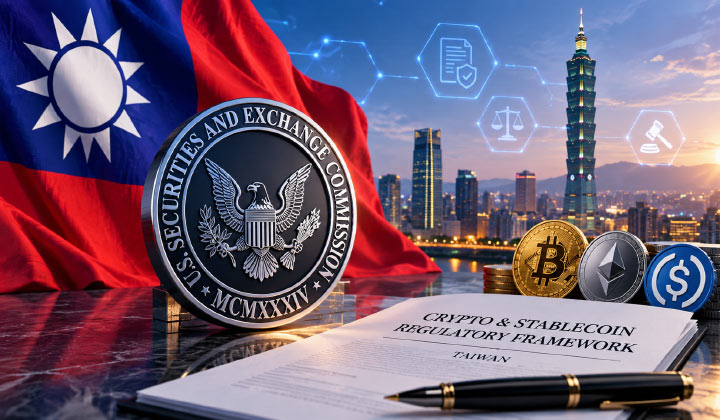
Taiwan’s Financial Supervisory Commission is moving to formalize oversight of the island’s digital asset industry, with new stablecoin rules potentially taking effect as early as the first quarter of 2027.
FSC Chairman Peng Jinlong confirmed on September 2 that regulators are drafting nine subsidiary regulations under the country’s Virtual Asset Service Act, a legislative framework covering everything from customer protection to cybersecurity and financial reporting standards.
Stablecoin issuers precisely will face a dual approval process requiring sign-off from both the FSC and Taiwan’s central bank, alongside stringent requirements around preserving full reserve backing.
The timeline positions Taiwan among a growing list of Asian jurisdictions moving authoritatively toward structured digital asset supervision.
BREAKING: 🇹🇼 Taiwan is working on detailed rules for its new stablecoin framework, with implementation targeted for Q1 2027.
MASSIVE for crypto adoption in Asia!
— Crypto Rover (@cryptorover) September 3, 2026
FSC Drafts Nine Rules Under Virtual Asset Service Act
Taiwan’s legislature passed the Virtual Asset Service Act in its third reading back on June 30, establishing an official licensing structure for virtual asset service providers operating within the country. The FSC is now filling in the operational details needed to actually impose that law, with stablecoin-specific rules forming a core part of the package.
Under this emerging framework, crypto businesses spanning exchanges, trading platforms, transfer providers, custodians, underwriters, and lending operations will all need FSC approval to legally operate, and firms currently working under Taiwan’s older anti-money laundering registration system will need to transition into the new licensing regime.
Stablecoin issuers face additional scrutiny beyond that baseline, needing to hold reserve assets in trust while meeting defined audit and disclosure obligations, building on groundwork the FSC first laid out in a draft proposal released back in March 2025.
Semiconductor Industry Sees Cross-border Payment Use Case
This regulatory push isn’t happening in a vacuum. Taiwanese financial institutions and industry bodies have increasingly been exploring stablecoins as tools for cross-border payments and corporate treasury management.
Lu Chaoqun, executive director of the Taiwan Semiconductor Industry Association, pointed to the volatile growth of artificial intelligence as a major driver behind rising demand across Taiwan’s semiconductor supply chain.
Given that Taiwanese manufacturers handle roughly 90% of global AI server assembly and account for close to 76% of worldwide semiconductor foundry revenue, Lu noted this creates enormous cross-border payment and trade financing flows, precisely the kind of continuous, round-the-clock activity that traditional banking hours and settlement timelines struggle to accommodate.
He described stablecoins, blockchain, and fintech infrastructure as increasingly essential for managing that kind of international trade finance and corporate cash flow.

Source: money.udn.com
Cathay Financial Explores Stablecoin & Custody Opportunities
Traditional financial institutions across Taiwan are similarly evaluating where digital assets might fit into their existing service offerings. Sun Chih-te, senior executive vice president at Cathay Financial Holdings, a major Taiwanese financial conglomerate, said stablecoins and digital assets have moved noticeably closer to becoming mainstream priorities for established banks.
Cathay is currently evaluating opportunities spanning stablecoins, digital asset custody, cross-border payments, and tokenization, along with potential extensions into lending, trading, insurance, and wealth management.
Sun highlighted cross-border payments specifically as one of the more likely areas for near-term adoption, though he cautioned that regulatory clarity, market scale, and customer experience all remain significant hurdles still needing to be addressed, particularly given that any cross-border stablecoin system will require coordination across multiple regulatory jurisdictions.
Cross-border Coordination Remains A Key Regulatory Hurdle
Beyond stablecoin-specific rules, Taiwan is also strengthening broader digital asset infrastructure. The FSC proposed expanded Travel Rule requirements back in August, adding stricter identification obligations for virtual asset transfers exceeding NT$30,000, with plans to extend that framework to cover transfers between Taiwanese and international virtual asset service providers by the end of 2027.
That signals the regulatory challenge here extends well beyond simply approving and monitoring stablecoin issuers, touching on cross-border reserve management, redemption mechanics, and technology standards that all need to function coherently across different legal systems.
Wang Li-ling, chairwoman of the Taiwan FinTech Association, emphasized that a stablecoin’s real value ultimately rests on the trust underpinning its stability, while suggesting that programmable payments combined with blockchain and AI could eventually bring financial transactions much closer to physical supply chain operations, potentially enabling automated payments triggered by predefined conditions and faster liquidity management across borders.
Q1 2027 Timeline Would Mark Formal Framework Launch
Assuming the FSC’s timeline holds, these subsidiary regulations would represent the critical bridge between Taiwan’s newly passed legislation and actual, functioning digital asset oversight, with the first quarter of 2027 potentially marking the true beginning of structured regulatory enforcement across the country’s crypto and stablecoin markets.
Financial institutions and technology firms are already actively exploring potential use cases, particularly around cross-border payments and asset tokenization, though how effectively this framework performs will ultimately hinge on implementation clarity and whether it can move digital asset services beyond limited pilot projects into genuine commercial scale.
Stay informed with the latest trends in Web3, blockchain innovation, and cybersecurity updates at 3verseTV
You need to login in order to Like

















Leave a comment