



- Solana is working on making block times shorter aiming for 200 milliseconds. This will make the blockchain produce blocks often.
- The update is meant to raise the number of blocks created each second from 2.5 to five.
- The last part of this change finishes a set of slot-time cuts that started in August 2026.
Solana is targeting 200-millisecond block times in its final upgrade scheduled for October 9. The change would halve the network’s target block time from 400 milliseconds, allowing it to produce blocks twice as frequently.
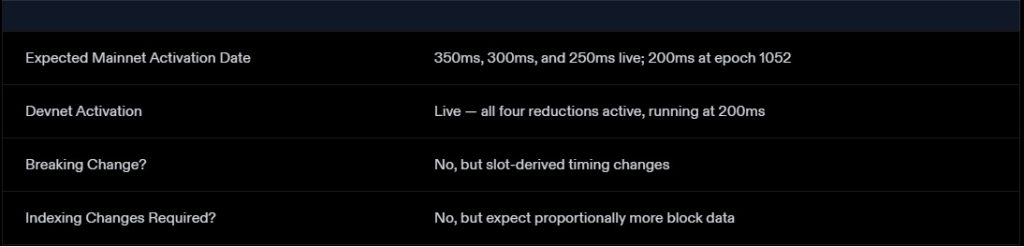
The upgrade is expected to take effect at epoch 1053 around 15:00 UTC, according to Anza, the developer behind Solana’s Agave validator software. Once activated, the network will target five block-production opportunities per second, up from 2.5, under its configuration.
“Just in the last few months Solana has actually gotten twice as fast as it used to be. And we don’t mean that in transactions per second, but in the amount of time it takes a transaction to finalize.”
200ms 🔜
– @Austin_Federa, co-founder, @DoubleZero at Solana Summit Korea https://t.co/hWZLL0tReq
— Solana (@solana) October 7, 2026
This change could help traders, wallets, exchanges, and decentralized applications receive frequent transaction updates. However, faster block production does not automatically guarantee transaction finality or better real-world performance.
Solana Cuts Block Times In 4 Stages
On August 21, Solana began to decrease its desired slot time from 400 milliseconds to 350 milliseconds. On August 28 and September 18, the network lowered the goal to 300 and 250 milliseconds, respectively. The final reduction to 200 milliseconds will complete the seven-week rollout of SIMD-0525, a Solana improvement proposal designed to reduce slot times.
Under the new configuration, each block will have a maximum compute budget of 30 million compute units, down from 37.5 million at 250 milliseconds. This allows blocks to arrive more frequently while keeping the network’s theoretical processing capacity roughly unchanged.
Faster Blocks Could Change Crypto Trading
Shorter time slots mean validators have time to organize transactions during their block-production periods. Validators create blocks in groups of four back-to-back slots, which means their continuous time window will go down from 1.6 seconds in the setup to 800 milliseconds.
Source: Solana.com
The smaller window might make it harder to take advantage of price differences between exchanges because transactions will be delayed. But the real effect will rely on how the network’s working, how well the validators are performing, and how the trading apps handle transactions.
Validators & Wallets Face New Challenges
Validators that vote on every slot will need to submit votes more frequently, potentially increasing voting costs and putting additional pressure on network connections.
Wallets and other applications may also need to adapt to shorter blockhash validity windows. This could make transactions requiring manual approval or offline signatures more difficult to coordinate.
Stay informed with the latest trends in Web3, blockchain innovation, and cybersecurity updates at 3verseTV
You need to login in order to Like
















Leave a comment