


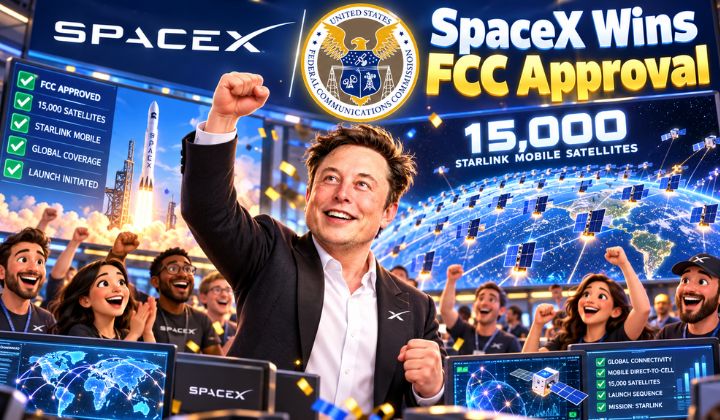
- The FCC approved SpaceX’s application on October 6, allowing up to 15,000 direct-to-device Starlink Mobile satellites that connect to standard phones.
- The V2 satellites are said to offer more than 100 times the bandwidth of current Starlink Mobile satellites, and will operate in nine orbital shells at 326–335 km.
- SpaceX has agreed to acquire 800 MHz low-band spectrum (up to 14 megahertz paired), but the deal still needs final regulatory approval.
- AT&T, Verizon and T-Mobile shares fell around 7%, while SPCX plunged 4.18% to $160.57 despite Barclays’ Overweight rating and $254 mark.
SpaceX, the Elon Musk-led rocket and satellite corporation behind the Starlink internet service, has received approval from the Federal Communications Commission (FCC) to launch 15,000 Starlink Mobile satellites. The FCC, the US regulator that manages communications networks, signed off on October 6. The satellites are manufactured to connect straight to regular phones, and SpaceX plans to use them to contend with AT&T, Verizon and T-Mobile, the country’s biggest wireless carriers.
SpaceX wins FCC approval to use extended L-band spectrum outside the USA.
This is part of the FCC’s broader approval for SpaceX’s constellation of up to 15,000 Direct-to-Cell satellites.
This gives SpaceX more spectrum options for international satellite mobile services. The additional spectrum could increase capacity and help connect more compatible devices in remote areas, supporting messaging, voice and data beyond the reach of cell towers.
The authorization covers two 7 MHz blocks: 1518–1525 MHz for satellite-to-Earth signals and 1668–1675 MHz for Earth-to-satellite signals.
Another step toward expanding Starlink’s mobile connectivity worldwide.
— DogeDesigner (@cb_doge) October 7, 2026
FCC Clears Next-generation Direct-to-Device Network
The approval covers SpaceX’s next-generation direct-to-device system. Under the authorization, up to 15,000 satellites can go into orbit and talk to standard mobile phones without any special hardware.
We announced an agreement to acquire a nationwide low-band spectrum license portfolio that will pave the way for @Starlink to become a major mobile carrier in the US.
With this new spectrum and our Gen2 constellation, Starlink Mobile can ensure Americans have access to high-speed mobile broadband no matter where they are → https://t.co/1Uaf48v5pm
— SpaceX (@SpaceX) October 8, 2026
SpaceX says its new V2 satellites will offer over 100 times the bandwidth of the current Starlink Mobile satellites. The FCC also granted additional backhaul frequencies, which let the satellites link back to Starlink’s existing network of ground gateways.
The fleet will be spread across nine orbital shells, at heights between 326 km and 335 km. Not every request went through, though. The regulator put some spectrum requests on hold and placed limits on others that it did grant.
800 MHz Spectrum Deal Aims At Indoor Coverage
On the same day, SpaceX announced an agreement to buy nationwide low-band spectrum licenses in the 800 MHz range. The package comprises up to 14 megahertz of paired spectrum. The buying still needs final regulatory approval, so it has not closed.
Low-band frequencies travel further and pass through walls more effortlessly. If the deal is completed, Starlink Mobile signals could reach phones inside buildings and in places where satellite coverage is weak. SpaceX intends to pair the new spectrum with the 2 GHz spectrum it already holds and a terrestrial mobile network.
Markets reacted quickly. Shares of AT&T, Verizon and T-Mobile dropped about 7% during trading. The source notes that deployment and commercial service timelines are still subject to development, so no launch date for the mobile service has been set.
SPCX Slips Despite Barclays’ Bullish Call
SpaceX’s own stock, trading under the ticker SPCX, was down about 4.18% at $160.57 at the time of reporting. It progressed between $160.20 and $167.92 during the session.
The dip came even as Barclays, the British bank, started coverage of the stock with an Overweight rating and a $254 price target. That target implies roughly 58% upside from the current price. Mizuho and Morgan Stanley have also issued positive ratings on the stock.
Musk Talks Up Long-term Value
Musk also commented on the news on X. He said he sees a path for SpaceX to be worth “orders of magnitude more” than the current Earth economy.
Stay informed with the latest trends in Web3, blockchain innovation, and cybersecurity updates at 3verseTV
You need to login in order to Like
















Leave a comment