


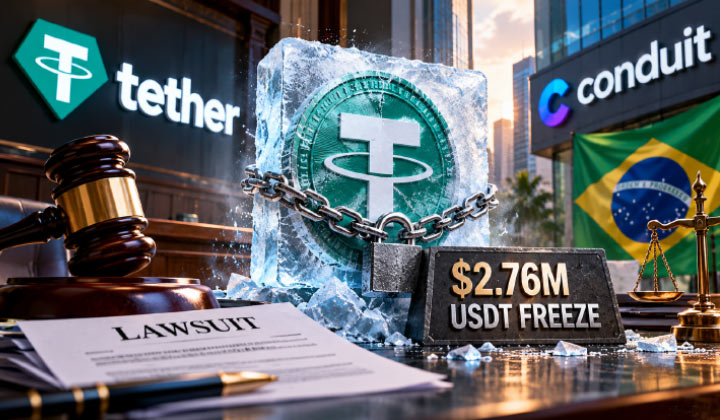
- Tether was sued by Conduit Technology for holding frozen USDT worth about $2.76 million in its Treasury wallet.
- Conduit links the dispute to a criminal probe in Brazil involving other corporations, claiming Tether locked the wallet without providing an explanation.
- Conduit is requesting access to its money, damages, and other relief in the case, which contests Tether’s authority over USDT.
Conduit Technology has started a case against Tether, the company that makes the USDT stablecoin, in New York. The legal paper was submitted on October 5 in the U.S. District Court for the Southern District of New York.
Conduit claims that Tether locked its treasury wallet on September 24 2025, and did not say why. The company is now seeking access to the frozen USDT and damages through the lawsuit.
The company claims this freeze disrupted its operations and caused damage. It is seeking compensation for the losses incurred. Since then, Tether has not let Conduit Technology use the wallet again. Conduit Technology wants its money back, at least $2.76 million, in damages and other relief.
Conduit Challenges Tether’s USDT Freeze
According to the complaint, Conduit created the wallet in May 2025 to hold working capital. The company says it was separate from customer transaction wallets and controlled exclusively by its treasury team.
Conduit claims the wallet processed 4,427 transactions involving 78 counterparties and more than $1.1 billion in transaction volume before the freeze.
The company says repeated requests for an explanation did not resolve the issue. It claims a formal demand from its lawyers in August 2026 also failed to restore access to the funds.
Brazilian Investigation At Center Of Dispute
The lawsuit involves a Brazilian criminal investigation into other companies, including Onix Intermediações Ltda. and Bull Intermediação de Negócios Ltda.
Conduit says it had no connection to the entities under investigation and that its wallet was never used by Onix. It also claims the wallet was created nearly a month after Onix’s final transaction through Conduit’s platform.
The complaint alleges Brazilian authorities identified specific wallets connected to the investigation and provided those addresses to Tether’s T3 Financial Crime Unit. Conduit says its wallet was not among them.
The company further claims that a Brazilian criminal court determined that Conduit was not among the companies under investigation or those whose assets were ordered frozen.
Conduit Says Freeze Hurt Business
Conduit alleges the frozen USDT represented a significant portion of its working capital, limiting its ability to pre-fund and settle customer transactions.
The company says the resulting liquidity constraints reduced transaction volumes and contributed to layoffs and office closures. It is seeking compensatory and consequential damages, along with legal costs and other relief.
Lawsuit Puts Tether’s USDT Controls Under Scrutiny
The complaint also challenges Tether’s ability to freeze USDT held in external wallets. Conduit says that Tether wrongly got involved with its property and used control that was not allowed by law.
The lawsuit has charges, about taking property, getting money without a reason, breaking trust duties and using computers in a way. Conduit is also asking the court to say that Tether does not have the right to stop its USDT and to tell the wallet to be unlocked.
Stay informed with the latest trends in Web3, blockchain innovation, and cybersecurity updates at 3verseTV
You need to login in order to Like














Leave a comment