


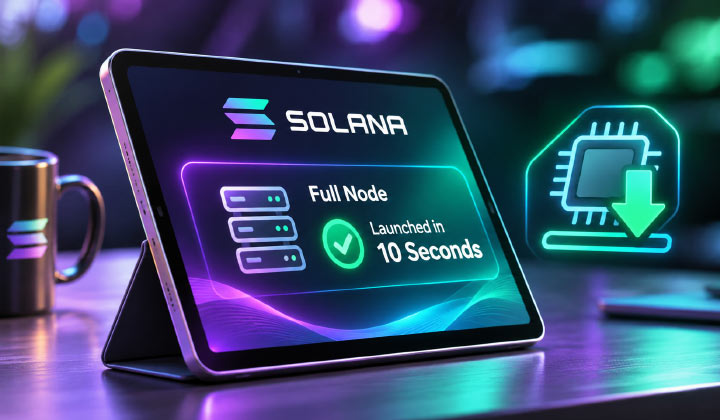
- A developer has successfully run a Solana mainnet node on a tablet, with the device syncing to the latest block in around 10 seconds.
- The experiment used less than one CPU core and a 5G internet connection.
- The demonstration has renewed discussions about reducing hardware requirements and making blockchain networks more accessible.
Solana Node Can Run On A Tablet
The blockchain has gained attention after developers showed how a full node can be run on a tablet, with the tablet syncing to the latest data on the blockchain in a matter of 10 seconds. This was achieved by utilizing Firedancer, an alternate validator software created for Solana.
@TrustlessState @mryalamanchi @toghrulmaharram @mikebelshe We did it @TrustlessState; sol is money
— toly 🇺🇸 (@toly) November 15, 2026
“We did it.” Anatoly Yakovenko, a co-founder of Solana, expressed his enthusiasm on November 15th 2026.
“We used a tablet connected via 5G, and it took about 10 seconds to sync to the latest block,” said Ritchie Patel, a developer working on Firedancer. This proves that the software can be run with less than one CPU core. Typically, blockchain nodes require strong computers.
Reducing Hardware Requirements
This has sparked a conversation regarding how we can make blockchain networks more accessible by reducing the hardware requirements. Blockchain nodes help keep the network running by verifying transactions. Validator nodes have the extra responsibility of helping verify them.
If the hardware required to run a node is expensive then it may be difficult for regular users to get involved. This will also create reliance on larger operators. Firedancer is a validator client being developed by Jump Crypto to improve the speed and efficiency of Solana.
Limitations
The developers had to take a snapshot of the blockchain meaning the tablet had to sync to the latest state of the blockchain but didn’t have to download all the transaction history. It also wasn’t shown how well it would perform if it was constantly being used when there was a lot of activity on the blockchain.
Powerful Computers Are Still Required For Production Validators
Although it is positive to see that you can run a blockchain node on a tablet, it doesn’t mean that all Solana validators can just switch to cheap hardware.
Typically, production validators require much more powerful hardware. Anza, a Solana infrastructure and engineering company recommends having 12+ CPU cores, 256GB of RAM, fast storage and high-speed internet.
This is because it was only a short test in a controlled environment. While Yakovenko has admitted that Solana hasn’t always placed emphasis on having the minimum hardware requirements, this has now become a key point.
This shows a key challenge for blockchain networks to become faster and more efficient without becoming too expensive for regular users to get involved. If developers can achieve this then in the future it may become easier to run blockchain infrastructure.
Stay informed with the latest trends in Web3, blockchain innovation, and cybersecurity updates at 3verseTV
You need to login in order to Like

















Leave a comment