


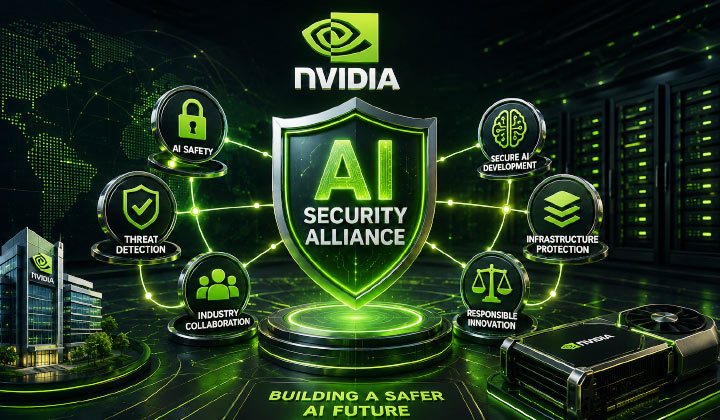
In an effort to develop open-source tools to enhance AI security, Nvidia has partnered with 36 top tech firms to form the Open Secure AI Alliance (OSAA). Notably, the partnership, which consists of firms like Microsoft, IBM, Red Hat, Cloudflare, CrowdStrike, Palantir, and Hugging Face, does not include OpenAI, Google, or Anthropic. The group claims that by improving the transparency and ease of inspection of AI security solutions, it would assist organizations in better detecting, investigating, and responding to cyber attacks.
After a recent cybersecurity problem using Hugging Face brought attention to the difficulties of utilizing closed AI models during security investigations, the partnership was revealed. Nvidia claims that closed AI systems have trouble differentiating between attackers and defenders, which made forensic investigation more challenging when responding to the incident.
To overcome this limitation, Hugging Face reportedly relied on GLM 5.2, an open-weight AI model developed by Chinese company Z.ai, to analyze more than 17,000 system actions and help contain the attack. Nvidia said the incident demonstrated why organisations need AI models that they can inspect, modify and operate on their own infrastructure during critical security events.
The alliance brings together companies from across the technology sector to contribute open-source security tools. Nvidia has released NOOA, a framework designed to test and audit AI agent behaviour. Microsoft has contributed MDASH, a multi-agent system that identifies software vulnerabilities, while SpaceXAI has open-sourced its Grok Build coding agent and plans to release the model weights for its Grok AI systems.
The endeavor coincides with an increase in the sophistication of cyberattacks, especially targeting blockchain networks and cryptocurrency platforms. Hackers used trusted control systems instead of cracking encryption in recent assaults on several crypto schemes that caused losses of over $35 million.
The alliance intends to increase transparency, speed up threat detection, and provide security teams more control over how AI is used during cyber events by supporting open-source AI security products. The partnership underscores a rising industry focus on transparency, accountability, and common defense against emerging digital threats as AI becomes more significant in cybersecurity.
Attackers have frontier AI. Defenders need a frontier AI ecosystem—the best open and closed models, force-multiplied by a global community.
During the Hugging Face incident, closed AI blocked essential forensics. An open-weight frontier model helped contain the intrusion.… https://t.co/lCZWt9nPBQ
— Jensen Huang (@JensenHuang) July 27, 2026
Stay informed with the latest trends in Web3, blockchain innovation, and cybersecurity updates at 3verseTV
You need to login in order to Like

















Leave a comment