


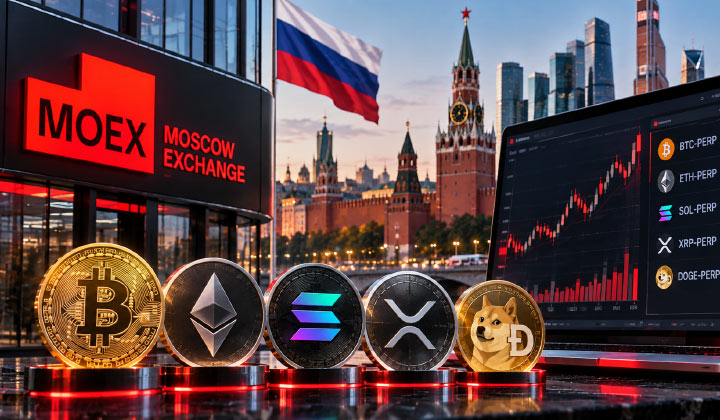
- On September 22, Moscow Exchange will introduce five cryptocurrency perpetual futures, including those for Bitcoin, Ether, Solana, XRP, and Tron.
- Investors will have exposure to cryptocurrency prices without having to keep the underlying assets thanks to the new contracts, which function as one-day futures with automatic rollover.
- The Moscow Exchange’s cryptocurrency-linked futures have been exchanged by more than 72,000 eligible investors, with a total volume of more than 600 billion rubles.
Moscow Exchange said in its Sept. 16 announcement that the five new products will operate as one-day futures with automatic rollover. The contracts will give investors exposure to crypto price movements without requiring them to hold or transfer the underlying digital assets.
🇷🇺 BIG: Russia’s largest exchange, the Moscow Exchange, will launch perpetual futures on BTC, ETH, SOL, XRP and TRX indices on September 22, available only to qualified investors. https://t.co/H0lBUHGONJ
— The Crypto Johannes (@TheCryptoJonny) September 17, 2026
The new contracts will track indexes calculated by Moscow Exchange. BTCUSDF will reference the exchange’s Bitcoin Index, while ETHUSDF will track its Ether benchmark. SOLUSDF, XRPUSDF and TRXUSDF will follow the corresponding Solana, XRP and Tron indexes.
The exchange already offers monthly futures linked to the same five crypto indexes. Bitcoin and Ether futures began trading in November 2025, while Solana, XRP and Tron contracts launched on May 14, 2026.
Moscow Exchange also updated its crypto benchmark methodology in May. The indexes use pricing data from major cryptocurrency exchanges, including Binance, Bybit, OKX and Bitget, and are updated every 15 seconds during relevant trading periods.
Crypto Futures Will Settle In Russian Rubles
Although the contracts will be quoted in U.S. dollars based on their underlying index values, financial settlement will take place in Russian rubles. No Bitcoin, Ether or other cryptocurrency will be physically delivered when positions are settled.
The one-day contracts will automatically roll over, distinguishing them from the exchange’s existing monthly crypto futures. Under the published specification, the K1 parameter is set at 0%, while K2 is set at 0.35%.
Moscow Exchange already offers perpetual futures across other asset classes, including currencies, indexes, precious metals and securities.
Maria Patrikeeva, managing director of the exchange’s derivatives market, described the launch as an important milestone for Russia’s derivatives market and pointed to investor demand for digital-asset-linked products.
Crypto Derivatives Volume Tops 600 Billion Rubles
More than 72,000 qualified investors have traded Moscow Exchange’s crypto-linked futures since their introduction, with cumulative transaction volume exceeding 600 billion rubles, according to the exchange.
The exchange first entered regulated crypto-linked derivatives in June 2025 with a futures contract tied to BlackRock’s iShares Bitcoin Trust ETF. It later introduced an Ether ETF-linked contract before launching futures based directly on its Bitcoin and Ether indexes.
Access to Moscow Exchange’s crypto futures remains restricted to qualified investors. The structure follows Bank of Russia rules, allowing regulated financial products linked to cryptocurrency prices for qualified investors, provided they do not involve physical crypto delivery.
Stay informed with the latest trends in Web3, blockchain innovation, and cybersecurity updates at 3verseTV
You need to login in order to Like
















Leave a comment