


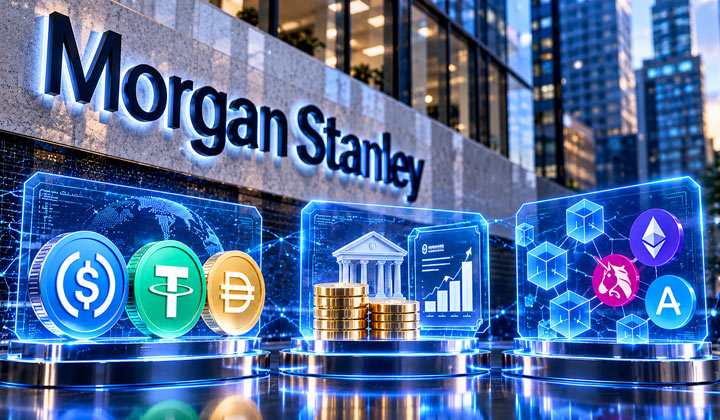
Morgan Stanley has established a Digital Asset Lab to test blockchain-based financial applications including tokenized deposits, stablecoins, CBDCs, tokenized funds and DeFi vaults.
According to a Bloomberg report, the lab provides the bank’s digital-asset team with a separate environment where these technologies can be tested before any potential connection with Morgan Stanley’s production systems.
The work covers both blockchain-based representations of traditional financial assets and decentralised applications that could eventually interact with regulated financial infrastructure.
LATEST: 🏦 Morgan Stanley has set up a Digital Asset Lab to test technologies including stablecoins, tokenization, and DeFi applications, per Bloomberg. pic.twitter.com/FDoItQc5XB
— CoinMarketCap (@CoinMarketCap) September 30, 2026
The Digital Asset Lab operates within Morgan Stanley’s broader network of technology and innovation facilities in New York, Glasgow and Bangalore. The bank uses these facilities to experiment with new technologies before deciding whether they are suitable for wider deployment.
Megan Brewer, who leads market innovation and labs at Morgan Stanley, said the facilities allow employees to test technologies before they are considered for broader use. Bloomberg reported that the bank runs as many as 270 projects a year through its innovation labs.
The digital-asset team, led by Amy Oldenburg, is using the lab to examine blockchain applications without directly connecting experimental projects to client-facing systems.
The bank’s research covers several areas. These include tokenized deposits, stablecoins, central bank digital currencies and tokenized money market funds. Morgan Stanley is therefore looking beyond cryptocurrencies themselves and examining how blockchain technology could be used across traditional financial services.
Tokenized deposits can represent bank liabilities on blockchain networks. Tokenized funds can use distributed-ledger technology to record ownership and facilitate transfers.
The lab is also testing DeFi vaults. These systems can pool assets and deploy capital according to predefined strategies. For a traditional financial institution, however, using DeFi brings additional questions around custody, compliance, security and operational controls.
Morgan Stanley is therefore treating the technology as an area for testing rather than an immediate production rollout. Oldenburg has said the bank needs to understand how DeFi vaults work before putting other parts of its financial platform at risk.
This distinction is important. Morgan Stanley already has some digital-asset products operating in the market, while the technologies being tested through the Digital Asset Lab remain under evaluation.
In July, Morgan Stanley Investment Management launched Ethereum and Solana exchange-traded products that track the two cryptocurrencies and include staking. Those products followed the bank’s earlier Bitcoin-focused offering.
In August, Morgan Stanley selected Galaxy as one of three staking providers for its ETH and SOL exchange-traded products.
The Digital Asset Lab is dealing with a different stage of development. Tokenized deposits, CBDCs and DeFi vaults are still being examined to determine how they might fit into the bank’s existing infrastructure.
The testing also allows Morgan Stanley to study practical issues such as custody, regulation, security and interoperability. These questions are particularly important when decentralised systems are connected with highly regulated financial institutions.
The bank’s experiments come as financial institutions across the industry explore blockchain applications for payments, settlement, asset issuance and fund management.
For Morgan Stanley, the lab provides a controlled environment to test these ideas before making decisions about production use. The approach separates technologies that are already part of the bank’s investment-product business from those that are still being researched.
Stay informed with the latest trends in Web3, blockchain innovation, and cybersecurity updates at 3verseTV
You need to login in order to Like

















Leave a comment