


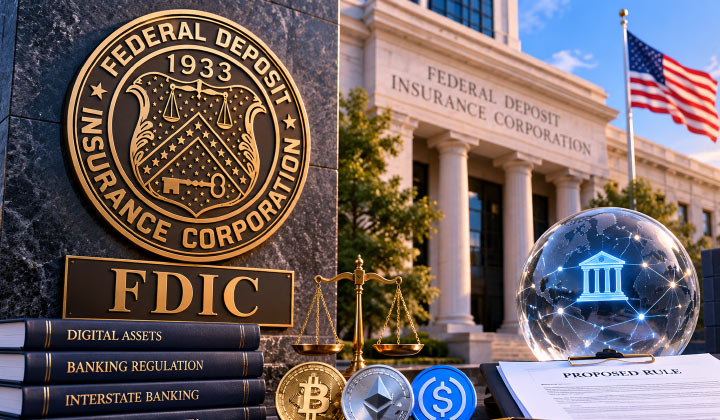
The U.S. Federal Deposit Insurance Corporation (FDIC) has proposed a rule to clarify when state laws can apply to state-chartered banks operating across state lines. Although the proposal doesn’t directly address cryptocurrencies or stablecoins, banks that deal with digital assets can benefit from it since they can operate in several jurisdictions while adhering to various state and federal regulations. Maintaining equivalence between state and federal bank charters is the fundamental goal of the proposal.
The proposed rule addresses Section 24(j) of the Federal Deposit Insurance Act. This provision provides a framework for deciding when laws in a state where a bank operates can apply to an out-of-state state-chartered bank.
The FDIC Board of Directors today approved a proposed rule that would promote parity between out-of-state state banks and national banks concerning the application of state laws.https://t.co/Suz49y9yUM pic.twitter.com/4aQJ7QQhO2
— FDIC (@FDICgov) September 17, 2026
Under the proposed approach, when a host state’s law does not apply to an out-of-state national bank providing comparable services, that law generally would not apply to an out-of-state state bank either. The FDIC said the approach is intended to maintain a level of parity within the U.S. dual banking system.
The proposal follows legal questions surrounding Illinois’ Interchange Fee Prohibition Act. The law places restrictions on interchange fees connected with the tax and gratuity portions of certain payment-card transactions and also limits the use of certain transaction data.
The FDIC said litigation over the Illinois law created uncertainty over whether similar requirements could apply to out-of-state banks serving customers in Illinois without maintaining a physical branch there. A federal court decision in June blocked parts of the law from being enforced against certain national banks, federal savings associations, payment networks and qualifying out-of-state state banks.
The FDIC proposal would clarify how the federal parity provision applies in comparable situations. However, it would not itself determine whether a particular state law is federally preempted.
The broader discussion about how banks offering digital asset services should function across state lines is where the cryptocurrency link originates. The proposal does not create a framework for cryptocurrency banking or permit the use of cryptocurrencies, stablecoins, or other digital assets.
Lawmakers have also been pursuing more precise federal banking regulations for digital assets. Senator Cynthia Lummis and other senators have urged banking regulators to address capital requirements for institutions involved in activities involving assets such as bitcoin and tokenized securities.
The FDIC estimates that its proposal could reduce compliance costs linked to the Illinois payment-card law by about $308 million in one-time costs and $6.7 million annually. Those estimates relate mainly to payment-card compliance rather than crypto activity. The proposal will be open for public comment after publication in the Federal Register. Its final form could therefore change.
Stay informed with the latest trends in Web3, blockchain innovation, and cybersecurity updates at 3verseTV
You need to login in order to Like

















Leave a comment