


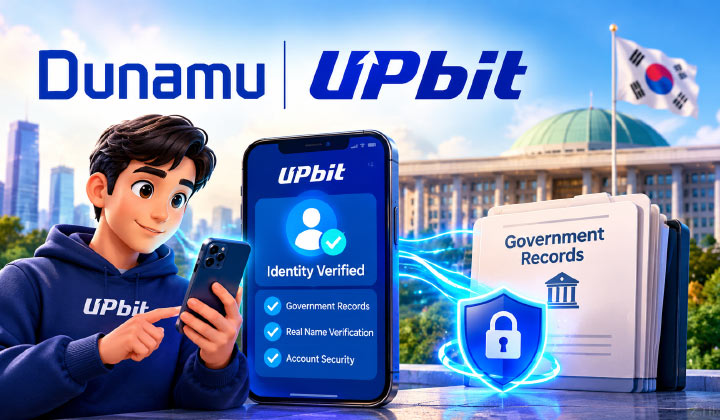
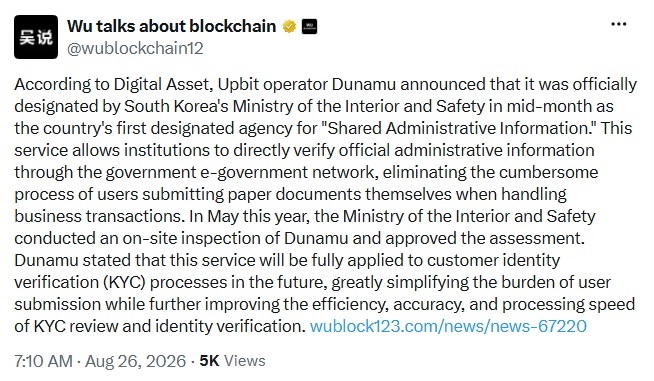
Dunamu, the company behind South Korea’s largest crypto trading platform Upbit, has just secured a regulatory first: official clearance to pull directly from the government’s shared administrative database when verifying customer identities. The approval, granted by the Ministry of the Interior and Safety this month, makes Dunamu the first virtual asset exchange operator in the country to gain this kind of access, meaning Upbit users may soon need far fewer paper documents to complete identity checks. The green light followed an on-site inspection back in May and a broader compliance review.
For context, Dunamu operates as the parent company running Upbit, South Korea’s dominant cryptocurrency exchange by trading volume, generating revenue primarily through transaction fees charged on buy and sell orders across its platform. Its business model has expanded well beyond simple spot trading over the years, branching into custody services, institutional partnerships, and now, public-sector collaborations that position the firm as something closer to a regulated financial institution than a typical trading venue.
So what does this approval actually change day to day? Rather than asking customers to physically obtain and upload records that government agencies already hold, Upbit will now be able to confirm certain personal details directly through the administrative information joint-use network.
Source: x.com
This system was originally built to cut red tape across various public and approved private services, and Dunamu is now applying it specifically to strengthen and speed up its know-your-customer procedures. The company says it’s still finalizing the technical groundwork needed before the feature goes fully live.
This regulatory nod arrives at a notably sensitive time for Dunamu. The firm has been under close watch following concerns the Financial Intelligence Unit raised last year about gaps in Upbit’s anti-money laundering and identity verification practices, a matter that triggered a formal sanctions review.
Separately, the Financial Supervisory Service opened its own investigation in July into how Dunamu handled a significant wallet breach disclosed in November 2025, examining whether the company met its obligations under the Virtual Asset User Protection Act. Upbit has since compensated impacted users and overhauled portions of its wallet security architecture, even as that review continues.
Beyond this KYC upgrade, Dunamu’s footprint in South Korea’s public sector keeps growing. Just last month, the company was named preferred bidder for a National Police Agency contract covering custody of crypto assets seized in criminal cases, beating out rival bidders K DAC and Hecto Wallet One. S
Separately, Dunamu’s planned merger with Naver Financial, which would fold Dunamu in as a wholly owned subsidiary, has been pushed back twice and now targets a year-end completion, pending sign-off from the Fair Trade Commission and other regulators. Both companies also intend to form an IPO committee within a year of finalizing that share swap.
It’s worth noting how differently exchange oversight plays out depending on jurisdiction and market structure. While centralized platforms like Upbit navigate government database integrations and compliance audits, decentralized venues such as Hyperliquid operate under an entirely different model built around on-chain settlement and permissionless access, a contrast that highlights just how fragmented global crypto regulation remains even as individual markets like South Korea push toward tighter, more centralized oversight of user verification.
Stay informed with the latest trends in Web3, blockchain innovation, and cybersecurity updates at 3verseTV
You need to login in order to Like

















Leave a comment