


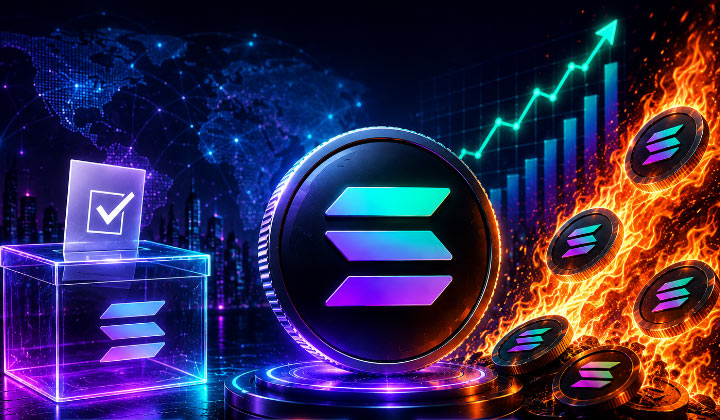
Solana validators have started voting on proposals that could slow new SOL token creation and sharply increase the amount of SOL burned each day, potentially taking daily burns toward $800,000. Voting began Sunday and is scheduled to run until Thursday at about 15:30 UTC. Two of the three proposals directly address Solana’s token supply.
One would make the network reduce new SOL issuance faster, while another would permanently destroy a portion of transaction fees based on the computational work required by each transaction.
The first supply proposal, SGP-0002, would accelerate Solana’s existing reduction in new token creation. The network currently cuts its annual rate of new SOL issuance by 15%. If the proposal passes, that reduction would increase to 30%, allowing Solana to reach its long-term issuance floor sooner.
The second proposal, SGP-0003, focuses on transaction fees. Under the proposed system, fees would be divided into two parts. A fixed portion would go to the validator producing the block, while another portion linked to the amount of computational work required by the transaction would be permanently burned.
That change could have a much bigger effect on SOL’s supply. Earlier estimates suggested that daily SOL burns could rise from roughly 650 SOL to between 7,500 and 9,000 SOL. At Monday’s prices, that would put the value of the daily burn between about $61,000 and $846,000.
For SOL holders, the combination is what makes the proposals interesting. Slower creation of new tokens would reduce the pace at which supply expands, while higher burns would remove more SOL from circulation.
However, neither proposal directly addresses demand for SOL. A tighter supply does not automatically mean a higher price, particularly if network activity or investor demand weakens.
Validators are voting on the proposals using a system weighted by the amount of SOL staked. This gives influence to validators as well as token holders who delegate their SOL to validators.
The third proposal, SGP-0001, deals with governance rather than token supply. It would formally ratify the Solana Constitution, a document outlining how network decisions are made, and activate the software required to run the new voting system.
There is an unusual timing issue, however. The governance proposal is itself being voted on at the same time as the two supply proposals. In effect, Solana is using the voting system to decide whether the rules governing that system should be formally adopted.
The outcome of the votes could therefore shape both Solana’s monetary policy and its future governance process. For SOL holders, the most closely watched question will be whether the network is prepared to reduce issuance while significantly increasing the amount of tokens removed through transaction fees.
Stay informed with the latest trends in Web3, blockchain innovation, and cybersecurity updates at 3verseTV
You need to login in order to Like












Leave a comment