


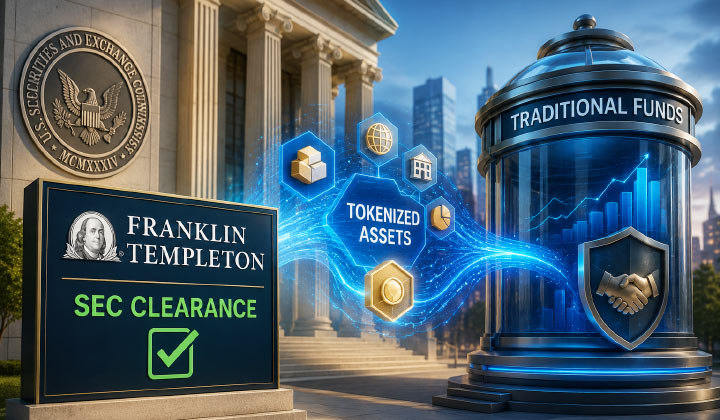
Franklin Templeton has received SEC staff relief that could allow its traditional investment funds to use tokenized assets for cash management. The US Securities and Exchange Commission’s Division of Investment Management issued a no-action letter on August 12 covering Franklin Templeton’s blockchain-based OnChain U.S. Government Money Fund, known as BENJI.
The move could allow eligible mutual funds and ETFs to hold BENJI shares or use them as collateral, bringing blockchain-based assets into conventional investment products. The move is expected to be implemented as early as the fourth quarter, subject to approval by individual fund boards.
The development is significant because tokenization has largely been discussed as a way to put traditional assets on blockchain networks. Franklin’s latest move takes the idea a step further by allowing a tokenized fund to become part of the infrastructure used by traditional investment funds.
BENJI represents shares of the Franklin OnChain U.S. Government Money Fund, which invests mainly in US government securities, cash and fully collateralised repurchase agreements. Franklin launched the fund in 2021, using a public blockchain as part of its system for recording transactions and share ownership.
The SEC relief is based on a no-action letter. That distinction is important. The letter does not amount to formal approval by the SEC or create a new regulatory rule. Instead, SEC staff said they would not recommend enforcement action under the specific arrangement described by Franklin, provided the stated conditions are met.
For Franklin’s funds, BENJI could offer some operational advantages over conventional money market funds. The tokenized fund supports more frequent pricing and intraday transactions, potentially allowing fund managers to move cash more efficiently instead of waiting for traditional end-of-day processes.
Franklin plans to use the tokenized money market fund for cash management and securities-lending collateral. That means tokenized assets could eventually sit inside otherwise conventional portfolios without investors necessarily having to seek out blockchain-based investments themselves.
The arrangement also addresses an important custody question. Franklin Templeton Investor Services will maintain control of the relevant blockchain wallets and private keys, while its traditional transfer-agent system will continue to maintain the official shareholder records. This combination of blockchain records and conventional recordkeeping helped form the basis for the SEC staff relief.
The move comes as large asset managers increasingly explore tokenization. Franklin Templeton has been one of the early institutional players in the field, and BENJI has expanded beyond its original Stellar-based setup to other blockchain networks. The fund itself had more than $750 million in total net assets as of June 30, according to Franklin Templeton’s latest fund information.
The broader significance could be even greater. If tokenized money market funds can be used for routine cash management inside traditional funds, blockchain technology may become less of a separate investment category and more of a behind-the-scenes financial tool.
For Franklin Templeton, the SEC letter therefore represents more than regulatory relief for one product. It provides a potential model for connecting tokenized assets with the traditional fund industry, while giving other asset managers a clearer example of how blockchain-based products can fit within existing investment structures.
The next step will depend on individual fund boards and the implementation of the proposed arrangements. If Franklin moves ahead as planned, the fourth quarter could mark an important new stage in the adoption of tokenized assets by mainstream investment funds.
BREAKING: Franklin Templeton receives U.S. regulatory clearance to bring tokenized assets into traditional investment funds.
— Polymarket (@Polymarket) August 20, 2026
Stay informed with the latest trends in Web3, blockchain innovation, and cybersecurity updates at 3verseTV
You need to login in order to Like
















Leave a comment