



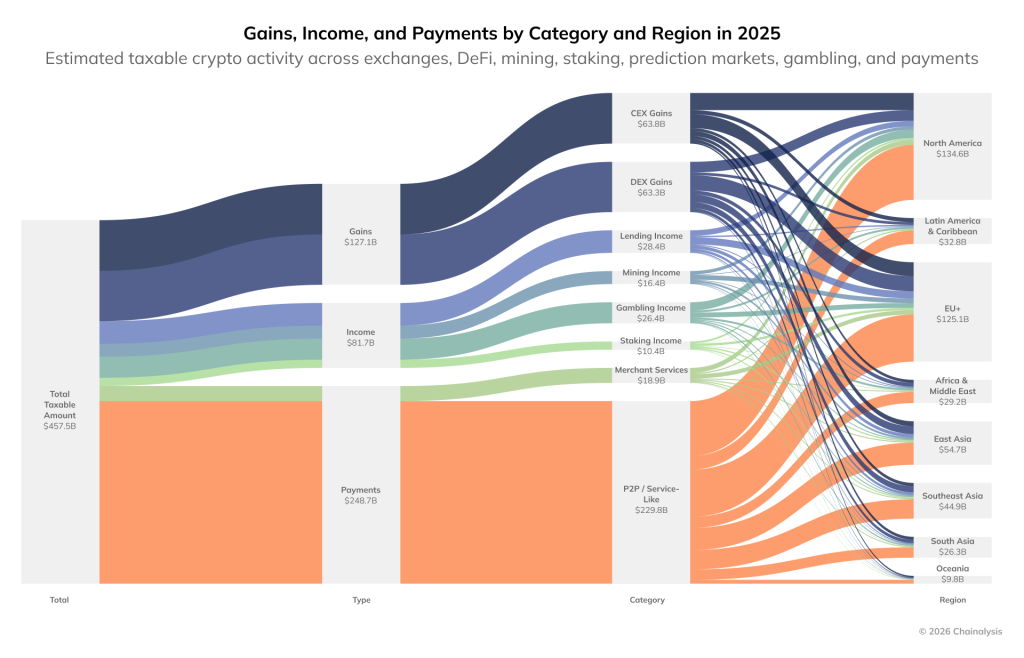
Blockchain forensics company Chainalysis has released information about crypto transactions with tax implications on Thursday. It reveals that the amount of transactions with tax implications reached at least $457 billion globally in 2025. The United States topped all tracked countries, contributing about $112.6 billion.
The report also shows that self-custodied wallets and decentralized finance protocols are sidestepping standard reporting. The data covers six major blockchain networks and represents a minimum estimate rather than a complete accounting of what governments might actually collect.
Source: chainalysis.com
Chainalysis, for those less acquainted, established its reputation as a blockchain intelligence company that tracks on-chain transactions for governments, law enforcement agencies, and financial institutions. Its business model revolves around selling investigative software and compliance tools that assist clients in following money across public ledgers, identifying illegal activity, and now, increasingly, understanding tax liabilities associated with crypto movements.
The firm’s latest research gathers data from Bitcoin, Ethereum, Solana, Tron, BNB Smart Chain, and Base, deliberately excluding transactions that occur entirely within centralized exchanges.
Breaking down the number for the US, income comprises of around $17.9 billion, gains accounted for $30.1 billion, with payments being the largest portion, totaling $64.6 billion. Germany ranked second among countries with approximately $24.1 billion, followed by China, close at $21 billion, the U.K. at $19.4 billion, and India, virtually on a par at $19 billion. Brazil, Canada, and Japan completed the list with amounts ranging from $13 billion to $16 billion.
India’s breakdown is particularly notable given its existing 30% tax on gains from virtual digital assets alongside a 1% deduction at source on qualifying transactions. Of its roughly $19 billion total, payments made up the largest chunk at $10.7 billion, followed by $5.1 billion in gains and $3.2 billion in income.
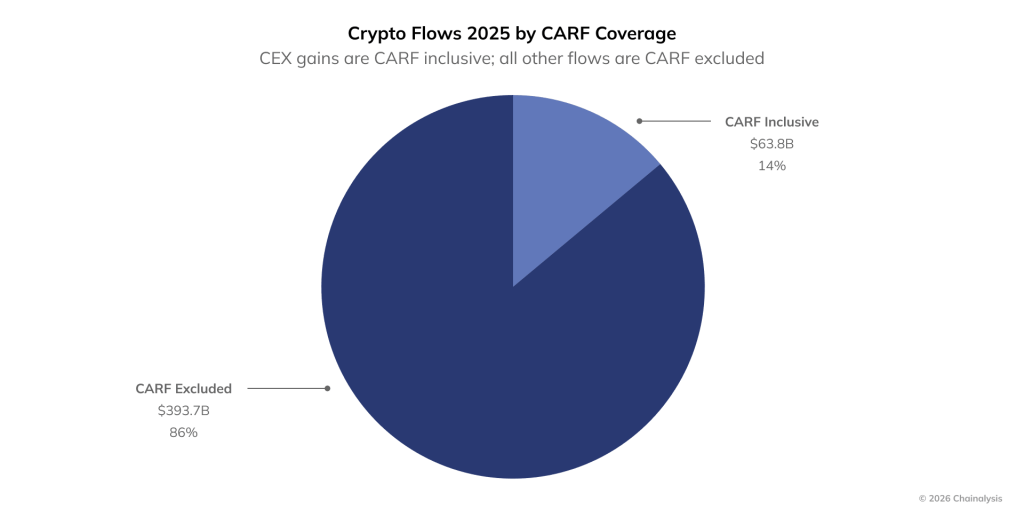
The report also examined how well international frameworks actually capture this activity. The OECD’s Crypto-Asset Reporting Framework, which several countries plan to start using for information exchange from 2027 onward, currently only accounts for about 14% of the taxable activity Chainalysis identified.
The remaining 86% moves through channels the framework simply wasn’t built to see, things like peer-to-peer trades, DeFi platforms operating outside conventional intermediary structures, and mining or staking rewards that never touch a centralized reporting entity.
Interestingly, this reporting gap becomes even more pronounced in high-velocity trading environments. Platforms such as Hyperliquid, which have become key centers for on-chain derivatives and perpetual futures trading, produce massive transaction volumes that mostly avoid the centralized intermediary reporting that tax authorities depend on, highlighting precisely the blind spot Chainalysis is referring to.
LATEST: 📊 Chainalysis found on-chain taxable crypto activity hit $457B globally in 2025, with the US alone accounting for $112.6B across gains, income, and payments. pic.twitter.com/KUi2pXiGyk
— CoinMarketCap (@CoinMarketCap) August 27, 2026
At the same time, the U.S. is tightening its own measures through Form 1099-DA, a new reporting requirement that Chainalysis estimates could generate nearly $28 billion in additional revenue over the next ten years, though it still won’t completely cover wallet-to-wallet transfers or activity on foreign platforms.
South Korea, in contrast, is considering postponing its planned 22% crypto income tax until 2030, which would give regulators more time to develop systems capable of actually monitoring this kind of activity before enforcement gets underway in full.
Stay informed with the latest trends in Web3, blockchain innovation, and cybersecurity updates at 3verseTV
You need to login in order to Like

















Leave a comment