



- Italian fintech Conio has received a MiCA license, allowing it to offer regulated crypto custody, transfer, and placement services across the European Union.
- Conio secured Crypto-Asset Service Provider (CASP) authorization from Italy’s financial regulators ahead of the EU’s July 1, 2026, MiCA compliance deadline.
- The MiCA framework creates a unified regulatory system for digital assets, aiming to improve investor protection, transparency, and operational standards across Europe.
- Conio plans to expand beyond retail crypto services by offering white-label digital asset infrastructure to banks, fintech firms, and institutional clients.
Conio has obtained regulatory permission under the EU’s Markets in Crypto-Assets (MiCA) framework, which is a major development in Italy’s quickly changing digital asset market.
The business, supported by Poste Italiane and Banca Generali, publicly traded financial institutions, reportedly declared that it has been granted permission to function as a Crypto-Asset Service Provider (CASP) in Italy, according to a Reuters story.
Conio, an Italian fintech, may now offer regulated cryptocurrency custody, transfer, and placement services within the European Union in accordance with the recently standardized digital asset regulations of the EU.
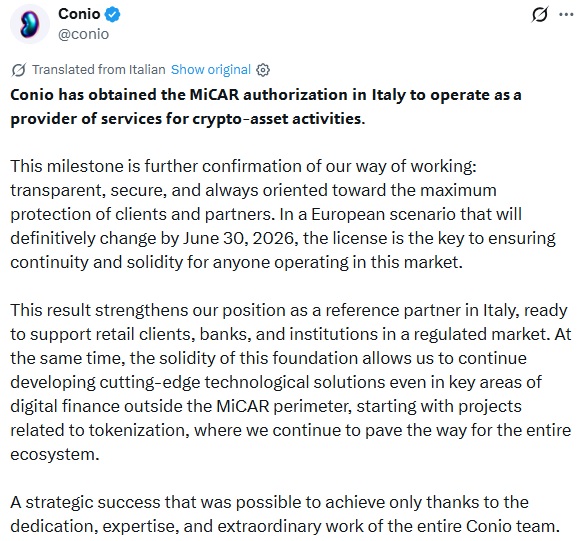

Conio will now be able to offer cryptocurrency custody, transfer, and placement services under a single regulatory framework in all EU member states with the support of Poste Italiane and Banca Generali. Following a joint review by the Bank of Italy and Consob, Italy’s financial regulators, the permit was approved.
In order to provide a precise set of regulations for the digital asset sector, MiCA was introduced. The framework seeks to strengthen operational requirements for cryptocurrency businesses operating in Europe, enhance investor protection, and promote market transparency.
Conio Targets Institutional Growth With MiCA License
Conio’s clearance before the deadline of July 1, 2026, when cryptocurrency companies will no longer be permitted to provide regulated services within the European Union if they do not have the necessary authorization.
Exchanges, custodians, fintech firms, brokers, and traditional financial institutions have all accelerated their licensing activities due to the impending deadline.
The MiCA license, according to Conio CEO Christian Miccoli, helps the business achieve its objective of becoming a strategic partner for financial institutions wishing to include digital assets in regulated investment portfolios.
He noted that as the need for regulated digital asset solutions grows, Conio intends to increase its involvement in tokenization and blockchain infrastructure projects.
Conio Expands Beyond Retail Crypto With White-label Digital Asset Services
The company plans to go beyond retail cryptocurrency services by providing banks and fintech companies with white-label digital asset infrastructure. Conio also intends to assist institutional and corporate clients who are investigating tokenization and blockchain-based financial services. Conio’s acceptance is indicative of a broader trend in the expanding digital asset market in Italy.
Banca Sella was the first Italian bank to be authorized under the MiCA framework earlier this year. Additionally, the bank became a member of the Qivalis consortium, a group of financial institutions that are developing a euro stablecoin that complies with MiCA regulations.
Stay informed with the latest trends in Web3, blockchain innovation, and cybersecurity updates at 3verseTV
You need to login in order to Like
















Leave a comment