


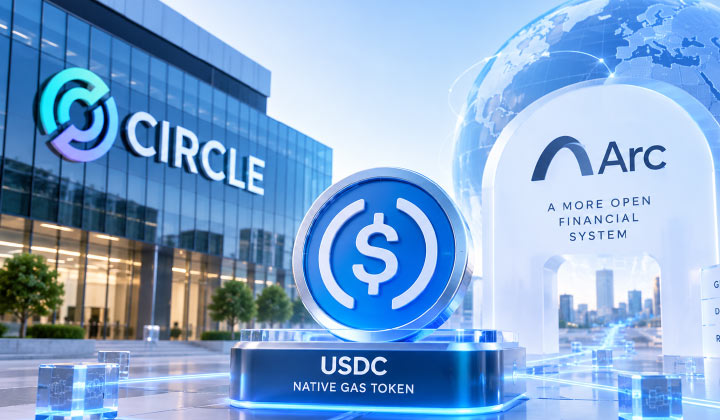
Circle has launched Arc, a new Layer-1 blockchain designed around stablecoin-based financial activity, on public mainnet. The network uses USDC as its native gas token, meaning users pay transaction fees in the dollar-pegged stablecoin rather than a volatile blockchain token.
Arc is secured at launch by a permissioned group of institutional validators, while developers can access the network without permission. Circle says the blockchain is built for payments, foreign exchange, tokenized assets, lending and other financial applications, with deterministic sub-second transaction finality.
The launch represents a major expansion for Circle beyond its core USDC stablecoin business. Chief executive Jeremy Allaire described Arc as a major platform launch for the company and said it could become an important infrastructure layer for financial activity moving onto blockchains.
Arc Mainnet is live.
Arc launches as the Economic OS for the internet: an open platform for global markets, real-time value movement, tokenized assets, and agentic economic activity.
Arc is more than a blockchain.
It launches as a full-stack financial platform with assets,… pic.twitter.com/SWg0NlUijO
— Arc (@arc) September 16, 2026
Arc is designed to address some of the issues that financial institutions can face when using general-purpose blockchains. Circle has highlighted volatile gas prices, uncertain transaction finality and public transaction data as areas that can make blockchain systems harder to use for certain institutional applications.
Using USDC for transaction fees is one of Arc’s most distinctive features. Users do not need to acquire a separate volatile token simply to pay for network activity. Circle says the fee system is inspired by Ethereum’s EIP-1559 model but is designed to smooth sudden changes in transaction costs.
The network uses the Malachite consensus engine and an Ethereum Virtual Machine environment. This means developers can use Solidity smart contracts and familiar Ethereum development tools while benefiting from Arc’s different consensus and fee structure.
Source: arc.io
Circle says Arc can provide deterministic, sub-second finality. In practical terms, transactions that are committed to the blockchain are not expected to be reversed through a later chain reorganisation.
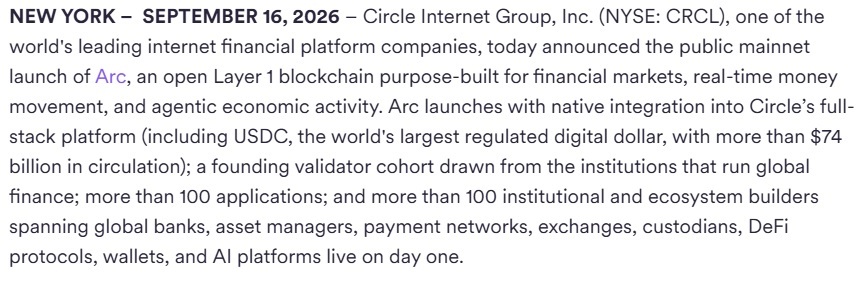
The validator structure is permissioned at launch. Circle is joined by institutions including BlackRock, DTCC, Galaxy, Global Payments, ICE, Mastercard, MoneyGram, SBI, Standard Chartered, Sumitomo Corporation and Visa.
Circle has positioned the network as complementary to existing blockchains rather than a replacement for them. Its interoperability infrastructure, including Cross-Chain Transfer Protocol and Gateway, is intended to allow assets to move between Arc and other networks.
The blockchain is already connected to a range of financial applications. Circle says lending and borrowing platforms include Aave and Morpho, while StableFX provides around-the-clock on-chain foreign exchange for fully reserved stablecoins.
Source: circle.com
Tokenized products listed for eligible users include BlackRock’s BUIDL, Circle’s USYC, Janus Henderson’s JAAA and JTRSY, and Circle’s programmable Bitcoin product, cirBTC.
Circle has also completed a genesis mint of 10 billion ARC tokens. However, the company has stressed that this does not mean the ARC token is being launched publicly. Network fees continue to be paid in USDC, and Circle says no decision has been made on public distribution of ARC.
The company is exploring a possible transition from Proof of Authority to Proof of Stake in 2027. If that happens, ARC could potentially have a role in network security, governance or utility, although the details have not been finalised.
Arc’s public launch therefore gives Circle its own blockchain infrastructure while keeping USDC at the centre of transactions. The next stage will be watching whether institutions and developers turn the network’s existing partnerships and applications into significant real-world activity.
Stay informed with the latest trends in Web3, blockchain innovation, and cybersecurity updates at 3verseTV
You need to login in order to Like














Leave a comment