



In the realm of Web3, technology is still developing. In fact, we are constantly implementing a number of protocols to give the network infinite scaling potential.
Technological development often precedes both vertical and horizontal scaling. Let’s examine the steps involved in this upgrading procedure and the advantages they offer to all consumers.
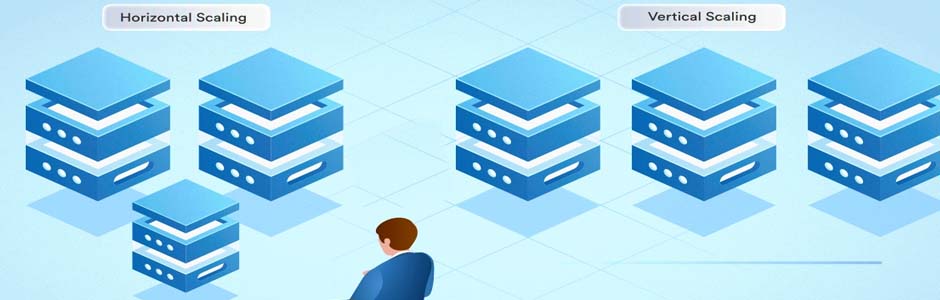
In contrast to horizontal scaling, which consists of adding additional nodes—that is, machines—to an already-existing system’s framework, vertical scaling involves growing a network by giving a system’s central processing unit more power and memory.
While discussing scalability, it’s critical to realize that the idea is typically brought up while attempting to boost a platform’s transaction capacity.
When referring to a classic client-server architecture, vertical scaling entails adding more processing power and memory to the system’s current hardware.
Similar to this, horizontal scaling refers to modifying the platform’s fundamental architecture in order to create a cluster of servers that can easily handle an increase in the volume of incoming transaction requests.
Does scaling work well with blockchains?
Traditional databases are the ideal format for scaling. Scalable blockchains are more practical and beneficial from a security perspective, but there is a cost associated with using them.
When bringing up the idea of scalability in relation to blockchain technology, it is important to note that, because blockchain systems are inherently distributed networks, it is challenging to boost a network’s throughput by merely adding more hardware components, like miners, nodes, or validators.
More precisely, horizontal scaling usually leads to a decrease in the system’s overall performance (transaction processing capacity), even if it tends to boost a network’s trust or security.
Conversely, vertical scaling typically entails accelerating and strengthening each system’s internal components. From the standpoint of a distributed ledger system, this implies the use of supercomputer nodes. However, the limitation of operating these nodes to a small group of people is a drawback.
How does scaling work?
Vertical scaling increases the effectiveness of each individual transaction, while horizontal scaling increases the platform’s total throughput capacity.
Simply put, “layering” promotes general scalability by designing each individual aspect of a system to interact with its digital equivalents in a sequential and hierarchical manner.
Additionally, blockchain developers work hard to keep their base chain immutable so that the scaling layer may benefit from the parent chain’s security.
The Lightning Network is one technology that exemplifies the previously described idea perfectly. It uses Bitcoin’s security to boost the system’s overall transaction volume.
Now that we’re discussing horizontal and vertical scaling, we can observe that the former involves expanding a system’s cluster count or number of virtual machines to accommodate growing transaction loads.
In contrast, vertical scaling involves increasing the processing power (or memory) of an already-existing virtual machine to increase its processing capacity.
That being said, there has been a lot of excitement surrounding the planned Ethereum 2.0 update, which aims to increase the project’s overall transactional capacity through a variety of design modifications, the main one being sharding.
By implementing these modifications, Ethereum’s fundamental foundation will transition from having a single execution environment to having numerous execution environments that validate transactions asynchronously.
When should I use horizontal or vertical scaling?
Although it is comparatively simpler to accomplish, pure vertical scaling has limitations in its usefulness. Horizontal scaling requires more time to create but increases a system’s overall throughput.
An analysis of a system’s bottleneck performance can help to clarify the problem. Placing an excessive amount of demand on a specific system creates a bottleneck that negatively impacts the platform’s overall performance.
For instance, a vertical scale could be helpful if the virtual machine’s local memory isn’t enough to handle all of the incoming transactions because it can lessen the overall burden by adding more RAM to the framework.
Conversely, adding more processing units or using a horizontal scale can solve the issue if a platform’s current hardware is unable to handle an incoming transaction load.
Jonathan R. Brandt, a leader in enterprise technology projects and the creator of the blockchain study course that is currently offered in several Minnesota state schools and institutions, will simplify the aforementioned notion for us.
“In crime-fighting, the Hulk scales vertically, and the Justice League scales horizontally. In Bitcoin, a mining server can be scaled vertically by increasing memory or upgrading its GPU, and it can be scaled horizontally by joining servers together.”
Are there any noteworthy blockchain-scaling solutions?
Over the past couple of years, a number of firms have worked to solve scalability issues that have plagued the crypto sector.
The newest technology developed by vCPU, LiquidApps, is a horizontal scaling solution that assigns decentralized application (DApp) service providers the task of reading on-chain requests, processing them, and returning the results to the requesting DApp.
This enables developers to access a larger supply of DApp computation power. The flexibility of vCPU to let DApps select the right and relevant level of trustlessness based on the demands and specifications of a specific use case is one of its main selling points.
EOS is another example. Resolving a large number of the industry’s scalability problems facing the industry is the main objective of EOS. The application of specific vertical scaling-related components (i.e., processing power addition) enables the parallel processing technology that sets EOS apart from vCPU.
However, Temtum’s temporal protocol ensures data transfer among nodes even if the current node lacks the required storage capacity to maintain the entire blockchain, lowering the entry barrier for new nodes joining the network.
Because there is a low entry fee to join the network, fewer resources are required to run nodes. This allows for the full utilization of otherwise idle nodes’ capabilities—something that most cryptocurrencies are now unable to do—which improves overall performance.
What are some of the key points to remember about scalability?
It is all about centralization vs. decentralization. When it comes to blockchain platforms, a chain’s scalability frequently comes down to how decentralized the network is. More controlled networks, like EOS with its 21 Block Producers, function far more quickly than highly decentralized ecosystems, like Bitcoin.
As a result, things move more quickly when there are fewer nodes generating blocks. Centralization, however, lessens the intriguing qualities that blockchains by nature have, such as their immutability, transparency, and resistance to censorship.
You need to login in order to Like
















Leave a comment