


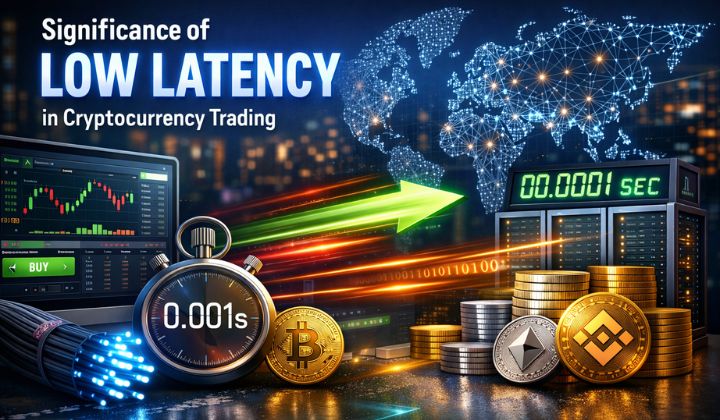

Significance Of Low Latency In Cryptocurrency Trading
In the ever-changing and dynamic realm of cryptocurrency trading, where every moment matters, minimal latency has become an indispensable element that can determine the prosperity of cryptocurrency exchanges.
To put it simply, latency is the amount of time that passes between sending out a request and getting a response. Low latency on cryptocurrency exchanges translates to quick and effective execution of trading orders, which is essential for traders trying to take advantage of market opportunities.
Latency In Cryptocurrency Trading
The term “latency” in cryptocurrency trading describes the lag or delay in the amount of time it takes for data to travel between two points in a trading system. Latency can have a significant effect on a trader’s capacity to carry out orders and make wise choices. Maintaining minimal latency throughout the entire trading process is crucial for gaining a competitive advantage in the fast-paced realm of bitcoin trading.
Furthermore, volatility and market conditions may impact latency. Exchanges may encounter delays in order processing, which raises latency, during times of high trading activity or abrupt price swings. Since high-frequency traders aim to complete many trades in a short amount of time, cutting latency is their top priority.
High-frequency trading, or HFT, is a trading strategy that uses extremely quick computers and algorithms to carry out a lot of trades in a short amount of time. By taking advantage of minute price differences, HFT firms use speed, low latency, and state-of-the-art technology to gain a competitive advantage in the financial markets.
Although latency may not be as important to some traders, optimal transaction execution is still necessary. In general, a trader’s ability to swiftly obtain and act upon market information increases their chances of making profitable transactions on cryptocurrency markets.
Types of Latency
In cryptocurrency trading, latency can take many different forms. These include data latency, order execution latency, network latency, software latency, hardware latency, market data feed latency, market latency, and exchange latency.
Data Latency
Delivery delays for market data are referred to as data latency. When calculating prices and order books, it accounts for the latency that exists between cryptocurrency exchanges and a trader’s trading platform. A low data latency is necessary for traders to receive accurate, real-time market data.
Order Execution Latency
The amount of time needed for an order to be sent from a trader’s trading platform to the exchange, processed by the exchange, and then executed is known as order execution latency. For HFT traders, order execution latency must be as low as possible, because even a millisecond of latency can lead to lost trading opportunities.
Network Latency
The term “network latency” refers to the delays resulting from both the physical distance between a trader’s location and the exchange’s servers, as well as the speed and dependability of an internet connection. To reduce network latency, traders commonly use co-location services, in which their trading servers are physically located close to the exchange’s computers.
Software Latency
A trader’s trading program or algorithm’s processing time requirements could cause a software delay. Software needs to be speed- and efficiency-optimized in order to reduce this kind of latency.
Hardware Latency
The term “hardware latency” refers to the delay that the actual components of a trader’s computer or server architecture cause. High-performance technology can decrease this kind of latency, resulting in faster order execution and data processing.
Market Data Feed Latency
The time lag between the exchange producing or updating market data and the trader receiving it is known as the market data feed latency. Timely trading decisions require low-latency market data streams.
Market Latency
The term “market latency” describes potential hiccups or delays in the Bitcoin (BTC) market. Exchanges may experience delays in order processing and order book updates during periods of high volatility or intense trading activity. Trade execution may be impacted by these delays, which can be particularly troublesome for high-frequency traders.
Exchange Latency
Exchange latency is a term that describes exactly how quickly the transaction engine of a cryptocurrency exchange reacts. Different exchanges may have different levels of latency depending on their technology, infrastructure, and order volume. When selecting trading platforms, exchange latency is a factor that traders often consider.
How To Achieve And Maintain Low Latency?
Scalability, security, and cost-effectiveness must be carefully balanced in order to achieve and maintain low latency.
Economic considerations are important because it can be expensive to implement the technology and infrastructure needed to reduce latency. This means spending money on high-performance hardware, network hardware, and efficient data processing systems.
Safety concerns are also very important. Latency reduction is crucial for real-time applications, but it must not jeopardize data and system security.
Finding the ideal balance between low latency and strong security can be difficult because faster processing can reveal weaknesses that malicious actors could exploit.
One persistent problem is maintaining latency when scaling infrastructure to handle higher loads. Maintaining low latency gets harder as digital systems grow and user demands increase.
Scaling necessitates constant improvements and optimizations to the infrastructure in order to maintain optimal response times, even in the face of high traffic.
Conclusion
Low latency has become a basic need for cryptocurrency exchanges in the fast-paced world of cryptocurrency trading. It is necessary for traders who want to engage in high-frequency trading, manage risk, execute arbitrage strategies, and obtain a competitive edge.
Low latency also improves the overall the overall user experience, increases market liquidity, and helps with regulatory compliance.
Low-latency exchanges not only draw more traders, but they also help the cryptocurrency industry as a whole advance technologically. Low latency, however, necessitates large infrastructure and technology investments in addition to a dedication to system security and stability.
As the cryptocurrency market develops, low latency will continue to be essential for profitable cryptocurrency exchanges. Individuals who adopt this principle are likely to achieve sustained success in the dynamic field of digital asset trading.
You need to login in order to Like
















Leave a comment