


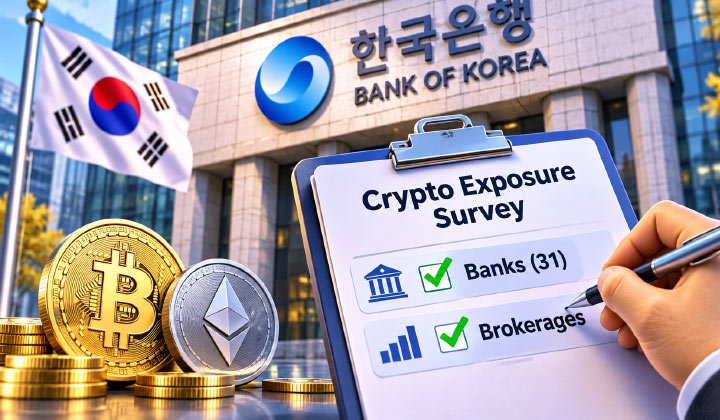
- Bank of Korea launched its first crypto risk survey targeting 18 banks & 13 brokerages from Oct 23
- Stress tests cover scenarios including a major exchange hack, sharp price drops & losses from crypto incidents
- Survey started before the Binance hack but the $6.3B incident illustrates the exact risks being assessed
- The Bank of Korea has advocated for bank-led stablecoin issuance in South Korea
- South Korea’s Digital Asset Basic Act progress has slowed amid disputes over stablecoin issuance authority
Survey Scope & Stress Scenarios
South Korea’s central bank launched its first-ever review of financial firms’ exposure to cryptocurrency risk, surveying 31 institutions including 18 banks and 13 brokerages.
🇰🇷 South Korea’s central bank is surveying 18 banks and 13 securities firms on their crypto businesses and related risks.
The questionnaire covers business development, investments in crypto companies and risk controls. It assesses how scenarios including a hack halting the country’s largest crypto exchange, sharp price falls and shrinking trading activity could affect financial firms. It was sent Oct. 23, with responses due Nov. 4.
— ChainCatcher (@ChainCatcher_EN) November 2, 2026
The survey, which began October 23, presents institutions with three stress scenarios: the temporary suspension of South Korea’s largest crypto exchange following a major hack, a sharp crypto price crash followed by a prolonged trading slump, and heavy losses at another financial institution from a crypto-related incident.
Firms are also asked to provide data on crypto-related staffing levels, budgets, business activities, reasons for market participation, and investments in both domestic and overseas crypto companies.
Post-Binance Hack Context
The survey was designed and initiated before the $6.3 billion Binance hack on October 29, but reporting by CoinTelegraph noted the incident underscores precisely the risks the central bank set out to assess. Responses from financial institutions were due by Wednesday.
Earlier in October, South Korea’s Financial Services Commission proposed tougher security rules after identifying deficiencies in 130 of 555 financial companies reviewed. KB Financial Group completed a won-denominated stablecoin pilot in May, and Kakao Pay partnered with Fireblocks in September, reflecting rapid institutional engagement with crypto infrastructure.
South Korea’s Crypto Regulatory Landscape
The Bank of Korea has been an active advocate for bank-led stablecoin issuance and has pushed for a framework giving banks authority over digital currency issuance. However, progress on South Korea’s proposed Digital Asset Basic Act has moved slower than industry expected, with officials citing disputes over who may issue stablecoins as a major sticking point.
An official quoted by CoinTelegraph noted that virtual asset legislation is moving more slowly than the market anticipated, signaling potential delays in establishing a comprehensive regulatory framework for crypto in the country.
Stay informed with the latest trends in Web3, blockchain innovation, and cybersecurity updates at 3verseTV
You need to login in order to Like
















Leave a comment