


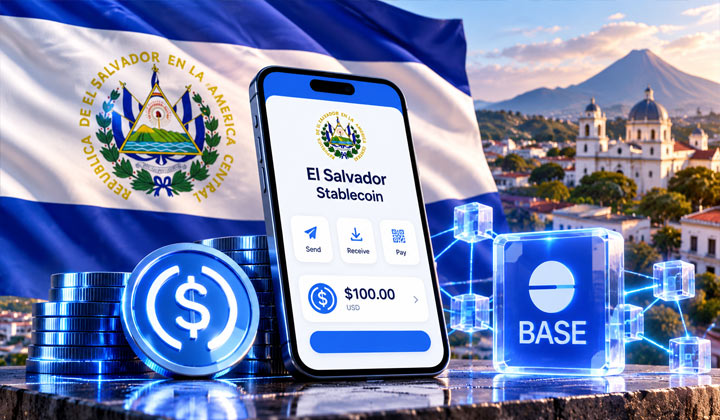
El Salvador’s government is building a state-backed wallet with Modveon on Coinbase’s Base network, aimed at allowing Salvadorans to hold and send dollar-backed stablecoins, including for remittances. The project comes five years after El Salvador made Bitcoin legal tender and after the government’s Chivo wallet was moved away from public operation.
The new app is intended to use a dollar-stablecoin payment rail rather than Bitcoin, potentially reducing the price volatility involved in crypto-based remittances. However, the public material reviewed does not confirm that the wallet is already live, which stablecoin it will use, or when a consumer launch will take place.
Salvadorans sent $9B home last year. Percentage fees took millions of it.@Modveon‘s Sivar now uses Coinbase infrastructure and Base to let US users send any amount to El Salvador for a flat $2.
Transfer to off-ramp, all included. pic.twitter.com/a5b2na5lJ0
— Coinbase 🛡️ (@coinbase) September 29, 2026
Modveon’s website lists payments and remittances among its product areas. A photograph from an event called the “First Sivar Community Gathering” in San Salvador on August 24 also shows the Modveon team in the country.
That provides evidence of Modveon’s presence in El Salvador, but it does not by itself establish that a national wallet is already operating. The public material reviewed also does not provide a contract address on Base, an official contract for the El Salvador project or a live consumer application listing.
#2DollarFlatFee is trending today. Guess why?
Modveon is live with Sivar, our first national deployment in El Salvador. Send $200 or $2,000 from the U.S. for a $2 flat fee.
Thank you @nayibbukele & team for the partnership.
One country to start a movement against unfair fees. https://t.co/lPJk5eAijj
— Modveon (@modveon) September 29, 2026
The exact dollar-backed stablecoin that would be supported is another unanswered question. Public information reviewed for the project does not specify whether the app will use USDC, another issuer’s stablecoin or a locally authorised digital dollar.
The proposed wallet comes against the backdrop of El Salvador’s five-year experiment with Bitcoin. The country passed its Bitcoin Law in June 2021, with the legislation taking effect on September 7 of that year. The government launched the Chivo wallet and offered new users a $30 Bitcoin incentive.
The policy changed in January 2025. El Salvador’s Legislative Assembly amended the Bitcoin Law, making acceptance of Bitcoin by private businesses voluntary and removing the option to pay taxes using Bitcoin. The changes formed part of the country’s 40-month Extended Fund Facility agreement with the International Monetary Fund.
The government’s approach to Bitcoin and digital payments has since become more divided. The IMF said in September that majority ownership and operational control of the government’s e-wallet had been transferred to a private operator, while the government retained a minority stake and custodial responsibilities for customer assets.
President Nayib Bukele has separately disputed the interpretation that El Salvador’s sovereign Bitcoin reserve was transferred to a private operator, saying the IMF language referred to ownership of Chivo rather than the Strategic Bitcoin Reserve.
Remittances remain an important part of the discussion. Bukele promoted Bitcoin adoption in part as a way to reduce the cost of sending money to El Salvador.
However, crypto wallets still account for a relatively small share of the country’s remittance flows. Data from El Salvador’s Banco Central de Reserva showed that $41.11 million in family remittances came through crypto wallets during the first seven months of 2026, compared with total remittances of $5.92 billion. The crypto-wallet share was about 0.69%.
A dollar-backed stablecoin on Base could therefore represent a different approach to the original Bitcoin payment strategy. It could retain the blockchain-based transfer mechanism while avoiding Bitcoin’s price movements during the payment itself.
That does not, however, show that the proposed wallet will gain significant adoption or replace banks and traditional money-transfer companies. Those providers continue to handle most remittance activity.
The project also remains separate from El Salvador’s Bitcoin reserve policy. Bitcoin is being treated as a treasury asset under the country’s current IMF-related framework, while the proposed Modveon wallet would focus on dollar-denominated digital payments.
For now, the most important details about the project remain open. Modveon and the government had not published a matching joint announcement confirming a live national wallet, while Coinbase had not published a Base case study confirming a government deployment. The project therefore represents a reported development in El Salvador’s digital-payment strategy, but its final structure and launch status are yet to be established.
Stay informed with the latest trends in Web3, blockchain innovation, and cybersecurity updates at 3verseTV
You need to login in order to Like














Leave a comment