


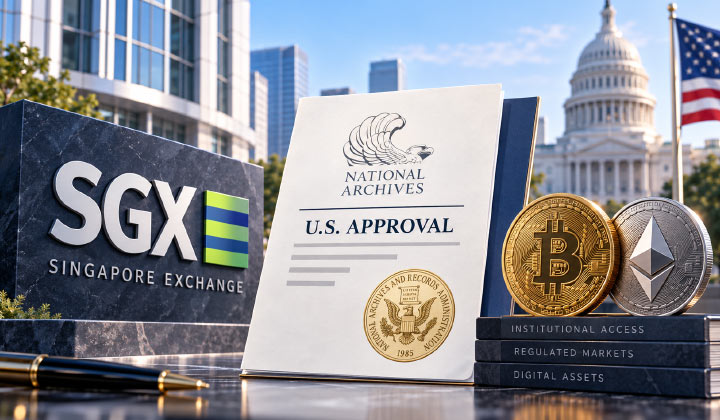
The Singapore Exchange (SGX) has received authorization from the US Commodity Futures Trading Commission (CFTC) to offer its Bitcoin and Ether perpetual futures to US institutional investors. The approval allows eligible American institutions to access the Singapore-listed contracts without SGX having to register separately as a US exchange.
Trading has not started yet, however. SGX is preparing its US clearing members to onboard clients over the next one or two months. The move gives US institutions access to crypto perpetuals through a regulated foreign exchange while a separate US debate over such products continues.
The authorization comes under Regulation 48.10, which allows a CFTC-registered Foreign Board of Trade to provide US participants with direct access to its trading system without registering as a domestic exchange.
KC Lam, head of crypto derivatives at SGX Group, said the authorization had been secured and that US participants who previously could not trade the contracts can now gain access.
SGX opens to U.S. clients! 📢
Singapore’s exchange is now cleared to offer its crypto perpetual contracts to American institutional participants.
Early volume has been solid, with Bitcoin driving the majority of activity.
How significant is this for the broader institutional… pic.twitter.com/p0Lm9TeLTu
— The Moon Show (@TheMoonShow) September 10, 2026
Before clients can start trading, SGX needs to complete its back-office integration and prepare its clearing members. New customers will go through those clearing members for know-your-customer checks, deposits and API connections. According to Lam, the onboarding process generally takes between two and four weeks.
The timing is notable because the US is still dealing with questions about the regulatory status of crypto perpetuals. CME Group is challenging the CFTC’s approval of Kalshi’s Bitcoin perpetual contract, arguing that such contracts should be treated as swaps under the Dodd-Frank Act rather than as futures.
SGX is taking a different route. Instead of waiting for the US classification dispute to be resolved, it is using an existing framework for foreign exchanges. That allows American institutional desks to access SGX’s products while the domestic legal battle continues.
SGX launched its Bitcoin and Ether perpetuals in November 2025. Since then, the contracts have recorded around $5.8 billion in cumulative trading volume, equivalent to roughly 400,000 lots.
At the end of August, open interest in the two contracts stood at about 1,300 lots, worth around $19 million. Bitcoin represented 66% of open interest and 83% of average daily volume since launch.
The exchange’s perpetuals are designed differently from many crypto-native products. SGX does not use automatic liquidations. Instead, margin calls and additional collateral are used to prevent positions from being forcibly closed during sudden market movements.
Trading and clearing are also separated. Trades go through clearing members, creating an additional layer between the exchange and the customer. SGX says this structure follows the traditional model used in futures and commodities markets. Stablecoins are not accepted as collateral because they could lose their peg during periods of market stress.
The exchange is also planning to introduce dated Bitcoin and Ether futures and options. Lam said the infrastructure required for those products is already being developed.
The SGX move is significant because it opens a regulated path for US institutional investors to access crypto perpetuals outside the American market. At the same time, it shows how global exchanges are adapting to growing demand for crypto derivatives while regulators continue to debate how these products should be classified.
Stay informed with the latest trends in Web3, blockchain innovation, and cybersecurity updates at 3verseTV
You need to login in order to Like

















Leave a comment