



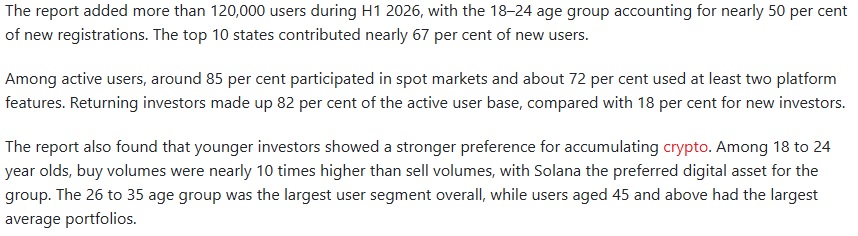
Young Indians accounted for a large share of new crypto users on ZebPay during the first half of 2026, even as many existing users made no trades, according to the exchange’s latest India report. ZebPay added more than 120,000 users between January and June, with people aged 18 to 24 making up around half of new registrations.
Their buying volume was nearly 10 times their selling volume, with Solana emerging as their most preferred digital asset. At the same time, 63% of ZebPay users held crypto without making a trade during the six-month period.
The figures come from ZebPay’s report, The State of Crypto in India: H1 2026 Review & H2 Outlook. The report was shared with the media but had not been published publicly at the time of the source material.
Source: outlookmoney.com
The data is based on ZebPay’s own platform activity and has not been independently audited. ZebPay, which was founded in 2014, is registered with India’s Financial Intelligence Unit.
ZebPay’s findings point to a strong interest among younger users in accumulating digital assets. The exchange said Gen Z users preferred buying and holding crypto rather than selling frequently.
Solana was their preferred asset, while stablecoins also featured among the assets they used. ZebPay described the pattern as a preference for newer Layer-1 assets alongside stablecoin-based trading.
The age pattern looks different when compared with other platform data. CoinSwitch’s Q1 2026 report found that users aged 18 to 25 represented 19% of its overall user base, while those aged 26 to 35 formed the largest group at 48%.
The two sets of figures measure different things, however. ZebPay’s numbers refer to new registrations, while CoinSwitch’s figures cover its overall user base. The age ranges also differ slightly.
ZebPay’s report found that 63% of users held crypto without making a trade during H1 2026. Another 29% traded while continuing to hold assets.
The report does not explain why such a large proportion of users remained inactive. India’s tax structure could be one factor in the broader trading environment. Virtual Digital Assets are taxed at a flat 30%, while a 1% Tax Deducted at Source applies to qualifying transfers, and losses cannot be set off against gains. Industry executives have argued that these rules make frequent trading more expensive, although that is an industry view rather than a finding established by ZebPay’s report.
Activity was also concentrated among users who remained engaged over longer periods. ZebPay said users active during all six months generated around 21 times the trading volume of those active for only one month. Based on the report’s figures, that works out to roughly 3.5 times the volume per active month.
Smaller Indian cities also accounted for a significant share of new registrations. Tier-2 and Tier-3 markets together contributed around 62% of new users. Tier-3 cities accounted for nearly 21%, while Tier-1 cities contributed the remaining 38%. The report does not explain how individual cities were assigned to these categories.
Bitcoin remained the largest investor category in ZebPay’s user classification. Bitcoin-focused investors accounted for 30% of users, followed by legacy altcoin holders at 17.3% and diversified investors at 15%.
By spot trading activity, Tether’s USDT ranked first, followed by Bitcoin, Ethereum, XRP and Solana. Layer-1 assets represented close to 90% of categorised trading volume, while memecoins recorded the second-highest level of trader participation.
The exchange also introduced automated investing during the period. Its Crypto Systematic Investment Plan allows users to make recurring purchases of Bitcoin and other crypto assets at fixed intervals. The feature launched on Android and web in January, followed by iOS a few days later.
However, ZebPay has not disclosed how many users adopted the SIP feature or how much trading volume it generated, so its contribution to the broader holding trend cannot yet be measured.
Overall, the report shows two different sides of India’s crypto market on one exchange: new registrations are being driven strongly by younger users, while a substantial proportion of existing users appear to be holding rather than actively trading. The findings are specific to ZebPay and should not be treated as a complete picture of India’s entire crypto market.
Stay informed with the latest trends in Web3, blockchain innovation, and cybersecurity updates at 3verseTV
You need to login in order to Like

















Leave a comment