

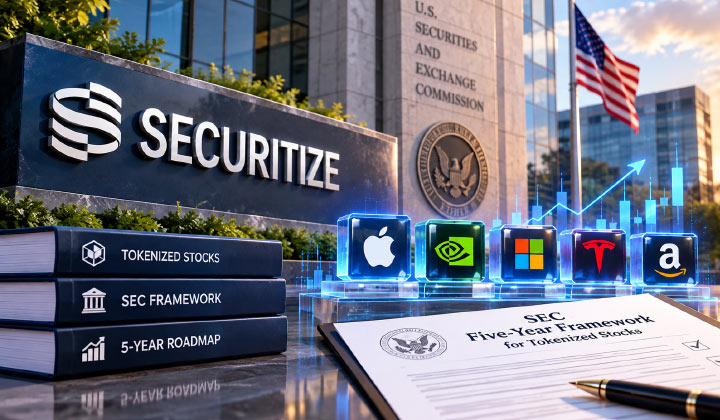
The US Securities and Exchange Commission (SEC) has established a five-year framework allowing certain tokenized US stocks to trade through permissioned automated market makers (AMMs) and liquidity pools.
The framework, described by Securitize President Carlos Domingo on September 23, provides limited regulatory relief for Tokenized Securities Venues (TSVs) and certain liquidity providers. It applies only to eligible tokenized NMS stocks and covers secondary-market trading, rather than the primary issuance of tokenized securities.
Under the framework, the relief is provided under Section 36(a)(1) of the Exchange Act. One part covers a TSV operating permissioned AMM liquidity pools, while the other applies to certain liquidity providers classified as Covered Firms. The exemptions are due to expire five years after publication.

— Securitize (@Securitize) September 23, 2026
The framework applies only to tokenized NMS-listed stocks that provide holders with the same rights and privileges as the corresponding traditional shares. These rights include receiving dividends and exercising voting rights. Synthetic instruments, including tokenized security-based swaps, are outside the framework.
The SEC has also placed limits on the number of securities and trading volume that can be handled under the exemption. Tier 1 covers stocks in the S&P 500 and Russell 1000, along with certain eligible exchange-traded products. The limit is 75 symbols and 0.25% of the previous month’s average daily volume. Tier 2 covers other eligible securities, with a limit of 250 symbols and 2.5% of average daily volume.
Trading volumes will be aggregated across affiliated TSVs. The first time a security exceeds its applicable volume threshold does not automatically trigger a pause. Any subsequent exceedance requires an immediate three-month trading pause for that security.
The framework also requires TSVs to use public and auditable smart contracts deployed on public, permissionless distributed ledgers. Trading in a tokenized stock must stop if trading in the underlying stock is halted on its primary exchange.
TSVs must also establish participant-access standards and make information about their operations and trading activity publicly available. Requirements covering sanctions compliance, record-keeping, technology safeguards and transparency also apply.
For stocks tokenized by unaffiliated third parties, the framework introduces an additional notification process. Before listing such a token, a TSV must notify the stock’s issuer in writing. The issuer then has 30 calendar days to object. A timely objection prevents the token from being listed under the exemption.
Securitize has highlighted another feature of the framework: access and compliance conditions can, according to its interpretation, be built directly into the token. However, this is the company’s interpretation of the SEC order and not an independent finding by the regulator.
There are also questions around verification and investor protection. The framework requires a TSV to verify that a tokenized stock carries rights equivalent to the underlying traditional share and disclose how that verification was performed.
Securitize noted that the order does not require an independent third-party audit, qualified custodian, transfer-agent verification or proof of reserves for certain third-party tokenization arrangements.
Legal firm Sidley Austin has separately pointed to questions surrounding broker-dealer status. According to the source material, the exemption removes a TSV from the definition of an exchange but does not separately exempt it from Section 15(a) of the Exchange Act. TSVs must also publish a public filing at least 30 days before beginning operations, covering areas such as governance, access, fees and risks.
The SEC has asked for public comments on 10 questions, including whether the five-year relief should eventually become permanent, whether the trading limits are appropriate and whether the framework should be extended beyond NMS stocks. The agency says the temporary structure will allow it to observe how tokenized stocks trade and use that information in developing longer-term policy.
The framework is part of a wider series of SEC actions involving tokenized financial products. The source also notes the agency’s September 17 exemption for tokenized US stock trading and its approval of a tokenized share class for the ARK Venture Fund.
Stay informed with the latest trends in Web3, blockchain innovation, and cybersecurity updates at 3verseTV
You need to login in order to Like













Leave a comment