


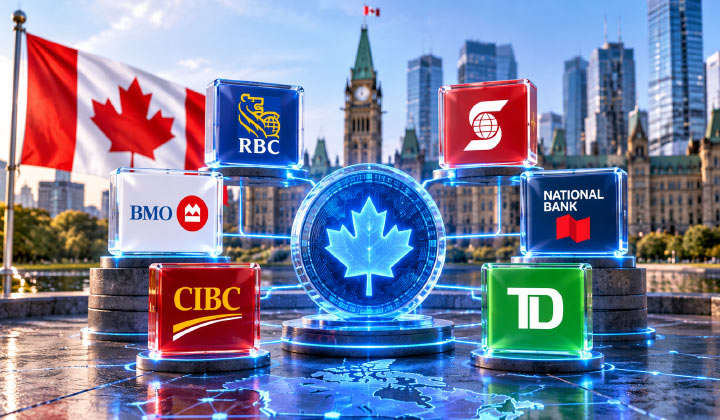
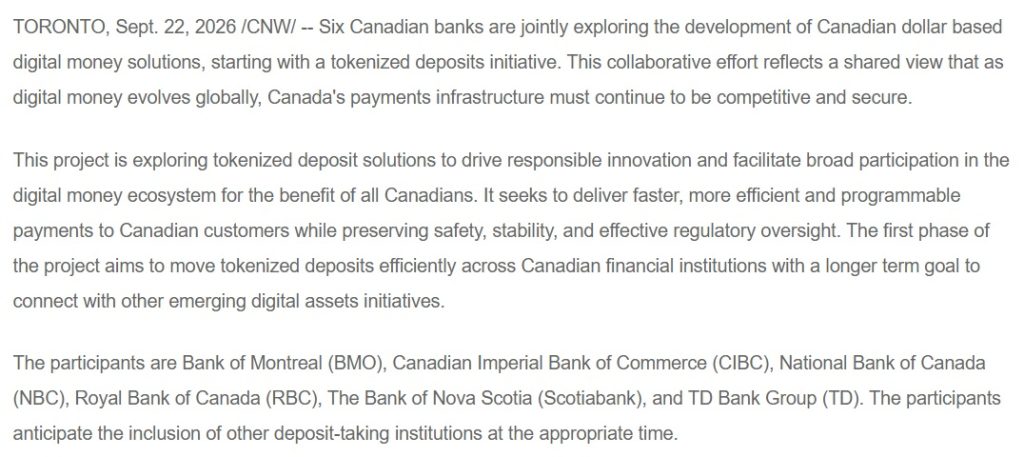
Canada’s six largest banks are exploring a system that would represent Canadian-dollar bank deposits in tokenized form and allow them to move between participating financial institutions. Bank of Montreal, CIBC, National Bank of Canada, Royal Bank of Canada, Scotiabank and TD Bank Group are involved in the initiative.
JUST IN: 🇨🇦 Canada’s six biggest banks launch joint tokenized deposits project to enable 24/7 blockchain-based payments.
• Bank of Montreal
• Royal Bank of Canada
• Toronto-Dominion Bank
• The Bank of Nova Scotia
• National Bank of Canada
• Canadian Imperial Bank of…— Watcher.Guru (@WatcherGuru) September 23, 2026
The first phase will focus on transfers between banks, with possible links to other digital-asset systems later. No commercial launch date or underlying distributed-ledger technology has been announced. The project comes shortly after Canada’s banking regulator provided additional clarity on how tokenized deposits are treated under existing rules.
Source: cibc.com
The Office of the Superintendent of Financial Institutions (OSFI) said on September 10 that tokenized deposits are not legally distinct from traditional deposits. The regulator is is of the opinion that the technology used to represent or deliver a financial product does not, by itself, determine its legal classification.
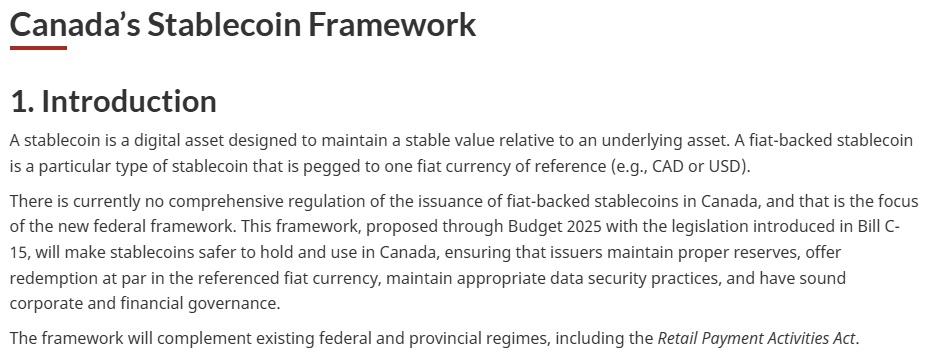
A tokenized deposit represents money held at a regulated bank and remains a liability of that bank. This is different from a fiat-backed stablecoin, which is a separately issued digital asset backed by reserves held under the stablecoin issuer’s structure.
The six banks said the proposed system could support faster and programmable payments.
For now, the project is focused on interbank transfers rather than consumer payments. Under the proposed model, existing bank deposits could be represented digitally and transferred using distributed-ledger infrastructure. Possible uses include settlement and programmable transactions between financial institutions. The initiative is part of a wider Canadian exploration of blockchain and tokenization in financial markets.
OSFI’s September guidance said federally regulated financial institutions remain responsible for complying with existing laws and regulations when developing tokenized deposit products. It also pointed to existing technology, cyber-risk and third party-risk guidelines.
Banks developing new products are expected to consult their OSFI supervisors before launching them. In other words, tokenization changes the technology used to represent a deposit but does not create a separate regulatory category simply because blockchain is involved.
Source: canada.ca
The proposed system is also separate from Canada’s stablecoin framework. A tokenized deposit remains a claim against the commercial bank, with the deposit forming part of the bank’s existing liabilities. A stablecoin, by comparison, is a separately issued digital asset backed by reserves under the issuer’s arrangement.
Canada already has a Canadian dollar stablecoin. Tetra Trust received approval for CADD in May, with the token launched on Ethereum and Base and Solana integration planned. The six-bank project is different because it focuses on deposits already held within the regulated banking system.
The initiative follows other Canadian experiments with distributed-ledger technology. In March, the Bank of Canada, Export Development Canada, RBC and TD completed Project Samara, which tested a tokenized Canadian bond. The experiment covered the bond’s issuance, trading, coupon payments and redemption, while settlement used wholesale central bank deposits.
The new six-bank project shifts the focus from securities to bank deposits. However, it remains at the development stage. Details such as the technology, expected transaction volumes, customer access and commercial launch date have not been disclosed.
For now, the initiative is another test of whether traditional Canadian bank deposits can be represented digitally and transferred between financial institutions while remaining within the existing banking and regulatory framework.
Stay informed with the latest trends in Web3, blockchain innovation, and cybersecurity updates at 3verseTV
You need to login in order to Like

















Leave a comment