



Cross-border stablecoin movements increased 77.5% to $220.3 billion in the 12 months ending in June 2026, despite a 37% decline in the overall value of the cryptocurrency market. According to Chainalysis, the surge indicates that stablecoins are being used more and more for money transfers and payments rather than just cryptocurrency trading.
The average cross-border transfer amount was about $3,000, indicating commonplace applications such remittances, supplier payments, and currency conversion of savings.
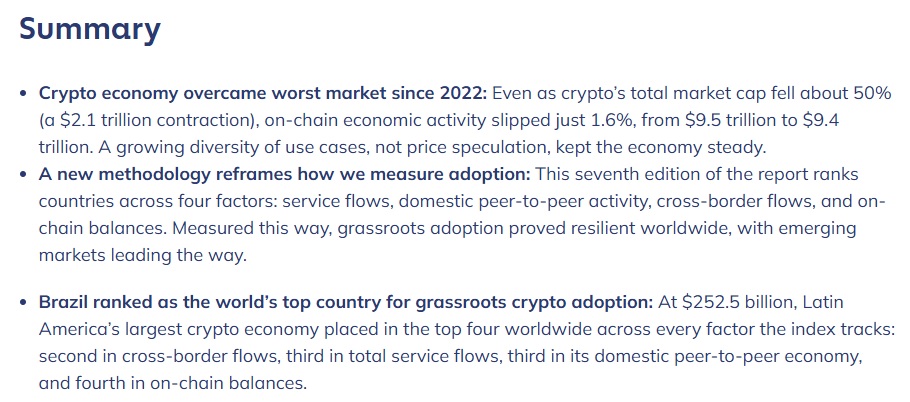
The numbers were included in Chainalysis’s 2026 Global Crypto Adoption Index. Over the preceding 12 months, cross-border stablecoin movements rose from $124.2 billion to $220.3 billion.
Source: chainalysis.com
Concurrently, the whole value of the cryptocurrency market dropped 37% to $2.1 trillion. The divergent patterns show that stablecoin activity has not merely mirrored the tendencies of speculative cryptocurrency markets.
Digital assets known as stablecoins are created to have a steady value, often in relation to a fiat currency like the US dollar. As more governments enact regulations controlling their issuance and operation, their usage has grown.
The European Union’s MiCA framework and Hong Kong’s stablecoin licensing system have further formalized financial regulation of stablecoins, while the United States passed the GENIUS Act in July 2025.
According to Chainalysis, the average value of many of the cross-border transfers it monitored was around $3,000. Payments to foreign suppliers, sending money home, and transferring funds away from volatile currencies are examples of such transactions.

Tether’s vise president of economics, Philip Gradwell, told Chainalysis that stablecoin activity has become more consistent, with transactions flowing through wallets steadily as opposed to sporadically. According to him, the trend is more in line with commerce and commercial action than conjecture.
Different areas have different use cases. The CEO and co-founder of StraitsX, Tianwei Liu, told Cointelegraph that Asia’s fragmented payment systems and currencies are driving demand for stablecoin settlement.
Stablecoins have other uses outside of Asia, such as facilitating access to US dollars, facilitating remittances, and giving an alternative in nations with capital controls or inflation.
During the reporting period, 4,708 new cross-border pathways were discovered by Chainalysis. These routes transported $2.64 billion in total. A transfer route between a country of origin and a country of destination is referred to as a corridor.
However, activity remains highly concentrated. The top 25% of measurable corridors accounted for 96.1% of cross-border stablecoin value. The remaining three-quarters carried $8.66 billion, up from $260 million in the previous period.
The global crypto economy held up through the bear market. At $9.4 trillion, it retreated just 1.6 percent YoY despite the widespread crypto price collapse. Our latest research explains why. pic.twitter.com/jHdQS2NXHg
— Chainalysis (@chainalysis) September 23, 2026
Traditional financial companies are also expanding their stablecoin offerings. Western Union launched a stablecoin wallet and Visa-linked card across 37 markets in August. The service allows users to hold and spend its branded US dollar-backed stablecoin. MoneyGram announced a similar card initiative in September, initially targeting Colombia, with more markets planned later this year.
Stablecoins still face practical challenges. Vincent Chok, co-founder and CEO of First Digital, pointed to regulatory clarity, reliable redemption, access to local currencies and connections with existing financial systems as continuing issues.
Blockchain settlement can move money quickly, but the process still has an off-chain side. Funds may need to be converted into local currency, pass compliance checks and eventually move through conventional banking systems.
The latest Chainalysis figures therefore point to a growing role for stablecoins in cross-border finance, while also showing that blockchain-based transfers still depend on the traditional financial infrastructure surrounding them.
Stay informed with the latest trends in Web3, blockchain innovation, and cybersecurity updates at 3verseTV
You need to login in order to Like

















Leave a comment