



A U.S. accounting standards body has suggested that some stablecoins be regarded as “cash equivalents,” which may provide companies with more precise accounting guidelines for digital assets. According to the Financial Accounting Standards Board (FASB), stablecoins may be eligible if they can be exchanged for US dollars on demand and are supported by liquid reserves at least equal to the number of tokens in circulation.
In addition to placing qualified tokens alongside other highly liquid assets like money market funds, commercial paper, and U.S. Treasury securities, the proposal seeks to clarify how current accounting regulations apply to specific stablecoins.
The proposal addresses an issue that has created uncertainty for companies holding or using stablecoins. At present, the way a digital asset is classified for accounting purposes can vary depending on how its features are interpreted. FASB said this can lead to different accounting treatments for similar assets.
FASB is seeking public comment on a proposed ASU addressing cash equivalents and certain digital assets, including stablecoins. Comments are due November 19, 2026. Learn more at https://t.co/uN3ymLcIdp. pic.twitter.com/3AFMGs2gj0
— FASB, GASB, and FAF (@FAFNorwalk) August 18, 2026
Stablecoins would not automatically be considered cash equivalents under the suggested method just because their value is intended to remain constant. They would need to fulfilll certain requirements. Among these, the reserves supporting the tokens would have to be at least as liquid as the quantity of tokens in circulation. Additionally, users must be able to exchange the stablecoins for dollars at any time.
The proposal is significant because cash and cash equivalents receive specific treatment under generally accepted accounting principles, or GAAP. Cash equivalents generally include short-term, highly liquid investments that can be readily converted into known amounts of cash.
FASB sets accounting standards used under U.S. GAAP. Its latest proposal would use illustrative examples to explain how the existing definition of cash equivalents could apply to certain digital assets, rather than creating an entirely separate accounting category for stablecoins.
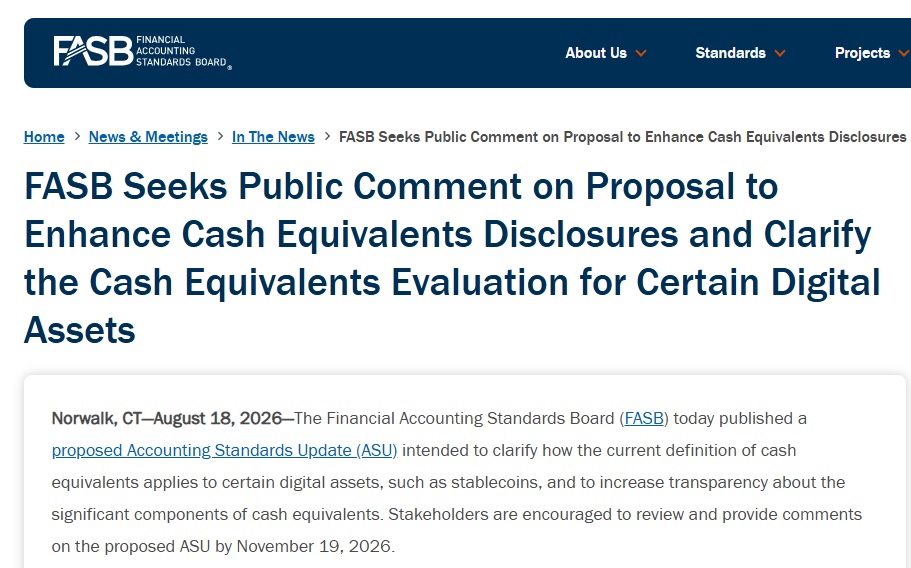
Source: fasb.org
The move follows FASB’s broader work on cryptocurrency accounting. The organisation began developing crypto-specific accounting guidance in 2023 as digital assets became increasingly relevant to companies and investors.
However, the proposal is not yet a final rule. FASB is seeking public comments on the proposed accounting standards update, with the comment period running until November 19.
If the proposal is eventually adopted, it could provide companies with greater clarity when reporting stablecoin holdings on their financial statements. For stablecoin issuers and businesses using these digital assets, that clarity could make accounting treatment more predictable and reduce uncertainty around how highly liquid tokens should be classified.
Stay informed with the latest trends in Web3, blockchain innovation, and cybersecurity updates at 3verseTV
You need to login in order to Like

















Leave a comment