


Ethereum co-founder Vitalik Buterin has warned crypto users not to panic and move their funds into new wallets because of the growing risk that artificial intelligence (AI) could make attacks on cryptography easier. He said users should take the threat seriously, but should not rush. Keeping funds in an address that has never been used for a transaction can be a sensible precaution if it is easy to do.
I don’t recommend anyone scramble to move their funds to new wallets today. But we should take the risks to cryptography from AI-accelerated math seriously, and minimize our exposure to not just quantum-vulnerable cryptography, but also potentially AI-vulnerable cryptography.
The core new area of risk from this viewpoint is, unfortunately, ML-DSA / FHE / lattices.
(and it’s also another reason, along with quantum, why ECDSA might fall even faster than expected, hence the “fresh address” recommendation)
So far most people have been in the mode of thinking “elliptic curves broken, hashes safe, lattices safe”. But there is a good chance that the concrete security of lattices will take serious hits from the next two years of AI math.
The basic threat model is: factoring is something that naively takes 2^(n/2) time, but over decades smart people have found and optimized number field sieves, and degraded that to 2^O(n^(1/3)), which is why RSA keys and signatures need to be ~400 bytes (and not 64 bytes). What if there are skeletons in the closet like that, both for elliptic curves and lattices, that we are simply not smart enough to discover – but bots soon will be?
This is a major part of the reason why for the past year ethereum’s lean roadmap has been going in the “hash-only” direction: no lattices, no ML-DSA, no Falcon, no lattice-based commitments inside ZK proofs, etc. Signatures in lean ethereum are all hash-based, either WOTS or SPHINCS-.
For signatures and proofs, we already know how to go hash-only. The bigger challenge is for *public-key encryption* – and this goes far beyond blockchains. Secure communication, anonymizing protocols, lots of things need public-key encryption.
And unfortunately there are long-standing mathematical theorems showing why public-key encryption cannot be done with hashes alone. You have to have some kind of trapdoor object that has at least one form of usable “structure” – either group theory (incl. isogenies) or lattices or code-based or potentially in the future even more newfangled and spooky things (local mixing?). But for anything that has structure, you should assume that AI will make at least some progress in breaking that structure. Here, one reasonable inference is that if you want to make something plausibly long-term secure, multiply the key sizes by 10.
To me that’s a very plausible world and something not at all extreme to predict. If AI will bring us 50 years of math in 2 years, then that 50 years of math may very plausibly include a “naive factoring -> GNFS” level of improvement to our ability to break lattices. In that world, lattices will still exist, but they will have to be significantly bigger to guarantee the same level of safety.
And at those new larger sizes, hash-based constructions will beat lattice-based constructions on concrete efficiency in every use case where hash-based constructions are possible at all.
Theoretically, of course it’s possible that hashes are broken too (eg. P = NP would imply that). But I think P = NP is very unlikely. And intuitively, it’s much more likely that a mathematical object has exactly no exploitable structure (like hashes are intended to), than that a mathematical object has exactly ~3 forms of exploitable structure (for elliptic curves: associativity, Schoof, pairings) and not some secret fourth form of structure we have not yet discovered that greatly degrades its security (for elliptic curves, ECDLP and pairing security). Similar for LWE, SVP, RLWE and the zoo of lattice problems.
For this reason, we do not yet see any reason to worry and start padding the byte size of hashes (if we start to worry more, we would pad the round count first before doing anything to the byte size).
Concrete TLDR, my own personal views:
* Hash-based > lattice-based, in those situations where hash-based is possible at all
* For anything lattice-based, be much more paranoid on param sizes. Remember that blockchains are only a small portion of the cryptography story; this point goes far beyond blockchains and applies to eg. access to websites, secure messaging, Tor / VPNs …
* For privacy protocols, strongly favor NOT putting encrypted notes onchain. Instead, send them offchain through some third-party mechanism.
* If it’s not difficult for you, keeping your funds in addresses which have not yet been used to make a transaction is a good idea. If it’s easy for you, do it. **But be careful about migrations; I personally have lost more money in botched migrations than I have lost in all hacks combined**.
* For multisig wallets, doing confirmations offchain is better than onchain, because this way the signatures of signer wallets do not get exposed to the public, so if ECDSA falls to AI much faster than expected, at least the multisig “gracefully degrades” to a 1-of-1 where the 1 is whoever was gathering the signatures – a much better place to be than “anyone can take the money”
https://t.co/oVjwZog2lL— vitalik.eth (@VitalikButerin) October 7, 2026
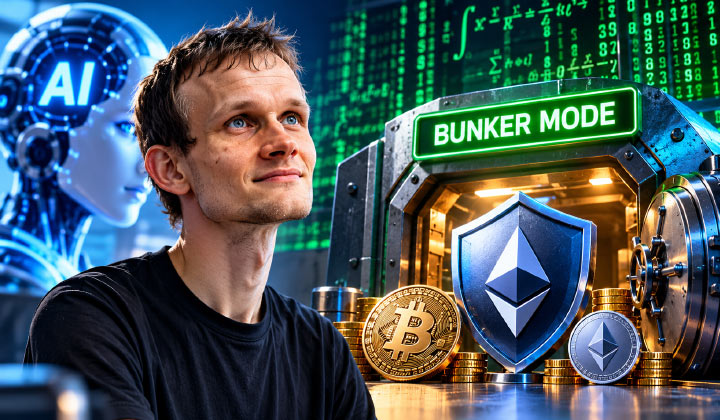
Buterin made the comments on October 8 while responding to concerns raised by Ethereum Foundation researcher Justin Drake. Drake has called for the crypto industry to prepare for what he describes as “bunker mode”. He believes large crypto holders should gradually move their funds to fresh addresses where the public key has not already been exposed.
Today I call upon the blockchain industry to calmly begin planning for “bunker mode”. My personal recommendation is to set in motion a controlled mass migration of assets to fresh addresses, i.e. addresses whose pubkeys remain hidden behind a hash.
Holders, starting with large and sophisticated ones, should consider moving the bulk of their funds to addresses that have never signed a transaction. And when they do sign one, they should also move remaining funds to a new address (possibly generated from the same seed phrase).
Don’t rush. While I believe there is cause for action a rushed migration would do more harm than good. Don’t panic either. Moving assets to protected addresses is a simple, preventative step which does not require new cryptography or new wallets.
IMO it is now reasonable to brace for the possibility that ECDSA breaks before qday, in the worst case in months not years. By “break” I mean fast private key recovery (e.g. in one week) on available hardware (e.g. a large GPU cluster).
Recent days have been humbling for human mathematical intuition. Long-held, unquestioned hypotheses have fallen. This includes the n log(n) bound for integer multiplication and the 3SUM conjecture. In hindsight, May’s unexpected disproof of the Erdős unit distance conjecture was our warning shot.
Yesterday’s OpenAI drop made it clear that mathematical superintelligence is upon us. They say there are weeks where decades happen. We are about to live through weeks where centuries of mathematical progress happen. Could our magic 64-byte ECDSA signatures be too good to be true? Was it just security through obscurity all this time?
Elliptic curves feel especially vulnerable to superintelligence. Curves carry rich structure, with room for fancy tricks like Schoof, Frobenius, pairings. (By contrast, hashes are designed to minimise algebraic structure.)
Separately, as Ewin Tang can attest, an efficient quantum algorithm sometimes foreshadows an efficient classical one. We should be open to the possibility of a classical counterpart to Shor that breaks elliptic curves and RSA at once.
Also noteworthy is the striking under-representation of cryptographic breakthroughs among the 722 mathematical results OpenAI published. I’ve witnessed first-hand the US government censoring academic quantum cryptanalysis results. Backroom interventionism is my base case.
I urge large, sophisticated actors to lead by example. Project11’s “risq list” (bitcoin-risq-list.projecteleven[.]com) is a great tracker of exposed BTC pubkeys. Binance, Bitbank, Robinhood, Bitfinex, and Tether have an opportunity to harden their cold storage. Next month I’ll address institutions in London in a live Q&A (forum.ethereuminstitutional[.]org/london-2026).
Again, please do not rush. Wallets holding under 50 BTC enjoy partial cover from “Satoshi’s shield”, i.e. his 20K exposed addresses that hold 50 BTC each. Load-bearing signers like oracles and L2 security councils should consider rotating ECDSA pubkeys with every signed message and/or multi-signing with a hash-based schemes like SPHINCS.
Exiting bunker mode safely will require post-AI cryptography. My inclination is to go all-in on hash-based cryptography and avoid structured mathematical assumptions entirely, whether from curves, lattices, or isogenies. A single battle-tested hash (e.g. from the SHA or BLAKE families) yields plausible post-AI security.
The Ethereum roadmap on strawmap[.]org fully embraces hash-based cryptography with end-to-end formal verification as a response to the quantum threat. Those timelines must now be revisited and accelerated in light of mathematical superintelligence. I’ll be pushing for maximum defensive acceleration.
— Justin Drake (@drakefjustin) October 7, 2026
The concern is linked to rapid progress in AI. AI is becoming better at solving difficult mathematical problems. This could eventually create new ways to attack the mathematical systems that protect cryptocurrencies.
For many years, the crypto industry has been more worried about quantum computers. Quantum computers could one day break some of the cryptography used by blockchains. But Buterin now says AI could create another problem.
He is particularly concerned about lattice-based cryptography. These systems have been considered promising because they are expected to be safer against quantum attacks. Examples include ML-DSA and other lattice-based systems.
Buterin said this assumption may not always be correct. If AI helps mathematicians discover new methods, some of these systems could become weaker much sooner than expected. He said the security of lattice-based systems could take “serious hits” from advances in AI mathematics over the next two years.
This does not mean that these systems have already been broken. The concern is that AI could discover mathematical shortcuts that humans have not found yet.
Buterin gave factoring as an example. Over many years, mathematicians found better ways to solve factoring problems. Similar breakthroughs could possibly be found in the mathematics behind elliptic curves and lattice-based systems.
This is also one reason Ethereum has been moving towards what Buterin calls a “hash-only” direction. Hash-based cryptography does not depend on the same kind of mathematical structures as elliptic curves and some other systems.
Ethereum’s roadmap tries to avoid lattice-based systems such as ML-DSA and Falcon where possible. Instead, it uses hash-based systems such as WOTS and SPHINCS-. However, hashes cannot replace every type of cryptography. Public-key encryption still needs mathematical structures, so the issue is much wider than Ethereum.
Buterin has also warned about the wider impact of AI on crypto. AI agents could eventually become a major way for people to use blockchains. At the same time, AI could make blockchain privacy more difficult by analysing huge amounts of public transaction data.
For ordinary crypto users, Buterin’s message is simple: do not panic, but do not ignore the risk either.
He said that if keeping funds in an unused address is easy, users can consider doing so because the public key remains hidden until the address is used to sign a transaction.
However, moving funds also has risks. A mistake during a wallet migration could lead to a permanent loss of money. Buterin said he had personally lost more money through badly handled migrations than through all hacks combined.
For now, there is no call for an emergency migration of all crypto funds. The bigger message is that developers and major crypto holders should start preparing for a future in which AI may change the security assumptions behind today’s blockchain systems.
Stay informed with the latest trends in Web3, blockchain innovation, and cybersecurity updates at 3verseTV
You need to login in order to Like
















Leave a comment