


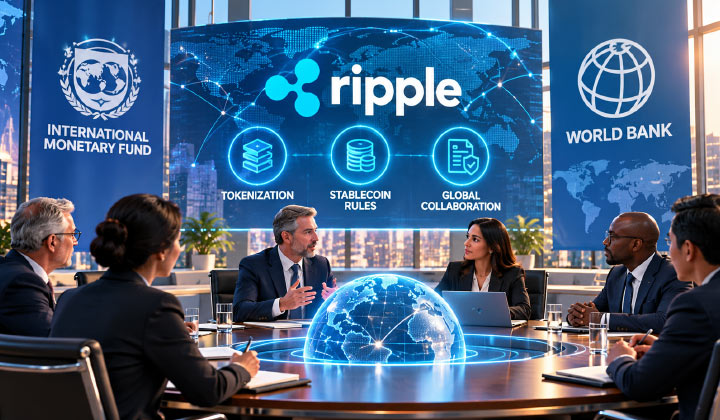
- Ripple’s Asia-Pacific policy director Rahul Advani spoke at an Atlantic Council panel during the IMF and World Bank Annual Meetings in Bangkok.
- Banks want stablecoins that are fully backed, meet Basel capital standards, offer 24/7 liquidity, and integrate with custody and treasury systems.
- Issuer rules under the U.S. GENIUS Act, EU MiCA, and Asian frameworks are converging, but cross-border recognition remains limited.
- Advani argued that well-supervised foreign stablecoins should be permitted market access to prevent global fragmentation.
Ripple, the U.S.-based blockchain company focused on cross-border payment infrastructure, participated in the International Monetary Fund (IMF) and World Bank Annual Meetings in Bangkok, where finance ministers, central bank governors, and technology industry leaders debated stablecoin regulation and tokenized settlement frameworks.
Banks Want Higher Standards Before Adopting Stablecoins
Rahul Advani, Ripple’s Asia-Pacific policy director, spoke on a panel hosted by the Atlantic Council GeoEconomics Center and reported meetings with Stefan Ingves, former Governor of Sweden’s Riksbank and former Chair of the Basel Committee on Banking Supervision.
Ripple joins IMF and World Bank talks on tokenization, stablecoin rules.
Ripple joined the IMF and World Bank meetings in Bangkok to discuss stablecoin regulation.
Central banks and regulators reviewed how $XRP and stablecoins fit into financial systems.
https://t.co/ZtZMsgfhbO— 🇳🇱 MackAttackXRP 🇳🇱 (@MackAttackXRP) October 26, 2026
Advani said banks are requesting that any stablecoins they use be fully backed one-to-one, comply with Basel Committee capital requirements, offer round-the-clock liquidity, and integrate with existing custody and treasury management infrastructure. Where those standards are already met, stablecoins are reportedly in active use.
Regulation Converging But Cross-border Recognition Lagging
Stablecoin issuer rules are converging across jurisdictions, the U.S. GENIUS Act, the European Union’s MiCA framework, and regimes in Singapore, Hong Kong, and Japan are increasingly aligned.
“The migration from fiat to onchain money is happening now.”
@Ripple’s policy lead Rahul Advani at the IMF / World Bank Annual Meetings in Bangkok:
🔹 Cross-border settlement & 24/7 ledger liquidity in production
🔹 Direct engagement with Basel Committee & Central Bank leadership
🔹 Unified frameworks connecting global finance to digital assets
Nobody does institutional adoption and regulatory alignment like @Ripple.— 𝗕𝗮𝗻𝗸XRP (@BankXRP) October 23, 2026
However, mutual recognition of compliant stablecoins across borders remains limited. Advani and analysts warned this gap could fragment global liquidity rather than create a unified digital payment layer.
Dollar Stablecoins As Global Rail, Local Currency For Domestic Settlement
Advani described an emerging dual structure: U.S. dollar stablecoins functioning as a cross-border liquidity layer, while local-currency stablecoins handle domestic settlement.
He argued that well-supervised foreign stablecoins should be permitted market entry in any jurisdiction to prevent isolation and encourage interoperability across the global financial system.
Stay informed with the latest trends in Web3, blockchain innovation, and cybersecurity updates at 3verseTV
You need to login in order to Like















Leave a comment