


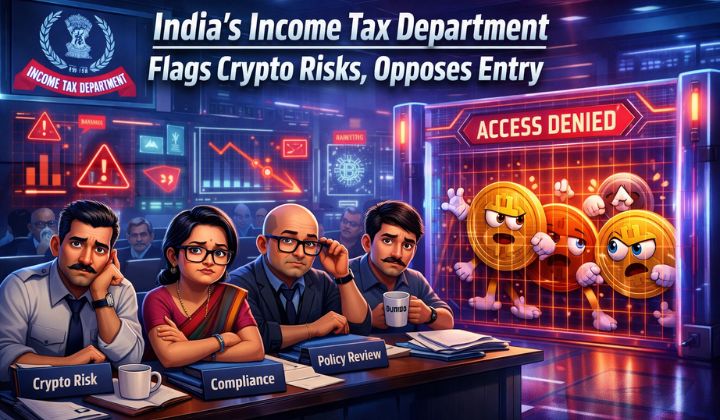
“With 30% tax and TDS tight, India put crypto trades in regulatory sight.”
Did India’s 30% crypto tax and 1% TDS trigger a 60% crash in trading volumes on domestic exchanges? The Income Tax (I-T) Department formally voiced worries about the risks associated with virtual digital assets (VDAs) and opposed their admission as a recognised financial instrument, further solidifying India’s cautious position on cryptocurrencies.
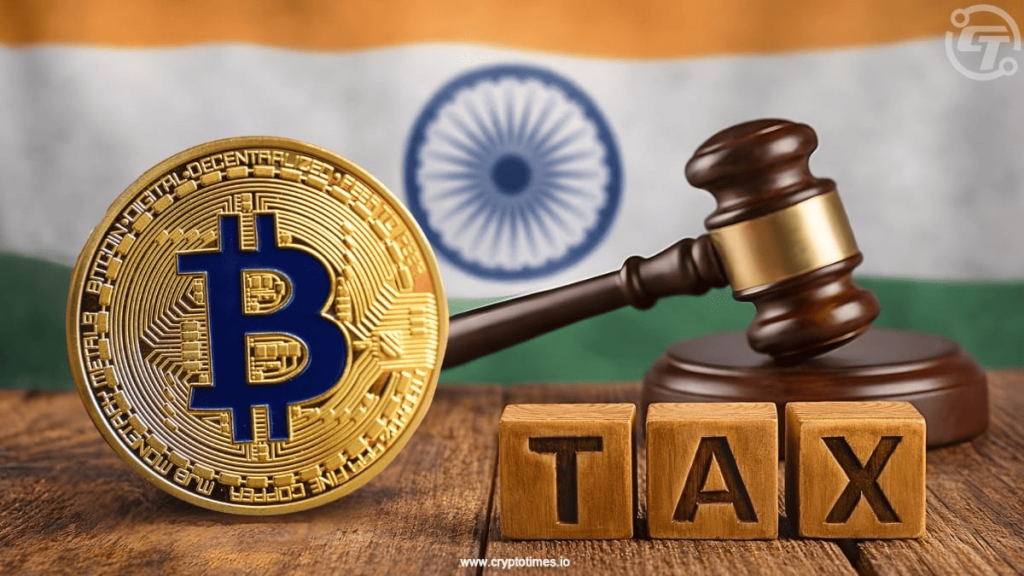
India has previously adopted a stringent tax policy. Income from cryptocurrency transactions has been subject to a fixed 30% tax since 2022, which is among the highest rates in the world. The only deductible permitted is the cost of acquisition. To further enhance traceability, a 1% TDS was added to each transaction.
The impact of the TDS was previously demonstrated by government data, which revealed that cryptocurrency trading volumes on Indian exchanges dropped by more than 60% in just a few months.
In line with RBI concerns, the department also identified threats associated with money laundering and terror financing. Because cryptocurrency lacks an underlying asset, it is extremely speculative, raising investment risk and causing financial instability.
The opinions, which were presented to the Parliamentary Standing Committee on Finance, closely matched the Reserve Bank of India’s (RBI) long-standing cautions.
The I-T Department claims that tax enforcement is very challenging due to the anonymous and international character of cryptocurrencies. VDAs enable almost instantaneous international transfers, frequently via decentralised platforms, private wallets, or foreign exchanges.
This makes it more difficult for the government to monitor transactions, find beneficial owners, or enforce compliance through summonses and the collection of Tax Deducted at Source (TDS).
Cryptocurrencies are not illegal in India, given these warnings. According to the Income Tax Act of 1961, they are regarded as assets rather than legal cash and are legally categorised as VDAs. All Virtual Asset Service Providers are required by the PMLA to register with FIU-IND in order to improve oversight.
You need to login in order to Like
















Leave a comment